Question


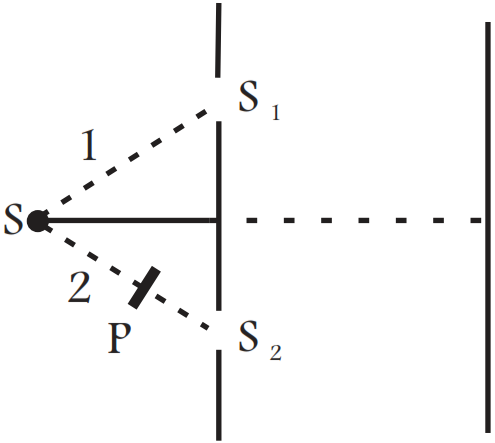
Figure shown a two slit arrangement with a source which emits unpolarised light. $P$ is a polariser with axis whose direction is not given. If $I_0$ is the intensity of the principal maxima when no polariser is present, calculate in the present case, the intensity of the principal maxima as well as of the first minima.
Answer

The resultant amplitude of wave reaching on screen will be the sum of amplitude of either wave in perpendicular and parallel polarisation.
Amplitude of the wave in perpendicular polarisation
$\text{A}_\bot=\text{A}_\bot^1+\text{A}_\bot^2=\text{A}_\bot^0\sin(\text{kx}-\omega\text{t})+\text{A}_\bot^2\sin(\text{kx}-\omega\text{t}+\phi)$
$\Rightarrow\ \text{A}_\bot=\text{A}_\bot^0(\sin(\text{kx}-\omega\text{t})+\sin(\text{kx}-\omega\text{t}+\phi))$
Amplitude of the wave in parallel polarisation
$\text{A}_{||}=\text{A}_{||}^{(1)}+\text{A}_{||}^{(2)}$
$\Rightarrow\ \text{A}_\bot=\text{A}_\bot^0[\sin(\text{kx}-\omega\text{t})+\sin(\text{kx}-\omega\text{t}+\phi)]$
$\therefore$ Average Intensity on the screen
$\text{I}=\begin{Bmatrix} \Big|\text{A}_\bot^0\Big|^2+\Big|\text{A}_\bot^0\Big|^2\end{Bmatrix}\big[\sin(\text{kx}-\omega\text{t})(1+\cos^2\phi+2\sin\phi)+\sin^2(\text{kx}-\omega\text{t})\sin^2\phi\big]_\text{average}$
$=\begin{Bmatrix} \Big|\text{A}_\bot^0\Big|^2+\Big|\text{A}_\bot^0\Big|^2\end{Bmatrix}\Big(\frac{1}{2}\Big)2(1+\cos\phi)$
$\Rightarrow\ \text{I}=2\Big|\text{A}_{||}^0\Big|^2(1+\cos\phi)\text{ since},\Big|\text{A}_\bot^0\Big|_\text{av}+\Big|\text{A}_\bot^0\Big|_\text{av}$
With polariser $P,$
Assume $\text{A}_\bot^2$ is blocked
Intensity $=(\text{A}_{||}^1+\text{A}_{||}^2)^2+({\text{A}_{||}^2})^2$
$=\Big|\text{A}_{\bot}^0\Big|(1+\cos\phi)+\Big|\text{A}_{\bot}^0\Big|.\frac{1}{2}$
Given, $\text{I}_0=4\Big|\text{A}_{\bot}^0\Big|=$ Intensity without polariser at principal maxima.
Intensity at first minima with polariser
$=\Big|\text{A}_{\bot}^0\Big|(1-1)+\frac{\Big|\text{A}_{\bot}^0\Big|}{2}=\frac{\text{I}_0}{8}.$

Need a full question paper?

Generate a complete, print-ready paper with questions like this in minutes — across 16+ boards, with answer keys.

Start Generating Free

Similar questions

A projectile is fired with a speed u at an angle $\theta$ above a horizontal field. The coefficient of restitution of collision between the projectile and the field is e. How far from the starting point, does the projectile makes its second collision with the field?
A capacitor of capacitance C is given a charge Q. At t = 0, it is connected to an uncharged capacitor of equal capacitance through a resistance R. Find the charge on the second capacitor as a function of time.
Find the currents through the resistances in the circuits shown in figure.
Suppose the block of the previous problem is pushed down the incline with a force of 4N. How far will the block move in the first two seconds after starting from rest? The mass of the block is 4kg.
Two particles A and B, each having a charge Q, are placed a distance d apart. Where should a particle of charge q be placed on the perpendicular bisector of AB so that it experiences maximum force What is the magnitude of this maximum force?
Obtain expression for force on unit length of two straight parallel current carrying conductors. Under what conditions is this force attractive or repulsive? Define the standard unit of electric current.
A plane electromagnetic wave is passing through a region. Consider (a) electric field (b) magnetic field (c) electrical energy in a small volume and (d) magnetic energy in a small volume. Construct the pairs of the quantities that oscillate with equal frequencies.
A small block of mass $200g$ is kept at the top of a frictionless incline which is $10m$ long and $3.2m$ high. How much work was required.
  1. To lift the block from the ground and put it at the top.
  2. To slide the block up the incline? What will be the speed of the block when it reaches the ground.
  3. It falls off the incline and drops vertically on the ground.
  4. It slides down the incline? Take g $= 10m/s^2.$
  1. Using Gauss Theorem show mathematically that for any point outside the shell, the field due to a uniformly charged spherical shell is same as the entire charge on the shell, is concentrated at the centre.
  2. Why do you expect the electric field inside the shell to be zero according to this theorem?
OR
A thin conducting spherical shell of radius $R$ has charge $Q$ spread uniformly over its surface. Using Gauss’s theorem, derive an expression for the electric field at a point outside the shell.
Draw a graph of electric field $E(r)$ with distance r from the centre of the shell for $0\leq\text{r}\le\infty.$
OR
Find the electric field intensity due to a uniformly charged spherical shell at a point $(i)$ outside the shell and $(ii)$ inside the shell. Plot the graph of electric field with distance from the centre of the shell.
OR
Using Gauss’s law obtain the expression for the electric field due to a uniformly charged thin spherical shell of radius $R$ at a point outside the shell. Draw a graph showing the variation of electric field with r, for $r > R$ and $r < R.$
A monoenergetic $(18$ ke $V)$ electron beam initially in the horizontal direction is subjected to a horizontal magnetic field of $0.04 G$ normal to the initial direction. Estimate the up or down deflection of the beam over a distance of $30 \ cm (m_e = 9.11 \times 10^{–19} C).$
$[$Note: Data in this exercise are so chosen that the answer will give you an idea of the effect of earth’s magnetic field on the motion of the electron beam from the electron gun to the screen in a $TV$ set.$]$