Question
Obtain expression for force on unit length of two straight parallel current carrying conductors. Under what conditions is this force attractive or repulsive? Define the standard unit of electric current.
Answer

Force between Two Parallel Current Carrying Conductors :
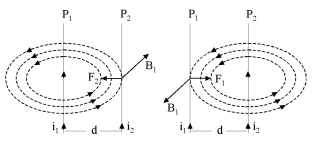
In the given figure, $P _1$ and $P _2$ are two current carrying conductors of infinite length which are situated at a distance $d$ from each other in the plane of the paper.
Current $i_1$ and $i_2$ are flowing in the same direction in the two wires and due to this magnetic field will be produced around them.
Here one current carrying conductor is present in the produced magnetic field due to other current carrying conductor.
Magnetic field produced at a distance $d$ due to current carrying conductor $P _1$
$ B_1=\frac{\mu_0 i_1}{2 \pi d} $
Force acting on length $/$ of current carrying conductor $P _2$ present in this magnetic field
$\overrightarrow{ F }_2={ }_{i_2}\left(\vec{l} \times \overrightarrow{ B }_1\right)$
$F _2=i_2 / B _1 \sin \theta$
$F _2=i_2 / B _1$
$\because\left[\vec{l} \perp \overrightarrow{B}_1\right] $
On putting value of $B _1$ from equation $(1)$,
$ F_2=i_2 l \times \frac{\mu_{o} i_1}{2 \pi d}$
$F_2=\frac{\mu_{o} i_2 l}{2 \pi d}$ Newton 
Direction of this force $F _2$ is perpendicular to the current carrying conductor $P _2$ and magnetic force $B _1$ produced on it.
Hence this force is inward the plane of paper and towards conductor $P _1$.
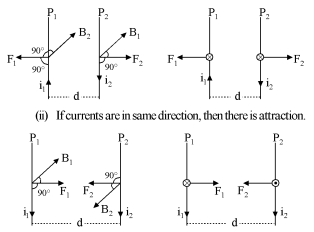
This direction of force can be determined with the help of Fleming's left$-$hand rule.
$ \frac{F_2}{T}=\frac{\mu_0 i_1 i_2}{2 \pi d} N / m $
This is magnetic force working on unit length of current carrying conductor $P _2$.
Magnetic field produced at a distance $d$ due to current carrying conductor
$P _2$. $ B_2=\frac{\mu_0 i_2}{2 \pi d} $
Magnetic field working on unit length $/$ of $P _1$ due to $P _2$,
$\overrightarrow{ F }_1=i_1\left(\vec{l} \times \overrightarrow{ B }_2\right)$ or $ F _1=i_1 / B _2$
or $F _1=\frac{i_1 / \mu_0 i_2}{2 \pi d}$
Image
or $ F _1=\frac{\mu_0 i_1 i_2 l}{2 \pi d}$
or $ \frac{F_1}{T}=\frac{\mu_0 i_1 i_2}{2 \pi d}\  N / m $
From equations $(3)$ and $(4),$
$ \frac{F_1}{T}=\frac{F_2}{l}=\frac{\mu_{o} i_1 i_2}{2 \pi d}\ N / m $
It is clear from the figure that when current in two parallel current carrying conductors is in the same direction, force of attraction is exerted between them.
Special conditions :
$(i)$ If currents are in mutually opposite directions, then there will be repulsion
Image
Mutual force acting on each wire per unit length of two parallel wires
$\frac{ F _1}{l}=\frac{\mu_0}{2 \pi}\left(\frac{i_1 i_2}{d}\right) N / m$
But $\mu_0=4 \pi \times 10^{-7} N / m ^2$
Hence, $\frac{ F _1}{l}=\frac{4 \pi \times 10^{-7}}{2 \pi}\left(\frac{i_1 i_2}{d}\right)\ N / m$
$=\left(2 \times 10^{-7}\right)\left(\frac{i_1 i_2}{d}\right) N / m$
If $i_1=i_2=i$ ampere and $d=1 m$, then $F _{1 / l}=\left(2 \times 10^{-7}\right) i^2\ N / m$
Therefore, if the force applied per meter length between these wires is $2 \times 10^{-7}$ then $1$ Ampere current will flow through the wires.
So $1$ ampere is that electric current which when flows through two straight, long and parallel wires kept at a distance of $1 m$ from each other in air $($or vacuum$)$ exerts a force of $2 \times 10^{-7}\ N / m$ on one meter length of each wire.

Need a full question paper?

Generate a complete, print-ready paper with questions like this in minutes — across 16+ boards, with answer keys.
Start Generating Free

Similar questions

Explain with the help of a diagram the formation of depletion region and barrier potential in a $p-n$ junction diode.
The amplifiers $X, Y$ and $Z$ are connected in series. If the voltage gains of $X, Y$ and $Z$ are $10, 20$ and $30,$ respectively and the input signal is $1 mV$ peak value, then what is the output signal voltage (peak value):
  1. If $dc$ supply voltage is $10V$?
  2. If $dc$ supply voltage is $5V$?
Draw a ray diagram to show the formation of real image of the same size as that of the object placed in front of a converging lens. Using this ray diagram establish the relation between u, v and f for this lens.
A solenoid is connected to a battery so that a steady current flows through it. If an iron core is inserted into the solenoid, will the current increase or decrease? Explain.
The intensity of the sunlight reaching Earth is $1380Wm^{-2}.$ Assume this light to be a plane, monochromatic wave. Find the amplitudes of electric and magnetic fields in this wave.
A bucket full of water is placed in a room at $15^\circ C$ with initial relative humidity $40\%$. The volume of the room is $50m^3$.
  1. How much water will evaporate?
  2. lf the room temperature is increased by $5^\circ C,$ how much more water will evaporate? The saturation vapour pressure of water at $15^\circ C$ and $20^\circ C$ are $1.6\ kPa$ and $2.4\ kPa$ respectively.
Light is incident from glass $(\mu=1.50)$ to water $(\mu=1.33).$ Find the range of the angle of deviation for which there are two angles of incidence.
A parallel$-$plate capacitor has plate area $20\ cm^2,$ plate separation $1.0\ mm$ and a dielectric slab of dielectric constant $5.0$ filling up the space between the plates. This capacitor is joined to a battery of emf $6.0V$ through a $100\text{k}\Omega$ resistor. Find the energy of the capacitor $8.9\mu\text{s}$ after the connections are made.
a. Two $-$ point charges $q _1$ and $q _2$ are kept r distance apart in a uniform external electric field $\overrightarrow{ E }$. Find the amount of work done in assembling this system of charges.
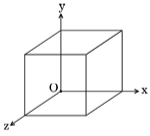
b. A cube of side $20 \ cm$ is kept in a region as shown in the figure. An electric field $\vec{E}$ exists in the region such that the potential at a point is given by $V =10 x +5$, where $V$ is in volt and $x$ is in m .
Image

Find the
$i$. electric field $\vec{E}$, and
$ii$. total electric flux through the cube.

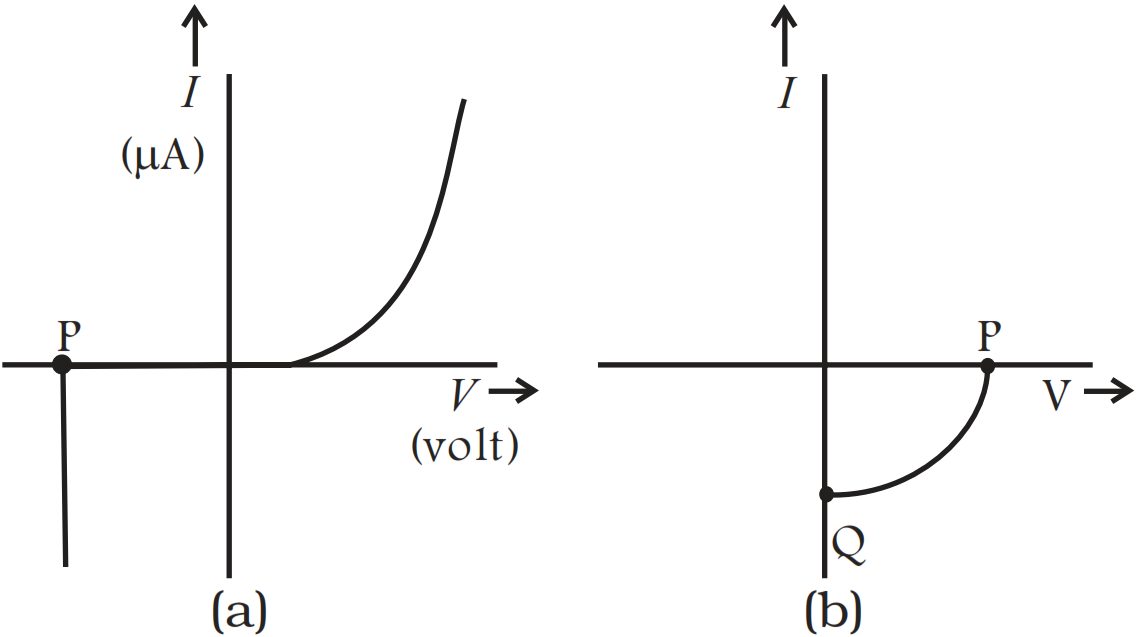
  1. Name the type of a diode whose characteristics are shown in Fig. (A) and Fig. (B).
  2. What does the point P in Fig. (A) represent?
  3. What does the points P and Q in Fig. (B) represent?