MCQ
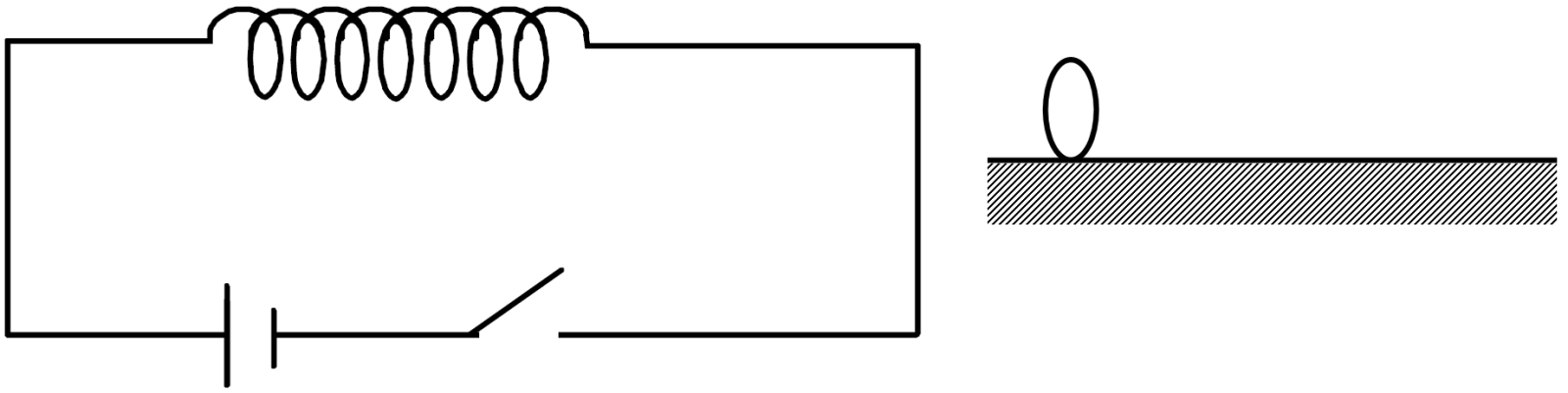
Figure shows a horizontal solenoid connected to a battery and a switch. A copper ring is placed on a frictionless track, the axis of the ring being along the axis of the solenoid. As the switch is closed, the ring will:
  • A
    Remain stationary.
  • B
    Move towards the solenoid.
  • Move away from the solenoid.
  • D
    Move towards the solenoid or away from it depending on which terminal (positive or negative) of the battery is connected to the left end of the solenoid.
Answer

Correct option: C.
Move away from the solenoid.

$\text{e}=-\text{L}\frac{\text{di}}{\text{dt}}$
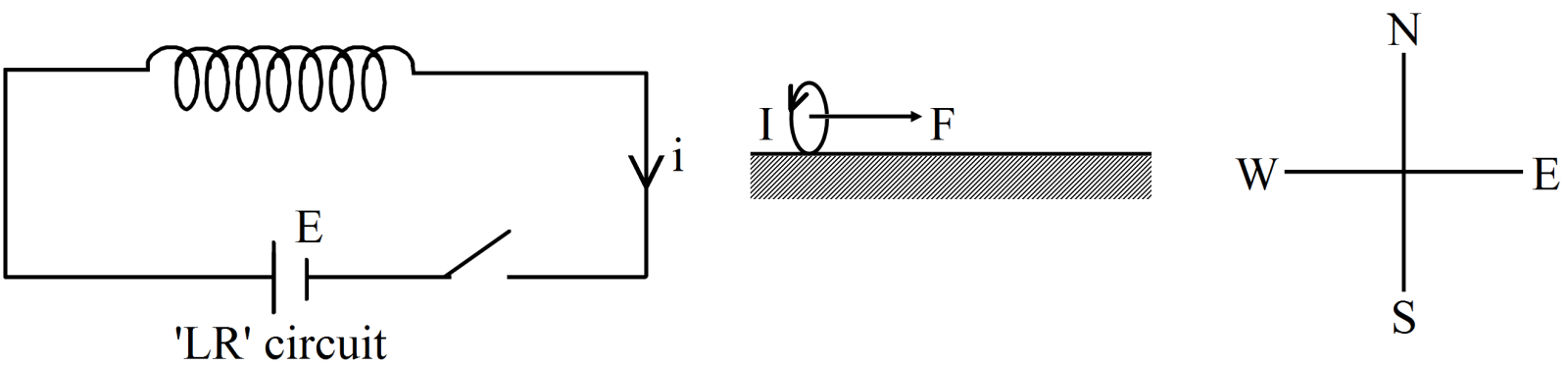
Current flow in the CKt is clock wise direction, due to Mutual Induction current flow in the loop anti clockwise direction. The net force applied on the loop in east direction. So we can say that the ring will move away from the solenoid.

Need a full question paper?

Generate a complete, print-ready paper with questions like this in minutes — across 16+ boards, with answer keys.

Start Generating Free

Similar questions

Water flows through two identical tubes $A$ and $B$. A volume $V_0$ of water passes through the tube $A$ and $2 V_0$ through $B$ in a given time. Which of the followinmay be correct?
​​​​​​
Two thermometers are used to record the temperature of a room. If the bulb of one is wrapped in wet hanky
A mass of 5kg is moving along a circular path of radius 1m. If the mass moves with 300 revolutions per minute, its kinetic energy would be:
A force $f$ is acting on a block of mass $m$. Coefficient of friction between block and surface is  $\mu$. The block can be pulled along the surface if :-
Production of ultra high magnetic fields is based on scientific principle of:
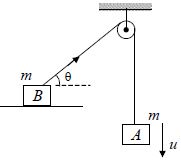
Two equal masses $A$ and $B$ are arranged as shown in the figure. Pulley and string are ideal and there is no friction. Block $A$ has a speed $u$ in the downward direction. The speed of the block $B$ is :-
A river is flowing from $W$ to $E$ with a speed of  $5 \,m/min$. A man can swim in still water with a velocity $10\, m/min$. In which direction should the man swim so as to take the shortest possible path to go to the south.
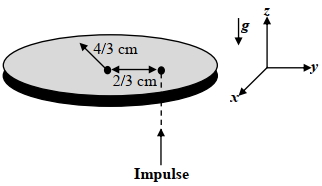
A thin circular coin of mass $5 \mathrm{gm}$ and radius $4 / 3 \mathrm{~cm}$ is initially in a horizontal $x y$-plane. The coin is tossed vertically up ( $+z$ direction) by applying an impulse of $\sqrt{\frac{\pi}{2}} \times 10^{-2} \mathrm{~N}-\mathrm{s}$ at a distance $2 / 3 \mathrm{~cm}$ from its center. The coin spins about its diameter and moves along the $+z$ direction. By the time the coin reaches back to its initial position, it completes $n$ rotations. The value of $n$ is. . . . . [Given: The acceleration due to gravity $\mathrm{g}=10 \mathrm{~ms}^{-2}$ ]
A lift is moving downwards with an acceleration equal to acceleration due to gravity. A body of mass $m$ kept on the floor of the lift is pulled horizontally. If the coefficient of friction is $\,\mu $, then the frictional resistance offered by the body is
Two planets $A$ and $B$ of radii $R$ and $1.5 R$ have densities $\rho$ and $\rho / 2$ respectively. The ratio of acceleration due to gravity at the surface of $B$ to $A$ is :