Question
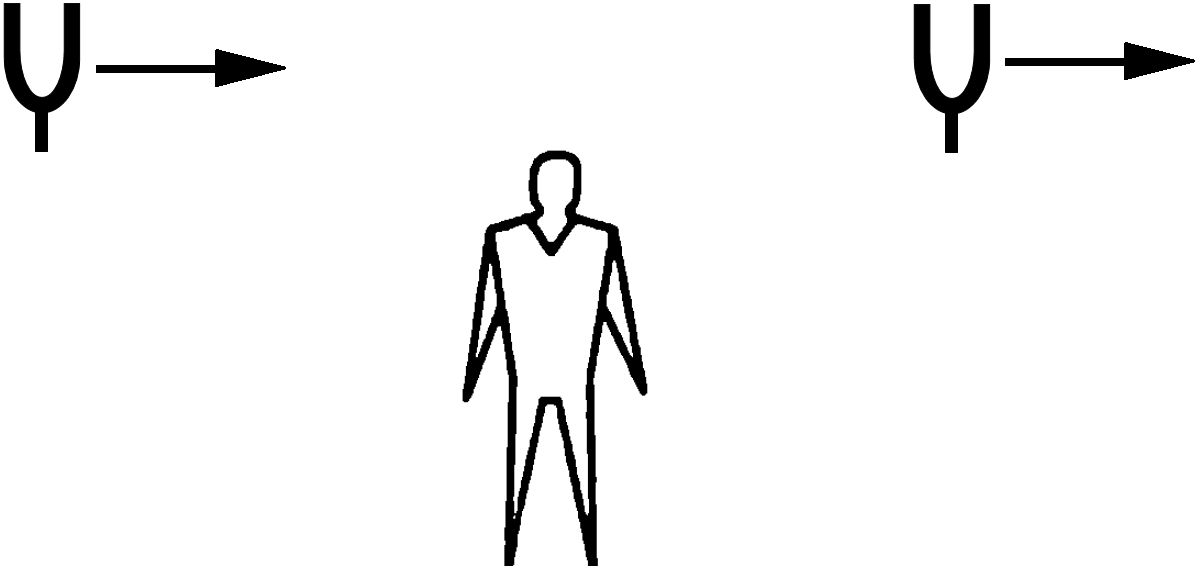
Figure, shows a person standing somewhere in between two identical tuning forks, each vibrating at $512\ Hz.$ If both the tuning fbrks move towards right at a speed of $5.5m/s,$ find the number of beats heard by the listener. Speed of sound in air $= 330m/s.$
Answer


According to the data, $V_s = 5.5\ m/s$ for each turning fork.
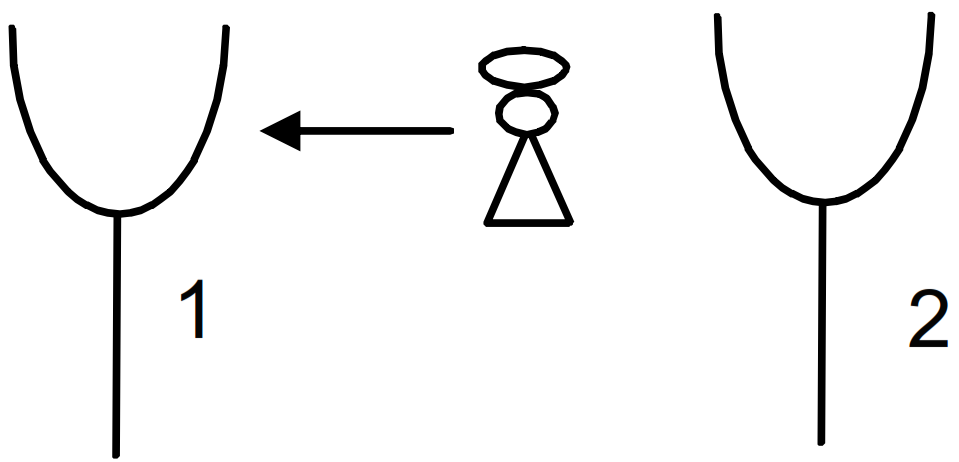
So, the apparent frequency heard from the tuning fork on the left,
$\text{f}\ '=\Big(\frac{330}{330-5.5}\Big)\times512=527.36\ \text{Hz}=527.5\ \text{Hz}$
Similarly, apparent frequency from the tunning fork on the right,
$\text{f}\ '=\Big(\frac{330}{330-5.5}\Big)\times512=510\ \text{Hz}$
So, beats produced $527.5-510=17.5\ \text{Hz}.$

Need a full question paper?

Generate a complete, print-ready paper with questions like this in minutes — across 16+ boards, with answer keys.

Start Generating Free

Similar questions

In a potentiometer arrangement for determining the emf of a cell, the balance point of the cell in open circuit is 350cm. When a resistance of $9\Omega$ is used in the external circuit of the cell, the balance point shifts to 300cm. Determine the internal resistance of the cell.
The charge on a proton is $+1.6 \times 10^{-19}\ C$ and that on an electron is$ -1.6 \times 10^{-19}\ C.$ Does it mean that the electron has a charge $3.2 \times 10^{-19}\ C$ less than the charge of a proton?
Can you add two vectors representing physical quantities having different dimensions? Can you multiply two vectors representing physical quantities having different dimensions?
What is the rms value of alternating current shown in figure?
A parallel beam of monochromatic light is used in a Young's double slit experiment. The slits are separated by a distance d and the screen is placed parallel to the plane of the slits. Show that if the incident beam makes an angle $\theta=\sin^{-1}\Big(\frac{\lambda}{2\text{D}}\Big)$ with the normal to the plane of the slits, there will be a dark fringe at the centre $P_0 $ of the pattern.
Find the dimensions of:
  1. The specific heat capacity c.
  2. The coefficient of linear expansion a.
  3. The gas constant R.
Some of the equations involving these quantities are$\text{Q = mc(T}_2-\text{T}_1),\text{l}_{\text{t}}=\text{l}_0[1+\alpha(\text{T}_2-\text{T}_1)]$ and $\text{PV = nRT}.$
An alternating voltage of frequency $f$ is applied across a series $\text{LCR}$ circuit. Let $f_r$ be the resonance frequency for the circuit. Will the current in the circuit lag, lead or remain in phase with the applied voltage when $(i)\ f > f_r, (ii)\ f < f_r$? Explain your answer in each case.
Light possesses wave nature. It is strongly proved from which two experiments ?
Due to diffraction effects, the beam of ray gets focused as a spot of radius of approximately what value?
A steel rod is clamped at its two ends and rests on a fixed horizontal base. The rod is unstrained at $20^\circ C.$ Find the longitudinal strain developed in the rod if the temperature rises to $50^\circ C.$ Coefficient of linear expansion of steel $=1.2 \times 10^{-5}{ }^{\circ} \mathrm{C}^{-1}.$