Question
Figure shows a series LCR circuit connected to a variable frequency 230V source. L = 5.0H, C = 80μF, R = 40Ω.
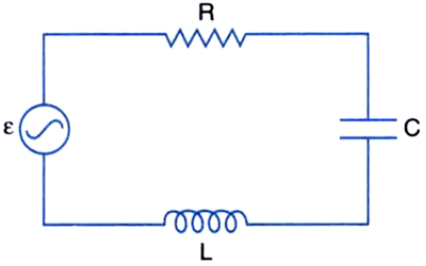
  1. Determine the source frequency which drives the circuit in resonance
  2. Obtain the impedance of the circuit and the amplitude of current at the resonating frequency.
  3. Determine the rms potential drops across the three elements of the circuit. Show that the potential drop across the LC combination is zero at the resonating frequency.
Answer

Here, we are given a LCR circuit.
Inductance, $L = 5.0H$
Resistance, $\text{R}=40\Omega$
Capacitance, $C = 80\mu F = 80 \times 10^{-6}F$
Effective voltage, $E_v = 230$volt
$\Rightarrow\ \text{Peak voltage},\ \text{E}_0=\sqrt{2}\text{E}_{\text{v}}=\sqrt{2}\times230\text{V}$
  1. Resonance angular frequency is given by
$\omega_{\text{r}}=\frac{1}{\sqrt{\text{LC}}}$
$=\frac{1}{\sqrt{5\times80\times10^{-6}}}$
$=\frac{1}{2\times10^{-2}}$
= 50rad/sec.
  1. Impedance of the circuit,
$\text{Z}=\sqrt{\text{R}^2+\big(\omega\text{L}-\frac{1}{\omega\text{C}}\big)^2}$
At resonance, $\omega\text{L}=\frac{1}{\omega\text{C}}$
Therefore,
$\text{Z}=\sqrt{\text{R}^2}=\text{R}=40\Omega$
Amplitude of current at resonating frequency
Peak value of current, $\text{I}_0=\frac{\text{E}_0}{\text{z}}=\frac{\sqrt{2}\times230}{40}=8.13\text{A}$
Rms value of current, $\text{I}_{\text{v}}=\frac{\text{I}_0}{\sqrt{2}}=\frac{8.13}{\sqrt{2}}=5.75\text{A}$
  1. Potential drop across L
$\text{V}_{\text{L rms}}=\text{I}_\text{v}\omega_{\text{r}}\text{L}$
$= 5.75 × 50 × 5.0$
$= 1437.5V$
Potential drop across R
$\mathrm{V_{R\ rms} = I_v \times\ R}$
$= 5.75 × 40$
$= 230$volts
Potential drop across C
$\text{V}_{\text{C rms}}=\text{I}_{\text{v}}\Big(\frac{1}{\omega_{\text{r}}\text{C}}\Big)$
$=5.75\times\frac{1}{50\times80\times10^{-6}}$
$=\frac{5.75}{4}\times10^3$
= 1437.5V
Therefore,
Potential drop across LC circuit
$\mathrm{V_{LC\  rms} = V_{L\ rms} - V_{C\ rms} = 0}$
Thus, the potential drop across the LC combination is zero at the resonating frequency.
Need a full question paper?

Generate a complete, print-ready paper with questions like this in minutes — across 16+ boards, with answer keys.

Start Generating Free

Similar questions

Draw a ray diagram to show the formation of real image of the same size as that of the object placed in front of a converging lens. Using this ray diagram establish the relation between u, v and f for this lens.
A calorimeter contains 50g of water at $50^\circ C$. The temperature falls to $45^\circ C$ in 10 minutes. When the calorimeter contains 100g of water·at $50^\circ 0$, it takes 18 minutes for the temperature to become $45^\circ C$. Find the water equivalent of the calorimeter.
A smooth sphere of radius R is made to translate in a straight line with a constant acceleration a. A particle kept on the top of the sphere is released from there at zero velocity with respect to the sphere. Find the speed of the particle with respect to the sphere as a function of the angle $\theta$ it slides.
Four charges are arranged at the corners of a square $\text{ABCD}$ of side $d$, as shown in Fig. $2.15.\ (a)$ Find the work required to put together this arrangement. $(b)$ A charge $q_0$ is brought to the centre $E$ of the square, the four charges being held fixed at its corners. How much extra work is needed to do this?
Image
  1. Derive an expression for drift velocity of electrons in a conductor. Hence, deduce Ohm's law.
  2. A wire whose cross-sectional area is increasing linearly from its one end to the other, is connected across a battery of V volts.
Which of the following quantities remain constant in the wire?
  1. Drift speed.
  2. Current density.
  3. Electric current.
  4. Electric field.
Figure shows two rigid vessels A and B, each of volume $200cm^3,$ containing an ideal gas $(C_v = 12.5JK^{-1}mol^{-1})$. The vessels are connected to a manometer tube containing mercury. The pressure in both the vessels is 75cm of mercury and the temperature is 300K.
  1. Find the number of moles of the gas in each vessel.
  2. 5.0J of heat is supplied to the gas in vessel A and 10J to the gas in vessel B. Assuming there's no appreciable transfer of heat from A to B, calculate the difference in the heights of mercury in the two sides of the manometer. Gas constant, $R = 8.3JK^{-1}mol^{-1}.$
Write the definition of electrostatic at any point. Also write its S.I. units. As shown in the figure, three points charges $q_1$, $q _2$ and $q _3$ are placed at points $A, B$ and $C$ respectively. Drive an expression for the electrostatic potential energy of this system.

Image
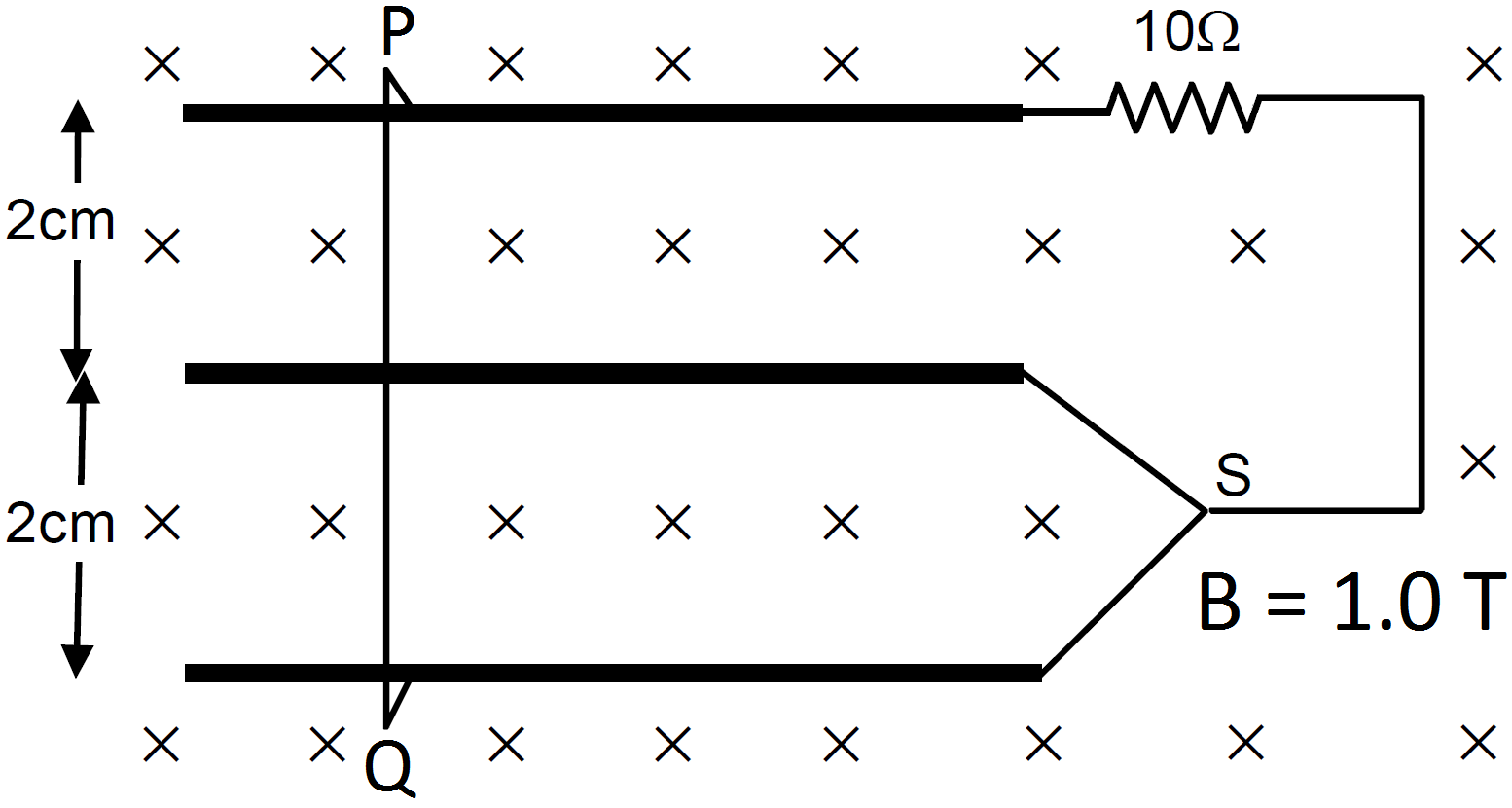
Consider the situation shown in figure. The wire PQ has a negligible resistance and is made to slide on the three rails with a constant speed of 5cm/s. Find the current in the $10\Omega$ resistor when the switch S is thrown to:
  1. The middle rail.
  2. The bottom rail.
Analyze the force acting on a moving charge in a uniform magnetic field.###Analyze the magnetic force acting on a moving charged particle in a magnetic field. Write the magnitude of force in different conditions. Write suitable rule for finding the direction of force.
In an experiment with Foucault's apparatus, the various distances used are as follows:
Distance between the rotating and the fixed mirror $= 16m$
Distance between the lens and the rotating mirror $= 6m$
Distance between the source and the lens $= 2m$
When the mirror is rotated at a speed of 356 revolutions per second, the image shifts by 0.7mm. Calculate the speed of light from these data.