Question
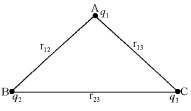
Write the definition of electrostatic at any point. Also write its S.I. units. As shown in the figure, three points charges $q_1$, $q _2$ and $q _3$ are placed at points $A, B$ and $C$ respectively. Drive an expression for the electrostatic potential energy of this system.
Image

Answer

Electrostatic Potential : "Electric potential at any point inside the electric field is equal to the ratio of the work W done in bringing a test positive charge from infinity to that point without acceleration and the value of the test charge $q_0$." The unit of electric potential in SI system is Volt. If charge $q_1$ is brought from infinity to $\vec{r}_1$, no work is done. Therefore $W _1=0$.
Work done in bringing charge $q _2$ from infinity to $\overrightarrow{r_2}$,
$ W_{12}=q_2, V_1=\frac{1}{4 \pi \varepsilon_0} \frac{q_1 q_2}{r_{12}} $
where the potential at distance $r_{12}$ is $V _1$.
Now charges $q_1$ and $q_2$ produce potential at the distance $\vec{r}_3$
$ V_3=\frac{1}{4 \pi \varepsilon_0} \cdot \frac{q_1}{r_{13}}+\frac{1}{4 \pi \varepsilon_0} \cdot \frac{q_2}{r_{23}} $
Work done in bringing the charge $q_{13}$ from infinity to $\overrightarrow{r_3}$,
$W ^{\prime}= W _{13}+ W _{23}=q_3 V_3$
$=q_3\left[\frac{1}{4 \pi \varepsilon_0} \cdot \frac{q_1}{r_{13}}+\frac{1}{4 \pi \varepsilon_0} \cdot \frac{q_2}{r_{23}}\right]$
$=\frac{1}{4 \pi \varepsilon_0} \frac{q_1 q_3}{r_{13}}+\frac{1}{4 \pi \varepsilon_0} \frac{q_2 q_3}{r_{23}}$
Therefore, the value of electrostatic potential energy of this system is
$U = W _{12}+ W ^{\prime}$
$=\frac{1}{4 \pi \varepsilon_0} \frac{q_1 q_2}{r_{12}}+\frac{1}{4 \pi \varepsilon_0} \frac{q_1 q_3}{r_{13}}+\frac{1}{4 \pi \varepsilon_0} \frac{q_2 q_3}{r_{23}}$
$=\frac{1}{4 \pi \varepsilon_0}\left(\frac{q_1 q_2}{r_{12}}+\frac{q_1 q_3}{r_{13}}+\frac{q_2 q_3}{r_{23}}\right)$

Need a full question paper?

Generate a complete, print-ready paper with questions like this in minutes — across 16+ boards, with answer keys.

Start Generating Free

Similar questions

A small town with a demand of 800kW of electric power at 220V is situated 15km away from an electric plant generating power at 440V. The resistance of the two wire line carrying power is 0.5Ω per km. The town gets power from the line through a 4000-220V step-down transformer at a sub-station in the town.
  1. Estimate the line power loss in the form of heat.
  2. How much power must the plant supply, assuming there is negligible power loss due to leakage?
  3. Characterise the step up transformer at the plant.
A 1kg block is executing simple harmonic motion of amplitude 0.1m on a smooth horizontal surface under the restoring force of a spring of spring constant 100N/m. A block of mass 3kg is gently placed on it at the instant it passes through the mean position. Assuming that the two blocks move together, find the frequency and the amplitude of the motion.
The current in a discharging LR circuit without the battery drops from 2.0A to 1.0A in 0.10s.
  1. Find the time constant of the circuit.
  2. If the inductance of the circuit is 4.0H, what is its resistance?
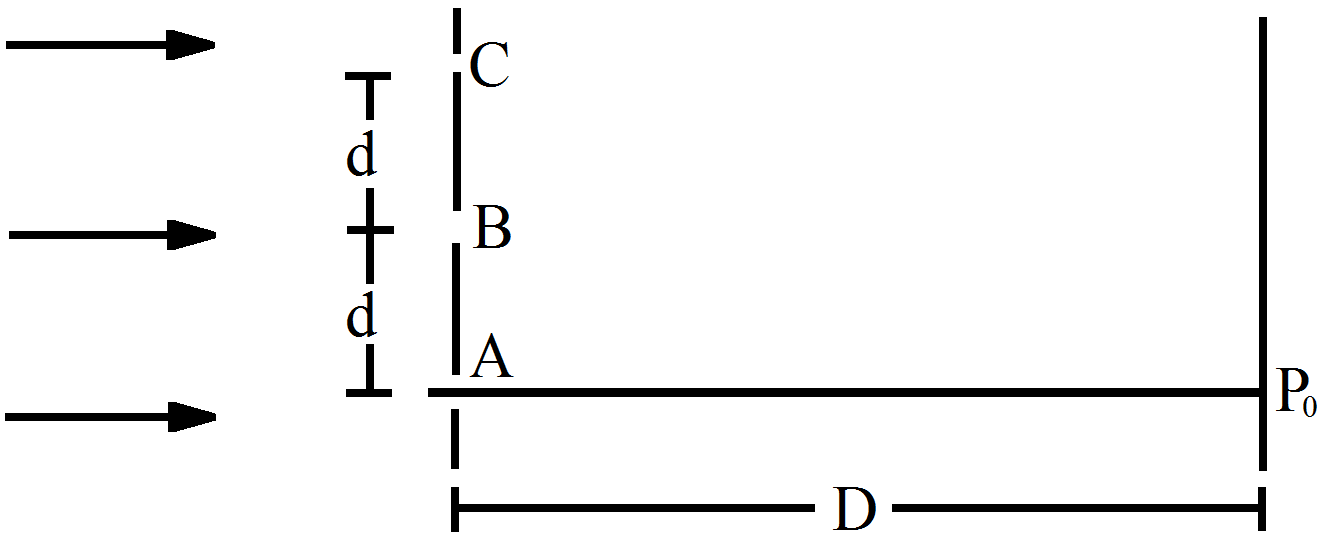
Figure shows three equidistant slits being illuminated by a monochromatic parallel beam of light. Let $\text{BP}_0-\text{AP}=\frac{\lambda}{3}$ and $\text{D}>\lambda.$
  1. Show that in this case $\text{d}=\sqrt{\frac{2\lambda\text{D}}{3}}.$
  2. Show that the intensity at P, is three times the intensity due to any of the three slits individually.
The volume of an ideal gas $(\gamma=1.5)$ is changed adiabatically from 4.00 litres to 3.00 litres. Find the ratio of,
  1. The final pressure to the initial pressure.
  2. The final temperature to the initial temperature.
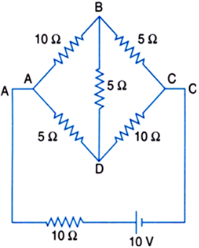
Determine the current in each branch of the network shown in Fig.:
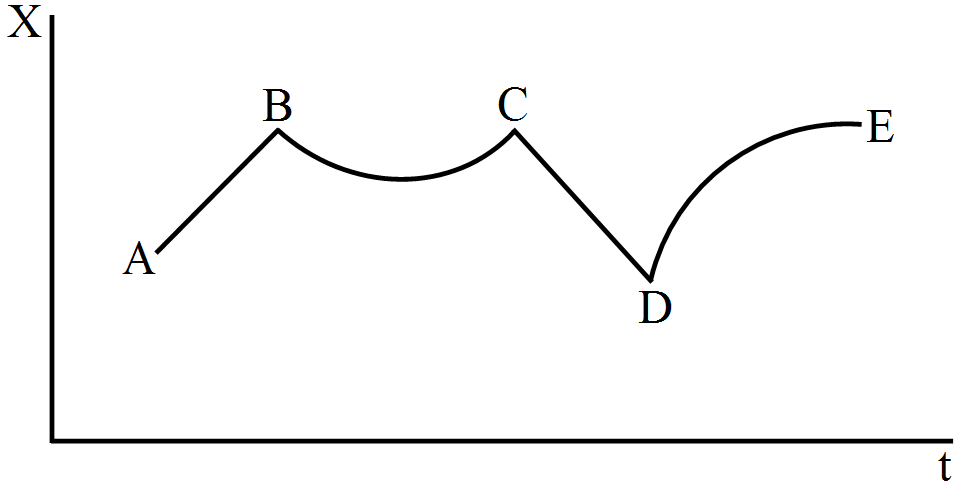
Figure shows the displacement of a particle going along the X-axis as a function of time. The force acting on the particle is zero in the region:
  1. AB
  2. BC
  3. CD
  4. DE
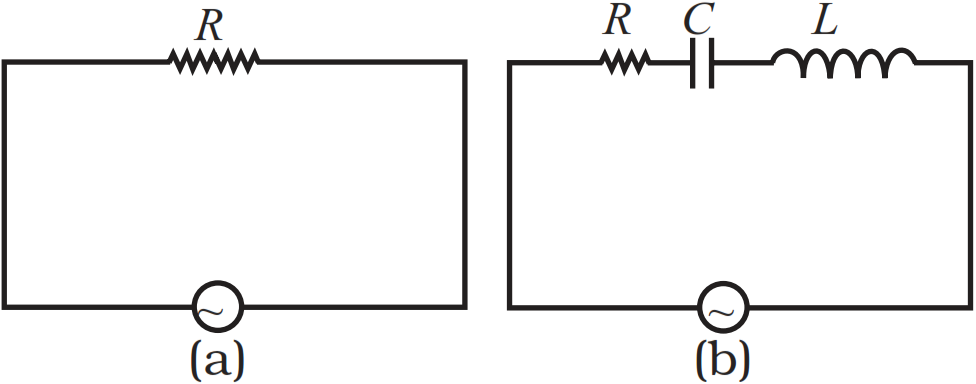
Study the circuits (a) and (b) shown in Fig. and answer the following questions.
  1. Under which conditions would the rms currents in the two circuits be the same?
  2. Can the rms current in circuit (b) be larger than that in (a)?
  1. Draw a labelled diagram of a moving coil galvanometer. Describe briefly its principle and working.
  2. Answer the following:
  1. Why is it necessary to introduce a cylindrical soft iron core inside the coil of a galvanometer?
  2. Increasing the current sensitivity of a galvanometer may not necessarily increase its voltage sensitivity. Explain, giving reason.
A particle of mass m and charge q is released from the origin in a region in which the electric field and magnetic field are given by
$\overrightarrow{\text{B}}=-\text{B}_0\overrightarrow{\text{j}}$ and $\overrightarrow{\text{E}}=\text{E}_0\overrightarrow{\text{k}}.$ Find the speed of the particle as a function of its z-coordinate.