Question
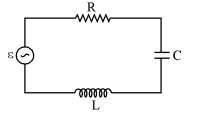
✓
Answer
Given : $L =5.0 H , C =80 \mu F=80 \times 10^{-6} F$$R =40 \Omega, E _{ rms }=230 V$
(a) Frequency f of the source which will cause reso-nance in the circuit
$f=f_r=\frac{1}{2 \pi \sqrt{ LC }}$
$f=f_r=\frac{1 \times 7}{2 \times 22 \sqrt{5.0 \times 80 \times 10^{-6}}}$
$=\frac{7}{2 \times 22 \times 20 \times 10^{-3}}$
$=\frac{7000}{880}=\frac{175}{22} Hz$
Hence, $\quad \omega_r=2 \pi f_r$
$=2 \times \frac{22}{7} \times \frac{175}{22}=50 rad s ^{-1}$
(b) Let the impedance at resonance be $Z$.
$Z=\sqrt{R^2+\left(\omega L-\frac{1}{\omega C}\right)^2}$
At resonance, $\omega=\omega_r$
and$\omega L=\frac{1}{\omega C}$
$\therefore \quad Z=R=40 \Omega$
$I_{ rms }=\frac{E_{ rms }}{Z}=\frac{E_{ rms }}{R}=\frac{230}{40}=5.75 A$
Amplitude of current at resonant frequency
$I_{rms}=\frac{I_0}{\sqrt{2}}$
$\therefore \quad I _0= I _{ rms } \sqrt{2}$
$=5.75 \times \sqrt{2} A$
$=8.13 A=8.1 A$.
(c) Potential drop across the ends of resistor
$V_R=I_{r m s} R$
$=5.75 \times 40=230 V$
Potential drop across the ends of L
$V_{r m s}=I_{r m s} X_L$
$= I _{ rms } \times \omega_{,} L$
$=5.75 \times 50 \times 5.0$
$V _{ rms }=1437.5 V$
In the same way, potential drop across the ends of capacitor
$= I _{ rms } \times X _{ C }$
$= I _{ rms } \times \frac{1}{\omega_r C }$"
$=5.75 \times \frac{1}{50 \times 80 \times 10^{-6}}$
$V _{ rms }=1437.5 V$
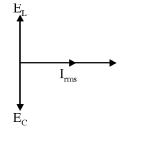
Potential drop across the ends of C = Potential difference across the endsL. $E _{ L }$ of and $E _{ C }$ are equal and opposite.
Hence magnitude of potential drop across the combination of LC combination is zero at resonant frequency.
(a) Frequency f of the source which will cause reso-nance in the circuit
$f=f_r=\frac{1}{2 \pi \sqrt{ LC }}$
$f=f_r=\frac{1 \times 7}{2 \times 22 \sqrt{5.0 \times 80 \times 10^{-6}}}$
$=\frac{7}{2 \times 22 \times 20 \times 10^{-3}}$
$=\frac{7000}{880}=\frac{175}{22} Hz$
Hence, $\quad \omega_r=2 \pi f_r$
$=2 \times \frac{22}{7} \times \frac{175}{22}=50 rad s ^{-1}$
(b) Let the impedance at resonance be $Z$.
$Z=\sqrt{R^2+\left(\omega L-\frac{1}{\omega C}\right)^2}$
At resonance, $\omega=\omega_r$
and$\omega L=\frac{1}{\omega C}$
$\therefore \quad Z=R=40 \Omega$
$I_{ rms }=\frac{E_{ rms }}{Z}=\frac{E_{ rms }}{R}=\frac{230}{40}=5.75 A$
Amplitude of current at resonant frequency
$I_{rms}=\frac{I_0}{\sqrt{2}}$
$\therefore \quad I _0= I _{ rms } \sqrt{2}$
$=5.75 \times \sqrt{2} A$
$=8.13 A=8.1 A$.
(c) Potential drop across the ends of resistor
$V_R=I_{r m s} R$
$=5.75 \times 40=230 V$
Potential drop across the ends of L
$V_{r m s}=I_{r m s} X_L$
$= I _{ rms } \times \omega_{,} L$
$=5.75 \times 50 \times 5.0$
$V _{ rms }=1437.5 V$
In the same way, potential drop across the ends of capacitor
$= I _{ rms } \times X _{ C }$
$= I _{ rms } \times \frac{1}{\omega_r C }$"
$=5.75 \times \frac{1}{50 \times 80 \times 10^{-6}}$
$V _{ rms }=1437.5 V$
Potential drop across the ends of C = Potential difference across the endsL. $E _{ L }$ of and $E _{ C }$ are equal and opposite.
Hence magnitude of potential drop across the combination of LC combination is zero at resonant frequency.
Need a full question paper?
Generate a complete, print-ready paper with questions like this in minutes — across 16+ boards, with answer keys.
Explore more
Similar questions
If a $LC$ circuit is considered analogous to a harmonically oscillating spring block system, which energy of the $LC$ circuit would be analogous to potential energy and which one analogous to kinetic energy?
→A polariod (I) is placed in front of a monochromatic source. Another polatiod (II) is placed in front of this polaroid (I) and rotated till no light passes. A third polaroid (III) is now placed in between (I) and (II). In this case, will light emerge from (II). Explain.
A block of weight 100N is slowly slid up on a smooth incline of inclination 37° by a person. Calculate the work done by the person in moving the block through a distance of 2.0m, if the driving force is:
- Parallel to the incline.
- In the horizontal direction.
A magnetic field $B$ is confined to a region $ r \leq$ a and points out of the paper $($the $z-$ axis$), r = 0$ being the centre of the circular region. $A$ charged ring $ ($charge $= Q)$ of radius $b, b > a$ and mass m lies in the $x-y$ plane with its centre at the origin. The ring is free to rotate and is at rest. The magnetic field is brought to zero in time $\triangle t$. Find the angular velocity $\omega$ of the ring after the field vanishes.
→When a dielectric is placed in an electric field, it gets polarized. The electric field in a polarized material is less than the applied field. When a paramagnetic substance is kept in a magnetic field, the field in the substance is more than the applied field. Explain the reason of this opposite behaviour.
Find the speed at which the kinetic enei:gy of a particle will differ by 1% from its nonrelativistic value $\frac{1}{2}\text{m}_0\text{v}^2$
→A gas is initially at a pressure of $100\ kPa$ and its volume is $2.0m^3.$ Its pressure is kept constant and the volume is changed from $2.0m^3$ to $2.5m^3.$ Its volume is now kept constant and the pressure is increased from $100\ kPa$ to $200\ kPa.$ The gas is brought back to its initial state, the pressure varying linearly with its volume.
→- Whether the heat is supplied to or extracted from the gas in the complete cycle?
- How much heat was supplied or extracted?
A compound microscope consists of an objective lens of focal length $2.0 \ cm$ and an eyepiece of focal length $6.25 \ cm$ separated by a distance of $15 \ cm.$ How far from the objective should an object be placed in order to obtain the final image at $(a)$ the least distance of distinct vision $(25 \ cm),$ and $(b)$ at infinity? What is the magnifying power of the microscope in each case?
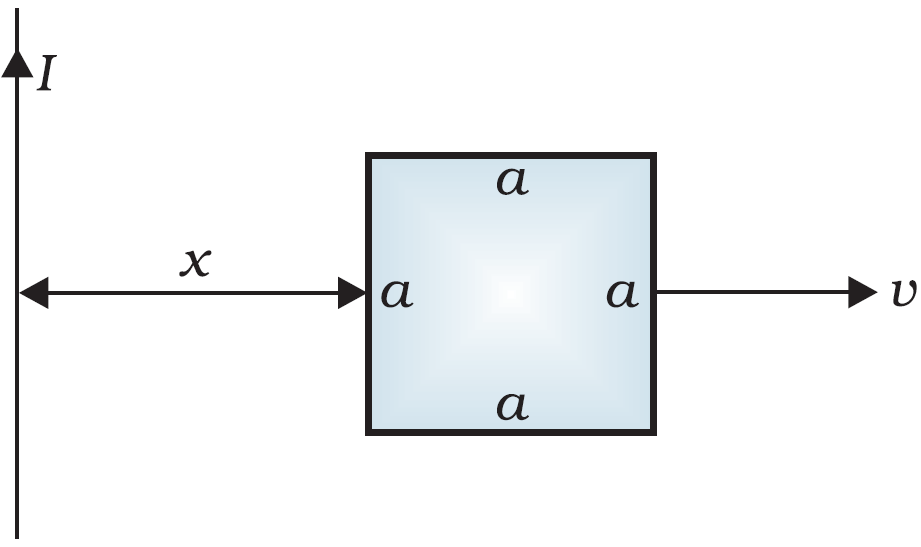
→- Obtain an expression for the mutual inductance between a long straight wire and a square loop of side a as shown in Fig.
- Now assume that the straight wire carries a current of $50A$ and the loop is moved to the right with a constant velocity $, v = 10\ m/s.$ Calculate the induced emf in the loop at the instant when $x = 0.2\ m$. Take $a = 0.1\ m$ and assume that the loop has a large resistance.
A particle of mass m and charge q is released from the origin in a region in which the electric field and magnetic field are given by
$\overrightarrow{\text{B}}=-\text{B}_0\overrightarrow{\text{j}}$ and $\overrightarrow{\text{E}}=\text{E}_0\overrightarrow{\text{k}}.$ Find the speed of the particle as a function of its z-coordinate.
→$\overrightarrow{\text{B}}=-\text{B}_0\overrightarrow{\text{j}}$ and $\overrightarrow{\text{E}}=\text{E}_0\overrightarrow{\text{k}}.$ Find the speed of the particle as a function of its z-coordinate.