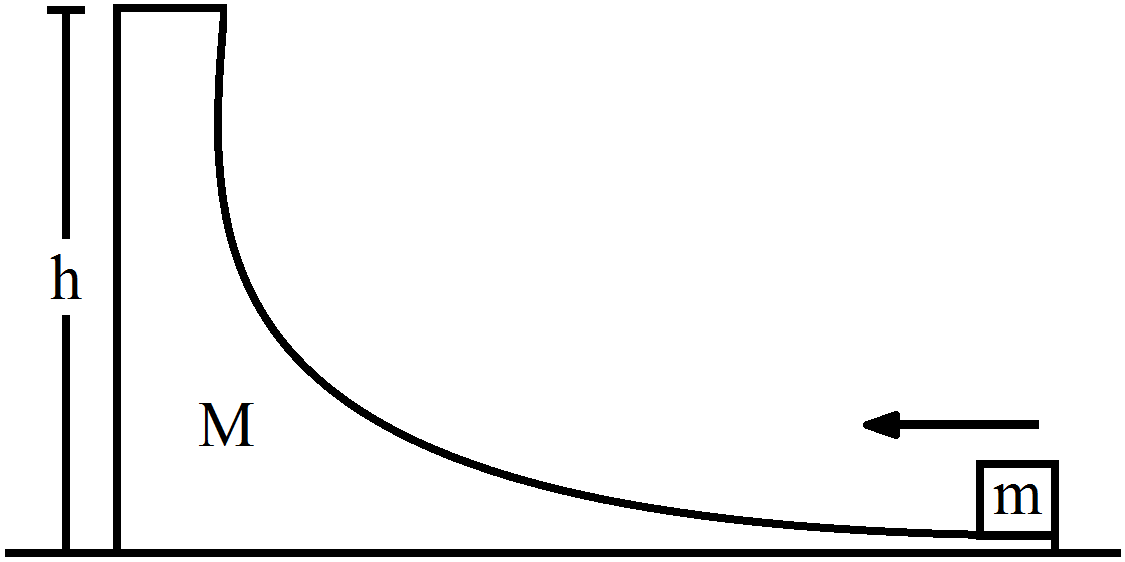
 The mass ‘m’ is given a velocity ‘v’ over the larger mass M.
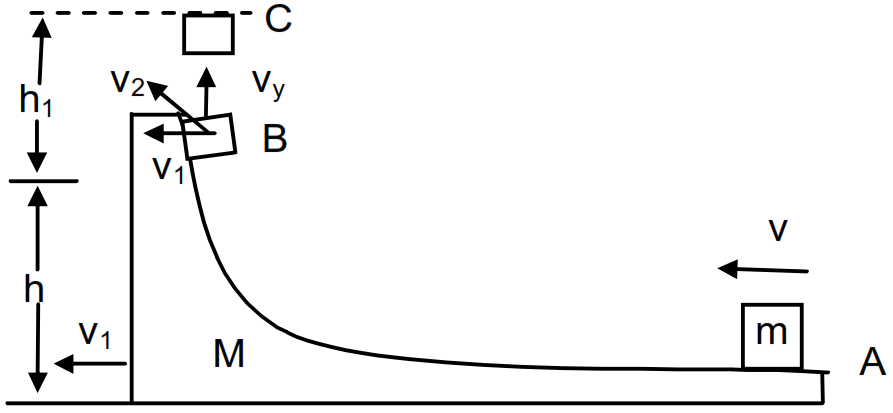
 - When the smaller block is travelling on the vertical part, let the velocity of the bigger block be v1 towards left.
From law of conservation of momentum, (in the horizontal direction)
$\text{mv}=(\text{M}+\text{m})\text{v}_1$
$\Rightarrow\text{v}_1=\frac{\text{mv}}{\text{M}+\text{m}}$
- When the smaller block breaks off, let its resultant velocity is v2.
From law of conservation of energy,
$\Big(\frac{1}{2}\Big)\text{mv}^2=\Big(\frac{1}{2}\Big)\text{mv}^2_1+\Big(\frac{1}{2}\Big)\text{mv}^2_2+\text{mgh}$
$\Rightarrow\text{v}_2^2=\text{v}^2-\frac{\text{M}}{\text{m}}\text{v}_1^2-2\text{gh}\ \dots(1)$
$\Rightarrow\text{v}_2^2=\text{v}^2\bigg[1-\frac{\text{M}}{\text{m}}\times\frac{\text{m}^2}{(\text{M}+\text{m})^2}\bigg]-\text{2gh}$
$\Rightarrow\text{v}_2=\bigg[\frac{(\text{m}^2+\text{Mm}+\text{m}^2)}{(\text{M}+\text{m})^2}\text{v}^2-\text{2gh}\bigg]^{\frac{1}{2}}$
- Now, the vertical component of the velocity v2 of mass ‘m’ is given by
$\text{v}_{\text{y}}^2=\text{v}_2^2-\text{v}_1^2$
$=\frac{(\text{M}^2+\text{Mm}+\text{m}^2)}{(\text{M}+\text{m}^2)}\text{v}^2-2\text{gh}-\frac{\text{m}^2\text{v}^2}{(\text{M}+\text{m})^2}$ $\Big[\therefore\text{v}_1=\frac{\text{mv}}{\text{M}+\text{m}}\Big]$
$\Rightarrow\text{v}_{\text{y}}^2=\frac{\text{M}^2+\text{Mm}+\text{m}^2-\text{m}^2}{(\text{M}+\text{m})^2}\text{v}^2-\text{2gh}$
$\Rightarrow\text{v}_{\text{y}}^2=\frac{\text{Mv}^2}{(\text{M}+\text{m})}-\text{2gh}\ \dots(2)$
To find the maximum height (from the ground), let us assume the body rises to a height ‘h’, over and above ‘h’
Now, $\Big(\frac{1}{2}\Big)\text{mv}_{\text{y}}^2=\text{mgh}_1$
$\Rightarrow\text{h}_1=\frac{\text{v}_{\text{y}}^2}{\text{2g}}\ \dots(3)$
So, Total height $=\text{h}+\text{h}_1=\text{h}+\frac{\text{v}_{\text{y}}^2}{\text{2g}}$
$=\text{h}+\frac{\text{mv}^2}{(\text{M}+\text{m})\text{2g}}-\text{h}$
[from equation (2) and (3)]
$\Rightarrow\text{H}=\frac{\text{mv}^2}{(\text{M}+\text{m})\text{2g}}$
- Because, the smaller mass has also got a horizontal component of velocity ‘v1’ at the time it breaks off from ‘M’ (which has a velocity v1), the block ‘m’ will again land on the block ‘M’ (bigger one). Let us find out the time of flight of block ‘m’ after it breaks off. During the upward motion (BC),
$0=\text{v}_{\text{y}}-\text{gt}_1$
$\Rightarrow\text{t}_1=\frac{\text{v}_{\text{y}}}{\text{g}}=\frac{1}{\text{g}}\bigg[\frac{\text{mv}^2}{(\text{M}+\text{m})}-2\text{gh}\bigg]^{\frac{1}{2}}\ \dots(4)$ [from equation (2)]
So, the time for which the smaller block was in its flight is given by,
$\text{T}=\text{2t}_1=\frac{2}{\text{g}}\bigg[\frac{\text{mv}^2-2(\text{M}+\text{m})\text{gh}}{(\text{M}+\text{m})}\bigg]^{\frac{1}2{}}$
So, the distance travelled by the bigger block during this time is,
$\text{S}=\text{v}_1\text{T}=\frac{\text{mv}}{\text{M}+\text{m}}\times\frac{2}{\text{g}}\frac{\big[\text{Mv}^2-2(\text{M}+\text{m})\text{gh}\big]}{(\text{M}+\text{m})}^{\frac{1}2{}}$
or $\text{S}=\frac{2\text{mv}\big[\text{Mv}^2-2(\text{M}+\text{m})\text{gh}\big]^\frac{1}{2}}{\text{g}(\text{M}+\text{m})^{\frac{3}{2}}}$