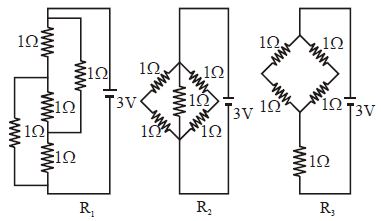
Figure shows three resistor configurations $R_1,R_2$ and $R_3$ connected to $3\,V$ battery. If the power dissipated by the configuration $R_1, R_2$ and $R_3$ is $P_1, P_2$ and $P_3$ , respectively then
Medium
Download our app for free and get started
$\mathrm{R}_{1}=1\, \Omega$
$\mathrm{R}_{2}=\frac{1}{2}\, \Omega \quad \mathrm{P} \propto \frac{1}{\mathrm{R}}$
$\mathrm{R}_{3}=2\, \Omega$
$P_{2}>P_{1}>P_{3}$

Download our appand get started for free
Experience the future of education. Simply download our apps or reach out to us for more information. Let's shape the future of learning together!No signup needed.*
Similar Questions
- 1In a potentiometer wire experiment the $\mathrm{emf}$ of a battery in the primary circuit is $20\,V$ and its internal resistance is $5\,\Omega$ . There is a resistance box in series with the battery and the potentiometer wire, whose resistance can be varied from $120\,\Omega$ to $170\,\Omega$ . Resistance of the potentiometer wire is $75\,\Omega$ . The following potential differences can be measured using this potentiometer.View Solution
- 2A battery of internal resistance one ohm and $emf$ $3\,volt$ sends a current through $1\,metre$ of uniform wire of resistance $5\,\Omega $. The pole of the cell of $emf$ $1.4\,volt$ are connected to two points on the wire so that no current passes through this cell. Then, the potential gradient of the wire isView Solution
- 3Four resistances of $15\; \Omega, 12\; \Omega, 4 \;\Omega$ and $10\; \Omega$ respectively in cyclic order to form Wheats tone's network. The resistance that is to be connected in parallel with the resistance of $10\; \Omega$ to balance the network is .................. $\Omega$View Solution
- 4Assertion : When current through a bulb decreases by $0.5\%$, the glow of bulb decreases by $1\%$.View Solution
Reason : Glow (Power) which is directly proportional to square of current.
- 5The specific resistance of a wire is $\rho $, its volume is $3\,{m^3}$ and its resistance is $3\, ohms$, then its length will beView Solution
- 6Water boils in an electric kettle in $15\,\min$ after switching on. If the length of the heating wire is decreased to $2/3$ of its initial value, then the same amount of water will boil with the same supply voltage in ............. $min$View Solution
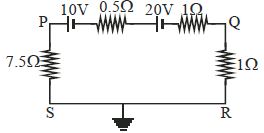
- 7View SolutionIn the circuit shown in figure, which of the statement is incorrect ?
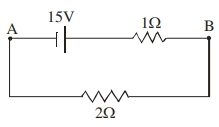
- 8For the network shown below, the value $V _{ B }- V _{ A }$ is_______ $V$View Solution
- 9Two electric bulbs marked $40\,W,$ $220\,V$ and $60\,W,\,\,220\,V$ when connected in series across same voltage supply of $220\,V,$ the effective power is $P_1$ and when connected in parallel, the effective power is $P_2.$ Then $\frac {P_1}{P_2}$ isView Solution
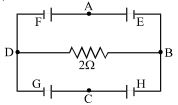
- 10In the circuit shown $E, F, G$ and $H$ are cells of $\mathrm{e.m.f.}$ $2\,V, 1\,V, 3\,V$ and $1\,V$ respectively and their internal resistances are $2\,\Omega , 1\,\Omega , 3\,\Omega$ and $1\,\Omega$ respectively.View Solution