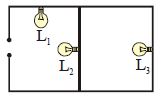
Figure shows three similar lamp. $L_1,L_2$ and $L_3$ connected across a power supply. If the lamp $L_3$ fuses, how will the light emitted by $L_1$ and $L_2$ change ?
Easy
Download our app for free and get started
When $L_3$ is fused Potential difference across $L_2$ increase and that of $L_1$ decreases

Download our appand get started for free
Experience the future of education. Simply download our apps or reach out to us for more information. Let's shape the future of learning together!No signup needed.*
Similar Questions
- 1Three resistances $4\,\Omega $ each of are connected in the form of an equilateral triangle. The effective resistance between two corners isView Solution
- 2View SolutionWatt-hour meter measures
- 3The resistance of a wire is $R$. It is bent at the middle by $180^o$ and both the ends are twisted together to make a shorter wire. The resistance of the new wire isView Solution
- 4If a wire is stretched to make it $0.1 \%$ longer, its resistance willView Solution
- 5$(1)$ The product of a volt and a coulomb is a joule.View Solution
$(2)$ The product of a volt and an ampere is a joule/second.
$(3)$ The product of volt and watt is horse power.
$(4)$ Watt-hour can be measured in terms of electron volt.
State if
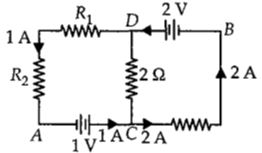
- 6In the circuit shown in the figure, if the potential at point $A$ is taken to be zero, the potential at point $B$ is ................ $V$View Solution
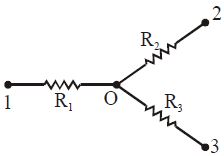
- 7.............. $A$ the current flowing through the resistance $R_2$ of the circuit shown in fig if the resistance are equal to $R_1 = 20\ \Omega, R_2 = 30 \ \Omega$ and $R_3 = 60 \ \Omega$ and potentials of points $1, 2$ and $3$ are equal to $V_1= 20\, V,$ $V_2 = 30\ V$ and $V_3 = 60\ V$View Solution
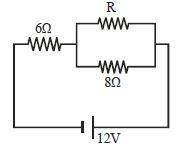
- 8In the circuit shown in figure, the power which is dissipated as heat in the $6\,\Omega $ resistor is $6\,W$. What is the value of resistance $R$ in the circuit? ................ $\Omega$View Solution
- 9A heating element has a resistance of $100\,\Omega $ at room temperature. When it is connected to a supply of $220\,V,$ a steady current of $2\,A$ passes in it and temperature is $500\,^oC$ more than room temperature. What is the temperature coefficient resistance of the heating element?View Solution
- 10What is the resistance of a carbon resistance which has bands of colours brown, black and brown .............. $\Omega$View Solution