Question
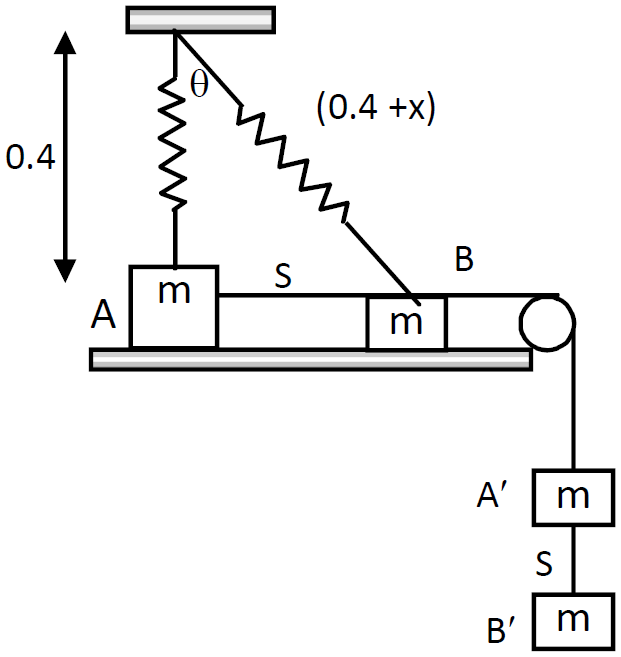
Figure shows two blocks A and B, each having a mass of 320g connected by a light string passing over a smooth light pulley. The horizontal surface on which the block A can slide is smooth. The block A is attached to a spring of spring constant 40N/m whose other end is fixed to a support 40cm above the horizontal surface. Initially, the spring is vertical and unstretched when the system is released to move. Find the velocity of the block A at the instant it breaks off the surface below it. Take $g = 10m/s^2$.
Answer

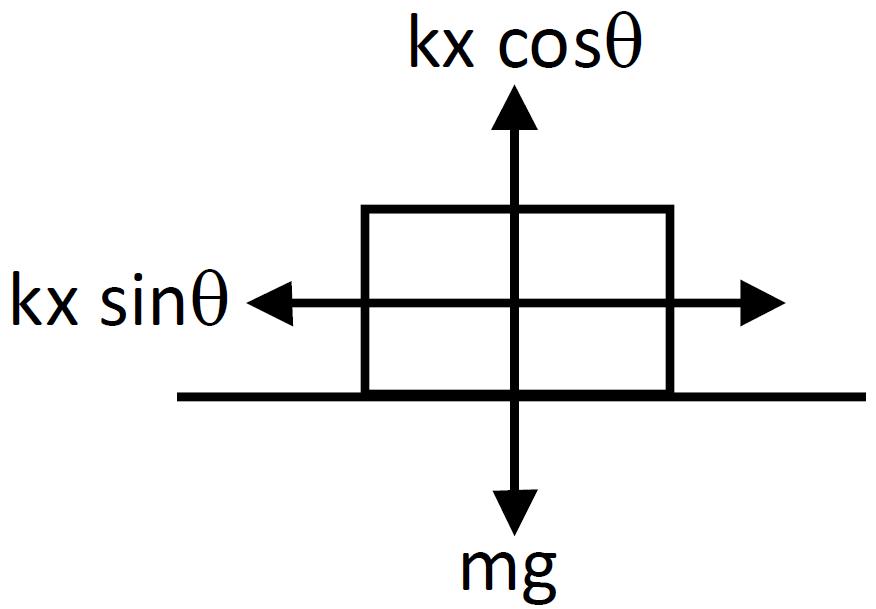
$m = 320g = 0.32kg, k = 40N/m h = 40cm = 0.4m, g = 10 m/s^2$ From the free body diagram,


$\text{kx}\cos\theta=\text{mg}$
(when the block breaks off R = 0)$\Rightarrow\cos\theta=\frac{\text{mg}}{\text{kx}}$
So, $\frac{0.4}{0.4+\text{x}}=\frac{3.2}{40+\text{x}}$$\Rightarrow16\text{x}=3.2\text{x}+1.28$
$\Rightarrow\text{x}=0.1\text{m}$
So, $\text{s}=\text{AB}$$\Rightarrow\sqrt{(\text{h}+\text{x})^2-\text{h}^2}$
$\Rightarrow\sqrt{(0.5)^2-(0.4)^2}=0.3\text{m}$
Let the velocity of the body at B be v, Charge in K.E. = work done (for the system)$\Big(\frac{1}{2}\text{mv}^2+\frac{1}{2}\text{mv}^2\Big)=\frac{-1}{2}\text{kx}^2+\text{mgs}$
$\Rightarrow(0.32)\times\text{v}^2=-\Big(\frac{1}{2}\Big)\times40\times(0.1)^2+0.32\times10\times(0.3)$
$\Rightarrow\text{v}=1.5\text{m}/\text{sec}$

Need a full question paper?

Generate a complete, print-ready paper with questions like this in minutes — across 16+ boards, with answer keys.

Start Generating Free

Similar questions

Solve the previous problem if the pulley has a moment of inertia I about its axis and the string does not slip over it.
A wave is described by the equation$\text{y}=(1.0\text{mm})\sin\pi\Big(\frac{\text{x}}{2.0\text{cm}}-\frac{\text{t}}{0.01\text{s}}\Big).$
  1. Find the time period and the wavelength.
  2. Write the equation for the velocity of the particles. Find the speed of the particle at x = 1.0cm at time t = 0.01s.
  3. What are the speeds of the particles at x = 3.0cm, 5.0cm and 7.0cm at t 0.01s?
  4. What are the speeds of the particles at x 1.0cm at t = 0.011, 0.012, and 0.013s?
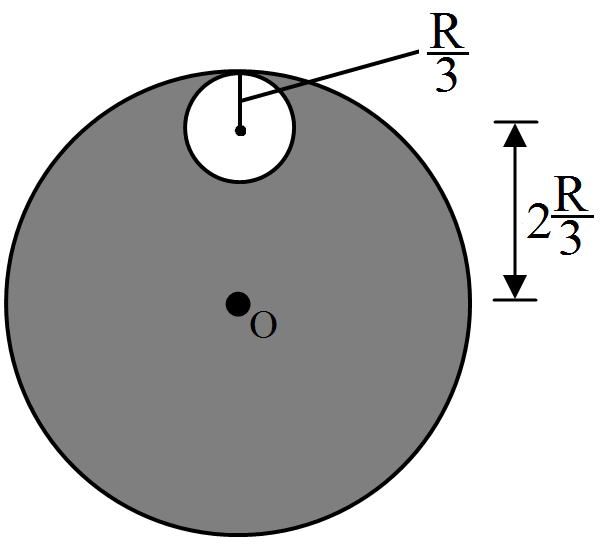
From a circular disc of radius R and mass 9M, a small disc of radius $\frac{\text{R}}{3}$ is removed as shown in Fig. Find the moment of inertia of the remaining disc about an axis perpendicular to the plane of the disc and passing through the point O.
Three particles of masses 1.0kg, 2.0kg and 3.0kg are placed at the corners A, B and C respectively of an equilateral triangle ABC of edge 1m. Locate the centre of mass of the system.
A train starts from rest and moves with a constant acceleration of $2.0m/s^2$ for half a minute. The brakes are then applied and the train comes to rest in one minute. Find:
  1. The total distance moved by the train.
  2. The maximum speed attained by the train.
  3. The position(s) of the train at half the maximum speed.
A suitcase kept on a shop's rack is measured 50cm × 25cm × 10cm by the shop's owner. A traveller takes this suitcase in a train moving with velocity 0.6c.
If the suitcase is placed with its length along the train's velocity, find the dimensions measured by:
  1. The traveller and.
  2. A ground observer.
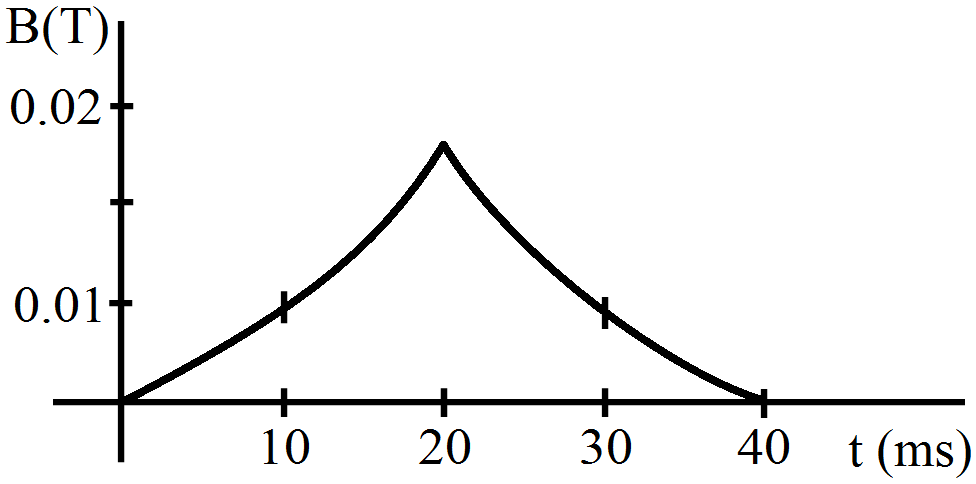
  1. The magnetic field in a region varies as shown in figure. Calculate the average induced emf in a conducting loop of area $2.0 \times 10^{-3}m^2$ placed perpendicular to the field in each of the $10ms$ intervals shown.
  2. In which intervals is the emf not constant? Neglect the behaviour near the ends of 10ms intervals.
State Newton's law of Gravitation. Find the percentage decrease in the weight of the body when taken to a height of 16km. above the surface of the earth. Radius of the earth is 6400km.
A current of 1.0A is established in a tightly wound solenoid of radius 2cm having 1000 turns/ metre. Find the magnetic energy stored in each metre of the solenoid.
Write the law of force for simple harmonic motion and prove that $T=2 \pi \sqrt{\frac{m}{ k }}$.