Question
State Newton's law of Gravitation. Find the percentage decrease in the weight of the body when taken to a height of 16km. above the surface of the earth. Radius of the earth is 6400km.

Answer

It states that every body in the universe attracts every other body with a force which is directly propotional to the product of their masses and inversely propotional to square of distance between them. $\text{F}=\frac{\text{Gm}_1\text{m}_2}{\text{r}^2}$ $m_1$ and $m_2$ → mass of two bodies r → distance between two bodies. The acceleration due to gravity at a height 'h' above the surface of the earth is $\text{g}'=\text{g}\Big(1-\frac{2\text{h}}{\text{R}}\Big)$ $\text{g}-\text{g}'=\Big(\frac{2\text{hg}}{\text{R}}\Big)$ $\frac{\text{mg}-\text{mg}'}{\text{mg}}\times100=\frac{\text{g}-\text{g}'}{\text{g}}\times100$ $=\frac{2\text{h}}{\text{R}}\times100$ $=\frac{2\times16}{6400}\times100=0.5\%$

Need a full question paper?

Generate a complete, print-ready paper with questions like this in minutes — across 16+ boards, with answer keys.
Start Generating Free

Similar questions

A train runs along an unbanked circular track of radius 30m at a speed of 54km/h. The mass of the train is $10^6kg$. What provides the centripetal force required for this purpose - The engine or the rails ? What is the angle of banking required to prevent wearing out of the rail?
A capacitor of capacitance $12.0\mu\text{F}$ is connected to a battery of emf 6.00V and internal resistance $1.00\Omega$ through resistanceless leads. $12.0\mu\text{s}$ after the connections are made, what will be (a) the current in the circuit (b) the power delivered by the battery (c) the power dissipated in heat and (d) the rate at which the energy stored in the capacitor is increasing.
A regular polygon of n sides is formed by bending a wire of total length $27\pi\text{r}$ which carries a current i.
  1. Find the magnetic field B at the centre of the polygon.
  2. By letting $\text{n}\rightarrow\infty,$ deduce the expression for the magnetic field at the centre of a circular current.
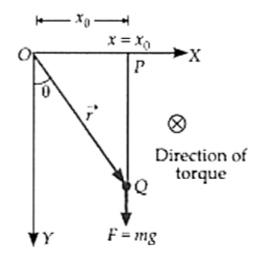
A particle of mass $m$ is released from point P at $x = x _0$ on the X -axis from origin O and falls vertically along the Y-axis, as shown in Fig.
Image

i. Find the torque $t$ acting on the particle at a time $t$ when it is at point Q with respect to O .
ii. Find the angular momentum L of the particle about O at this time t .
iii. Show that $\tau=\frac{d L}{d t}$ in this example.
A particle of mass $100g$ moving at an initial speed u collides with another particle of same mass kept initially at rest. If the total kinetic energy becomes $0.2J$ after the collision, what could be the minimum and the maximum value of u.
A beam of uniform cross-section and uniform mass-density of mass $20kg$ is supported at ends. A mass of $5kg$ is placed at a distance of $\frac{\text{L}}{5\text{m}} $ from one of its end. If beam is L m long, what are reactions of supports? In dealing with problems of equilibrium of a rigid body (like beam in this question). first of all draw a free body diagram of the system, indicating all of the forces acting on the system.
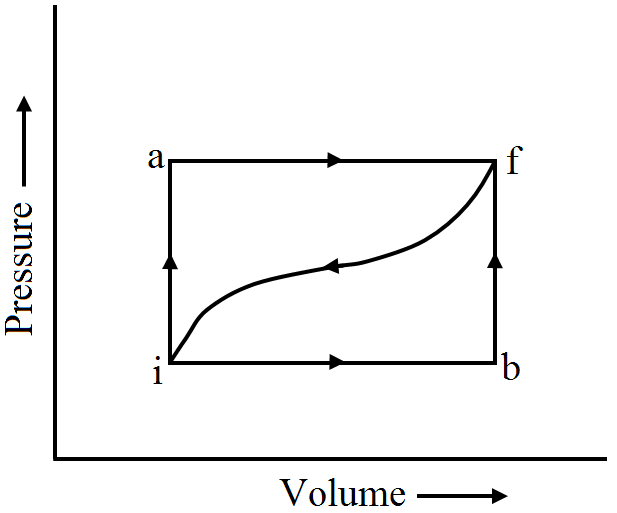
When a system is taken from state i to state f along the path iaf (see fig. below), it is found that the heat Q absorbed by the system is $50$ cal. and work done W by the system is equal to $20$ cal. along the path ibf; $Q = 36$ cal.
  1. What is W along the path ibf?
  2. If $W = -13$ cal. for the curved return path fi, what is for this path?
  3. Take $U_i= 10$ cal, what is $U_f$?
  4. If $U_b = 22$ cal. what are Q for the processes bf and ib?
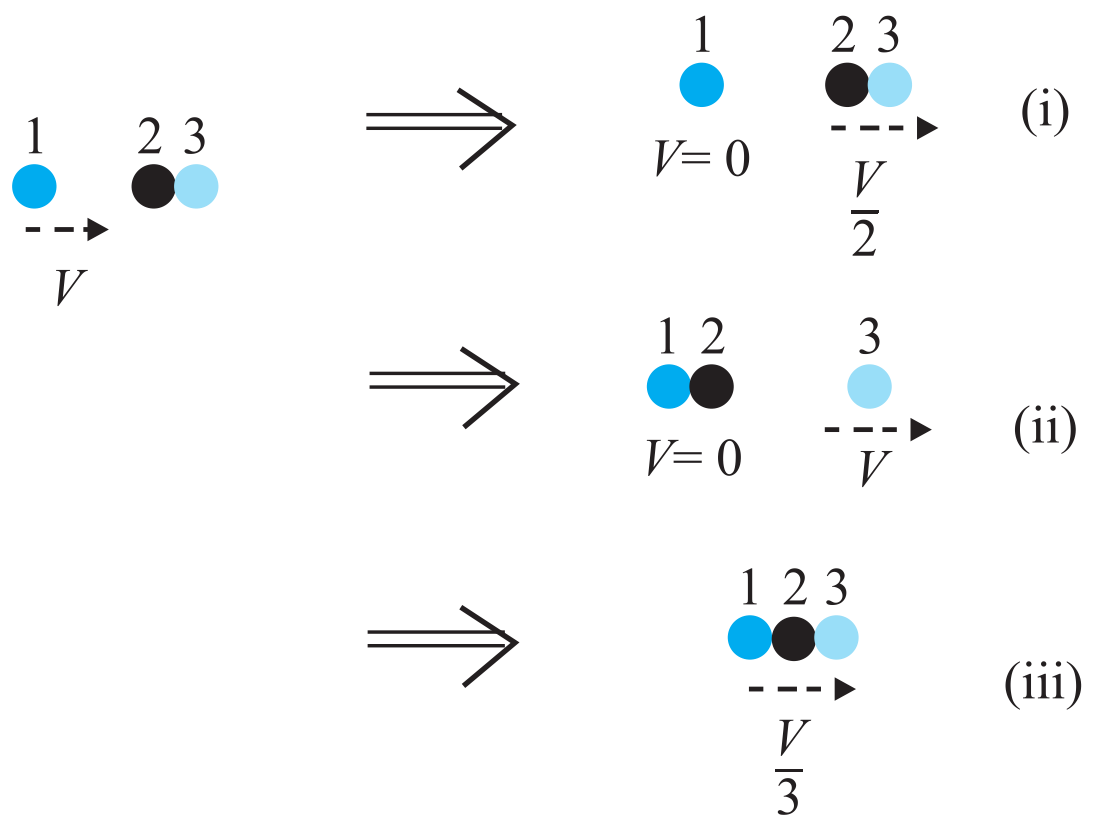
Two identical ball bearings in contact with each other and resting on a frictionless table are hit head-on by another ball bearing of the same mass moving initially with a speed V. If the collision is elastic, which of the following is a possible result after collision?
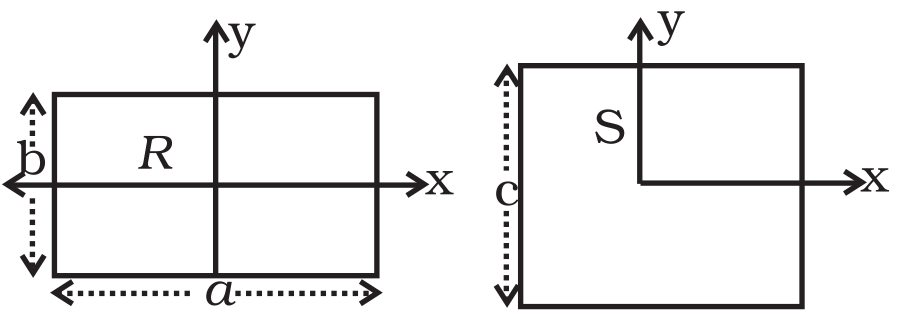
A uniform square plate S(side c) and a uniform rectangular plate R(sides b, a) have identical areas and masses:
Show that:
  1. $\frac{\text{I}_\text{xR}}{\text{I}_\text{xS}}<1$
  2. $\frac{\text{I}_\text{ys}}{\text{I}_\text{ys}}>1$
  3. $\frac{\text{I}_{2\text{R}}}{\text{I}_{2\text{s}}}>1$
Two particles of mass $2kg$ and $1kg$ are moving along the same line with speeds $2ms-1$ and $5ms^{-1}$ respectively. What is the speed of the centre of mass of the system if both the particles are moving (a) in same direction (b) in opposite direction?