Question
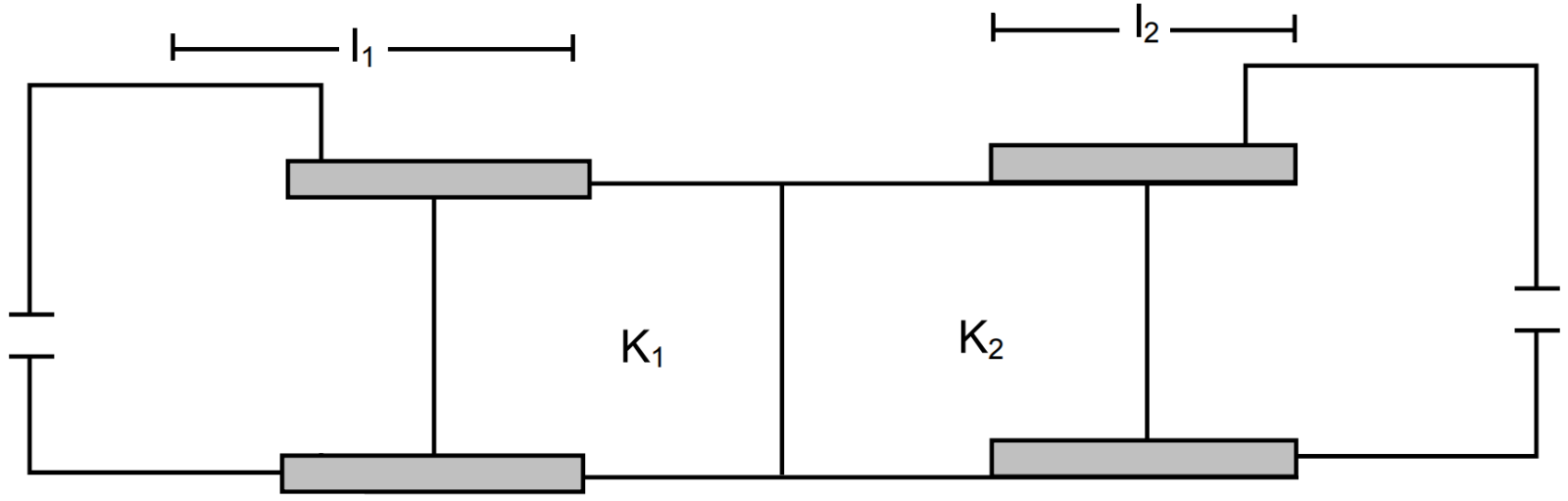
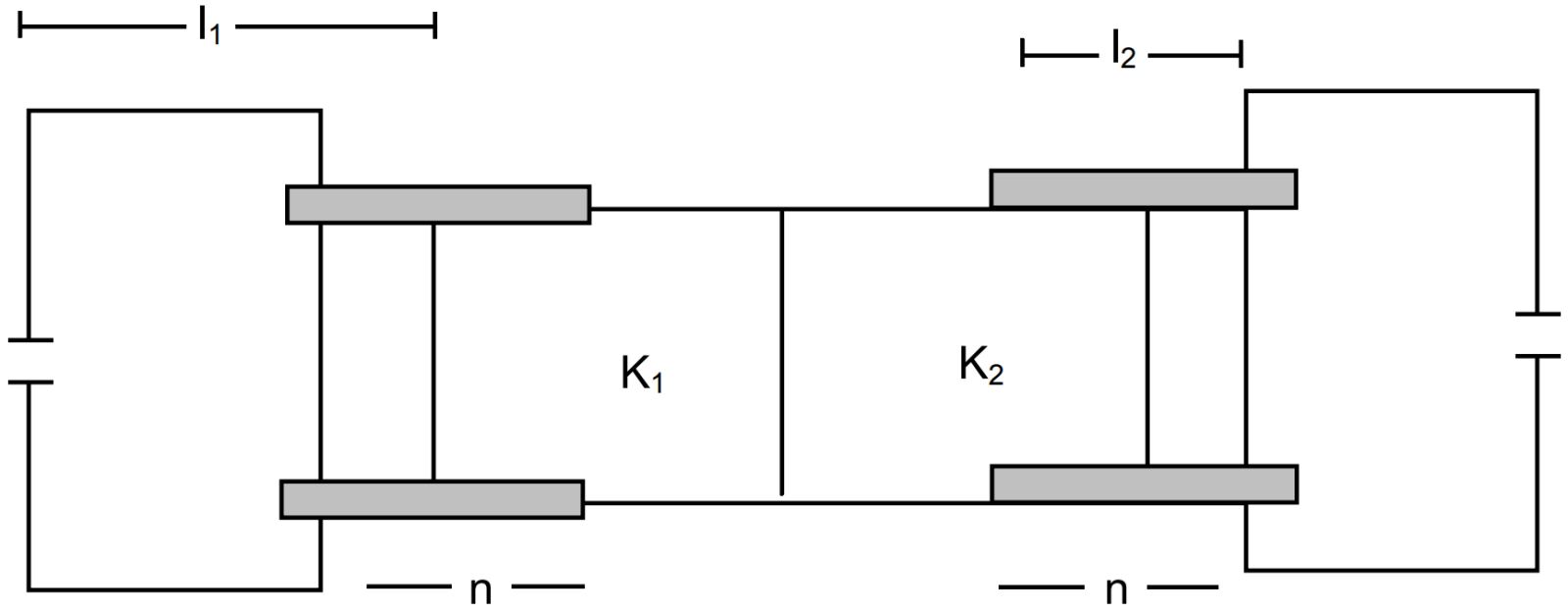
Figure shows two parallel plate capacitors with fixed plates and connected to two batteries. The separation between the plates is the same for the two capacitors. The plates are rectangular in shape with width b and lengths l1 and l2 The left half of the dielectric slab has a dielectric constant K1 and the right half K2. Neglecting any friction, find the ratio of the emf of the left. battery to that of the right battery for which the dielectric slab may remain in equilibrium.
Answer

Consider the left side

The plate area of the part with the dielectric is by its capacitance $\text{C}_1=\frac{\text{K}_1\in_0\text{bx}}{\text{d}}$ and with out dielectric $\text{C}_2=\frac{\in_0\text{b}(\text{L}_1-\text{x})}{\text{d}}$
These are connected in parallel

$\text{C}=\text{C}_1+\text{C}_2$

$=\frac{\in_0\text{b}}{\text{d}}[\text{L}_1+\text{x}(\text{k}_1-1)]$

Let the potential V1

$\text{U}=\Big(\frac{1}{2}\Big)\text{CV}_1^2=\frac{\in_0\text{bv}_1^2}{2\text{d}}[\text{L}_1+\text{x}(\text{k}-1)]\ \dots(1)$

Suppose dielectric slab is attracted by electric field and an external force F consider the part dx which makes inside further, As the potential difference remains constant at V.

The charge supply, dq = (dc)v to the capacitor.

The work done by the battery is dwb = v.dq = (dc)v2

The external force F does a work dwe = (–f.dx) during a small displacement.

The total work done in the capacitor is dwb + dwe = (dc)v2 - fdx

This should be equal to the increase dv in the stored energy.

Thus $\Big(\frac{1}{2}\Big)(\text{dk})\text{v}^2=(\text{dc})\text{v}^2-\text{fdx}$

$\text{f}=\frac{1}{2}\text{v}^2\frac{\text{dc}}{\text{dx}}$

from equation (1)

$\text{F}=\frac{\in_0\text{bv}^2}{2\text{d}}(\text{k}_1-1)$

$\Rightarrow\text{V}_1^2=\frac{\text{F}\times2\text{d}}{\in_0\text{b}(\text{k}_1-1)}$

$\Rightarrow\text{V}_1=\sqrt{\frac{\text{F}\times2\text{d}}{\in_0\text{b}(\text{k}_1-1)}}$

For the right side, $\text{V}_2=\sqrt{\frac{\text{F}\times2\text{d}}{\in_0\text{b}(\text{k}_2-1)}}$

$\frac{\text{V}_1}{\text{V}_2}=\frac{\sqrt{\frac{\text{F}\times2\text{d}}{\in_0\text{b}(\text{k}_1-1)}}}{\sqrt{\frac{\text{F}\times2\text{d}}{\in_0\text{b}(\text{k}_2-1)}}}$

$\frac{\text{V}_1}{\text{V}_2}=\frac{\sqrt{\text{k}_2-1}}{\sqrt{\text{k}_1-1}}$

$\therefore$ The ratio of the emf of the left battery to the right battery $=\frac{\sqrt{\text{k}_2-1}}{\sqrt{\text{k}_1-1}}$

Need a full question paper?

Generate a complete, print-ready paper with questions like this in minutes — across 16+ boards, with answer keys.

Start Generating Free

Similar questions

Two ideal gas thermometers A and B use oxygen and hydrogen respectively. The following observations are made:
Temperature
Pressure thermometer A
Pressure thermometer B
Triple-point of water
1.250 × 10⁵Pa
0.200 × 10⁵Pa
Normal melting point of sulphur
1.797 × 10⁵Pa
0.287 × 10⁵Pa

What is the absolute temperature of normal melting point of sulphur as read by thermometers A and B?

What do you think is the reason behind the slight difference in answers of thermometers A and B? (The thermometers are not faulty). What further procedure is needed in the experiment to reduce the discrepancy between the two readings?

The moment of inertia of a solid flywheel about its axis is 0.1kg-m2. A tangential force of 2kg/ wt is applied round the circumference of the flywheel with the help of a string and mass arrangement as shown in Fig. If the radius of the wheel is 0.1m, find the acceleration of the mass.

A plane is in level flight at constant speed and each of its two wings has an area of 25m2. If the speed of the air is 180km/ h over the lower wing and 234km/ h over the upper wing surface, determine the plane’s mass. (Take air density to be 1kg m–3).
Explain elastic and inelastic collision. For head on elastic collision, obtained expressions for the velocities of the colliding particles after the collision. Also mention the special conditions of collision.
Two 22.7kg ice sleds A and B are placed a short distance apart, one directly behind the other, as shown in Fig. A 3.63kg cat, standing on one sled, jumps across to the other and immediately back to the first. Both jumps are made at a speed of 3.05ms-1 relative to the ice. Find the final speeds of the two sleds.

A simple harmonic wave of amplitude 1cm and frequency 100Hz is travelling along positive x-direction with a velocity of 15m/s. Calculate the displacement y, particle velocity and particle acceleration at x = 180 cm from the origin at t = 5s.
Derive the formula for work done of stretched a wire.### The length of a wire is $L$, when a weight Mg is suspended on it, it length is increased by $\Delta L$ then prove that the work done is
$ W =\frac{1}{2} \text { Stress } \times \text { Strain }$
A fighter plane is flying horizontally at an altitude of 1.5 km with a speed of $720 km / h$. At what angle of sight (w.r.t horizontal) when the target is seen, should the pilot drop the bomb in order to attack the target?
Main concept used: $u =720 km / h =720 \times \frac{5}{18} m / s =200 m / s$
The position of a particle is given by $\text{r}=3.0\text{t}\hat{\text{i}}-2.0\text{t}^2\hat{\text{j}}+4.0\hat{\text{k }}\text{m}$
Where t is in seconds and the coefficients have the proper units for r to be in metres. (a) Find the v and a of the particle? (b) What is the magnitude and direction of velocity of the particle at t = 2.0s?
Mention the statements of the second law of thermodynamics given by Kelvin Planck and Clausius. How are the statements similar to each other?