Question
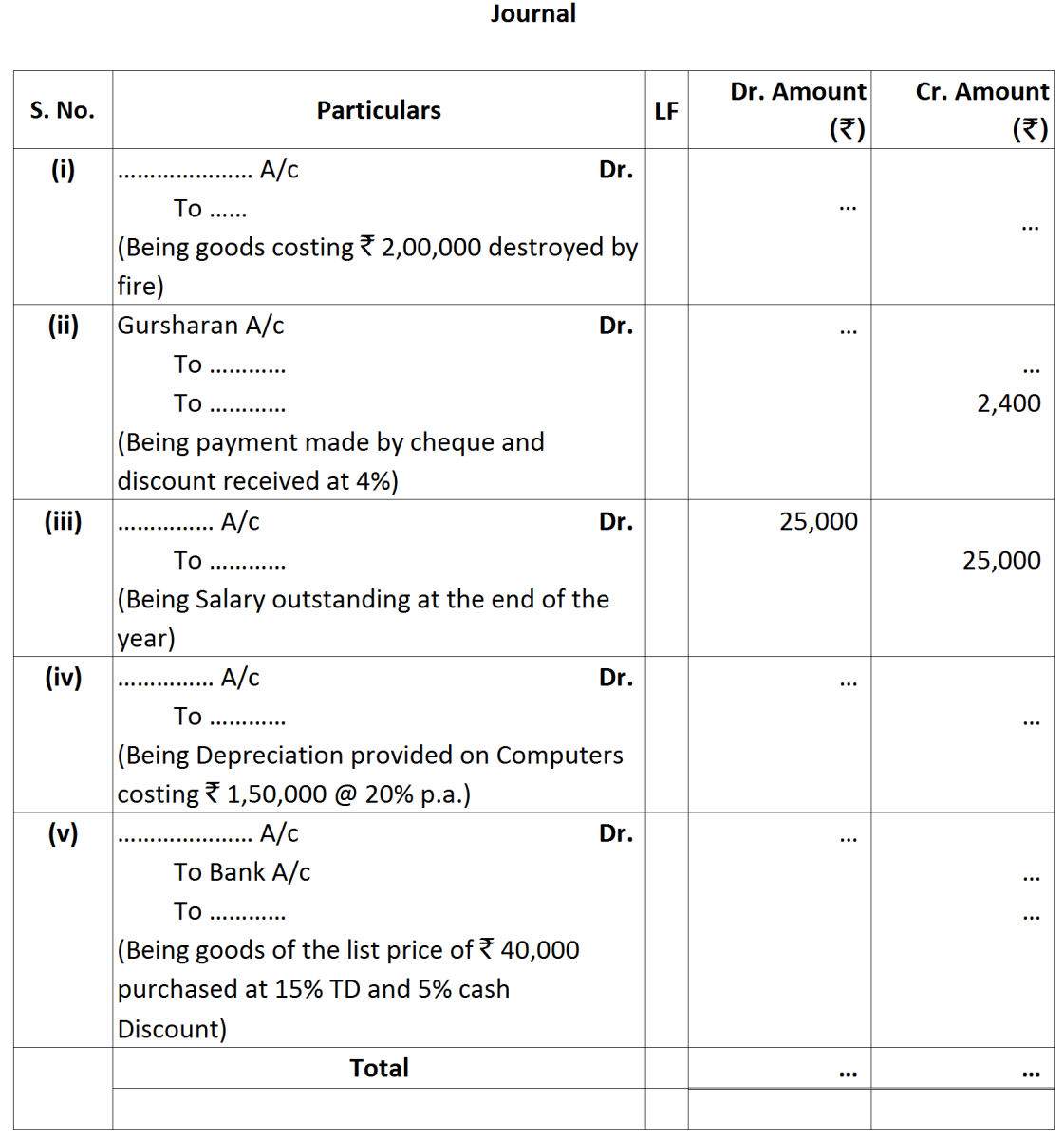
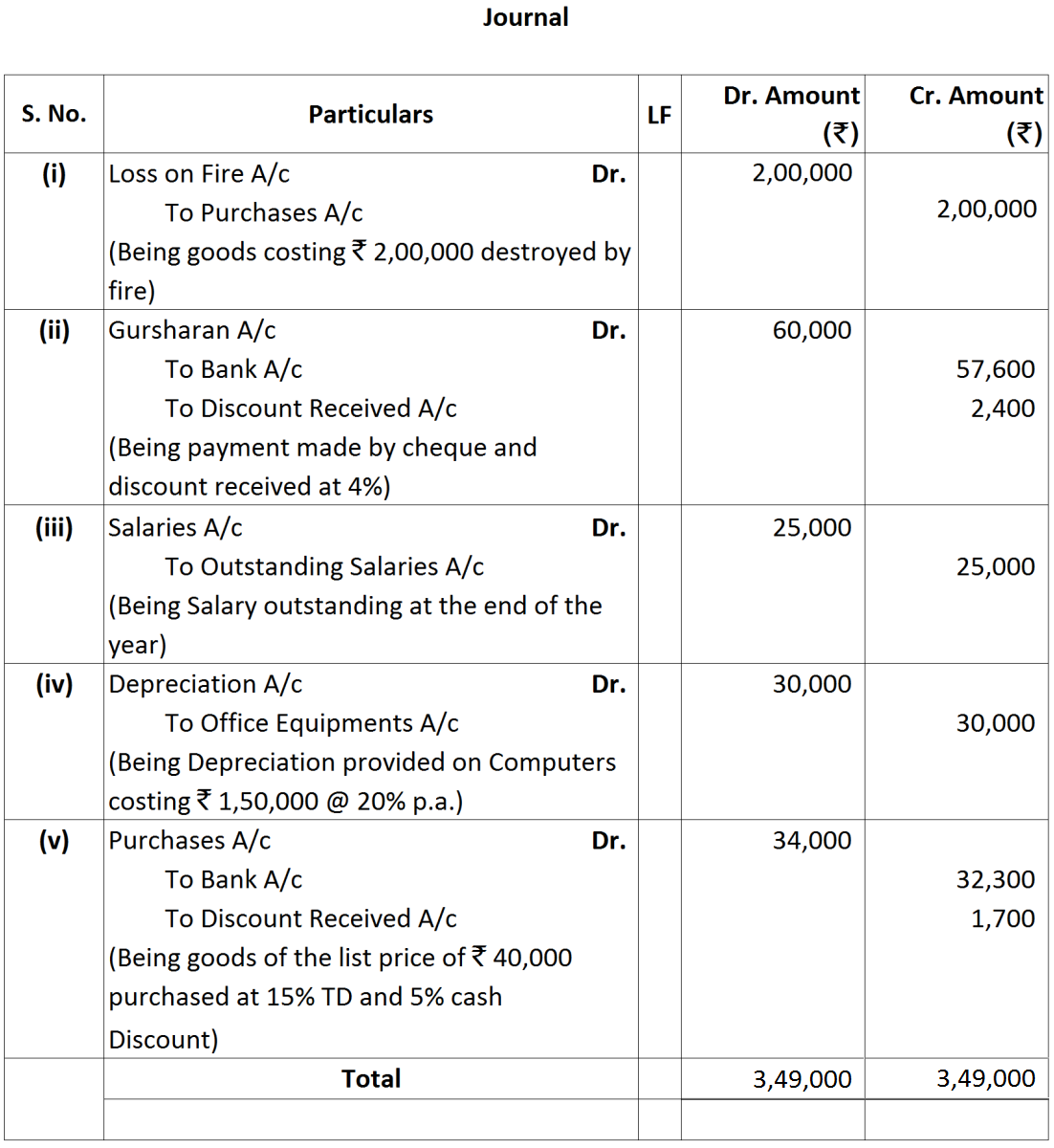
Fill in the missing information in the following journal entries:
Answer


Working Note:
  1. Total Amount $=\frac{2,400}{4}\times100=₹\ 60,000$

Need a full question paper?

Generate a complete, print-ready paper with questions like this in minutes — across 16+ boards, with answer keys.

Start Generating Free

Similar questions

Why is it necessary to sub-divide a Journal? What are its advantages?
Rectify the following errors assuming that suspense account was opened. Ascertain the difference in trial balance.
  1. Credit sales to Mohan ₹ 7,000 were recorded in Purchase Book. However, Mohan’s account was correctly debited.
  2. Credit purchases from Rohan ₹ 9,000 were recorded in sales book. However, Rohan’s account was correctly credited.
  3. Goods returned to Rakesh ₹ 4,000 were recorded in sales return book. However, Rakesh’s account was correctly debited.
  4. Goods returned from Mahesh ₹ 1,000 were recorded through purchases return book. However, Mahesh’s account was correctly credited.
  5. Goods returned to Naresh ₹ 2,000 were recorded through purchases book. However, Naresh’s account was correctly debited.
On July 01, 2011 Ashwani purchased a machine for ₹ 2,00,000 on credit. Installation expenses ₹ 25,000 are paid by cheque. The estimated life is 5 years and its scrap value after 5 years will be ₹ 20,000. Depreciation is to be charged on straight line basis. Show the journal entry for the year 2011 and prepare necessary ledger accounts for first three years.
A Ltd. purchased a machine for ₹ 5,00,000 on 1st April, 2012. Further addition were made on 1st October 2012 and on 1st July 2013 for ₹ 4,00,000 and ₹ 3,00,000 respectively. On 1st January, 2015, 1st machine was sold for ₹ 2,85,000 and new machine was purchased for ₹ 6,00,000.
Prepare Machine A/c for three years ending 31st March, 2015 if depreciation is to be charged @10% p.a. on straight line basis.
A sells goods for ₹ 30,000 to B on 1st January, 2017 and on the same day draws a bill on B at three months for the amount. B accepts it and returns it to A, who discounts it on 4th February, 2017 with his bank at 18% per annum. The acceptance is dishonoured on the due date, the noting charges paid by the bank being ₹ 200.
On 4th April, 2017, B accepts a new bill at two months for the amount then due to Atogether with interest at 12 per cent per annum. Make Journal entries to record these transactions in the books of A and B.
Use accounting equation to show the effect of the following transactions of M/s Royal Traders:
a.
Started business with cash
₹ 1,20.000
b.
Purchased goods for cash
₹ 10,000
c.
Rent received
₹ 5,000
d.
Salary outstanding
₹ 2,000
e.
Prepaid Insurance
₹ 1,000
f.
Received interest
₹ 700
g.
Sold goods for cash (Costing ₹ 5,000)
₹ 7,000
h.
Goods destroyed by fire
₹ 500
(Ans: Assets = Cash ₹ 1,21,200 + Goods ₹ 4,500 + Prepaid insurance ₹ 1,000; Liabilities = Outstanding salary ₹ 2,000 + Capital ₹ 1,25,200)
Discuss the principle based on the premise "do not anticipate profits but provide for all losses."
The following information are extract from the Trial Balance of M/s Nisha traders on 31 March 2017.
Sundry Debtors
80,500
Bad debts
1,000
Provision for bad debts
5,000
Additional Information
 
Bad Debts
₹ 500
Provision is to be maintained at 2% of Debtors.
Prepare bad debts accound, Provision for bad debts account and profit and loss account.
Journalise the following transactions in the books of Shri Manoj, Kolkata and prepare Ledger Accounts.
Opening Debit Balances:
Cash in Hand ₹ 15,000; Cash at Bank ₹ 55,000; Stock ₹ 28,000; Debtors ₹ 25,000 (Sunil ₹ 5,000; Abhay ₹ 10,000 and Alok ​₹ 10,000); Fixed Assets: Computer and Printer ₹ 50,000; Furniture ₹ 10,000; Delivery Van ₹ 25,000.
Opening Credit Balances:
Bank Loan ₹ 90,000; Salaries Outstanding ₹ 15,000; Creditors ₹ 20,000; Bills Payable ₹ 10,000; Capital ₹ 73,000.
Transactions for the month of April, 2019 were:
  1. Purchased goods from M/s Prabhat Electricals, Delhi ₹ 10,000 less 10% Trade Discount.
Cheque was issued immediately and availed 2% Cash Discount on purchase price.
  1. Cheque was received from Abhay for the balance allowing him discount of 2%*.
  2. Cheque was received from Alok for the balance due*.
  3. Sunil was unable to pay the full dues and offered to pay 75%, which was accepted. Cheque was duly received*.
  4. Gave goods costing ₹ 1,000 as charity. These goods were purchased in Kolkata.
  5. In a competition held by the RWA where the shop is located an electric iron costing ₹ 500 was given as an award. It had been purchased from Prabhat Electricals, Delhi.
  6. A debt of ₹ 10,000 that was written off as bad debt in the past was received*.
  7. Salaries amounting to ₹ 15,000 provided in the books for the month of March, 2019 were paid through cheque*.
  8. Sales for the month were: Cash Sales ₹ 15,00,000 (Intra-state) and Credit Sales ₹ 3,00,000 (Inter-state).
  9. Purchases for the month were: Cash Purchases ₹ 1,00,000 (Intra-state) and Credit
Purchases (Inter-state) ₹ 9,00,000.

Cheques Received from Debtors ₹ 2,00,000; Deposited Cash ₹ 15,00,000.
  1. Paid to creditors through cheques ₹ 8,90,000*.
  2. Bank Loan repaid during the month ₹ 20,000*.
Inter-state transactions are subject to levy of IGST @ 12% and Intra-state transactions are subject to levy of CGST and SGST @ 6% each. GST is not levied on transactions marked with (*).
Books of Mumbai Chemicals Ltd. showed the following balances on 1st April 2012:
Machinery A/c
10,00,000
Provision for Depreciation A/c
₹4,05,000
On 1st April, 2012, a machine which had a cost of ₹ 2,00,000 on 1st October, 2009 was sold for ₹ 80,000. The firm writes off depreciation @ 10% p.a. under the Reducing Balance Method and its accounts are made up on 31st March each year. You are required to prepare the Machinery A/c and Provision for Depreciation A/c for the year ending 31st March, 2013.