Question
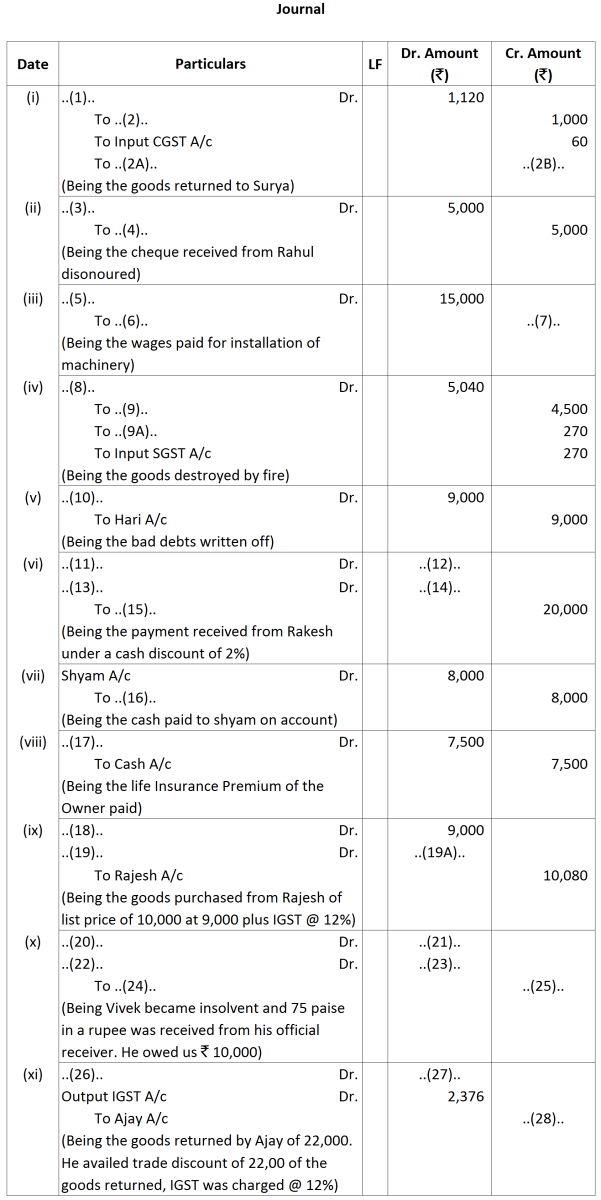
Fill in the missing values on the basis of narration:
Answer

Get the step-by-step solution for this question inside the Vidyadip app.

Get the answer in the app

Need a full question paper?

Generate a complete, print-ready paper with questions like this in minutes — across 16+ boards, with answer keys.

Start Generating Free

Similar questions

From the following particulars, prepare a Bank Reconciliation Statement of Alpha Electronic Motor. Private Ltd. as on 30th September, 2014:
  1. Overdraft on 30th September 2014 as per Pass Book ₹ 10,000.
  2. Cheque deposited in the bank but not recorded in Cash Book ₹ 100.
  3. Cheque received and recorded in the Cash Book but not sent to bank for collection ₹ 1,000.
  4. Several cheques were drawn in the last week of September, totalling ₹ 15,000; of these cheques totalling only ₹ 9,000 were cashed before 30th September.
  5. Similarly, several cheques, totaling ₹ 9,000 were sent for collection; of these cheques of the value of ₹ 1,500 were credited on 5th October and ₹ 2,000 on 7th October, balance being credited before 30th September.
  6. Fees of ₹ 250 was paid directly by the bank but was not recorded in the Cash Book.
  7. In the Cash Book, a bank charge of ₹ 30 was recorded twice while another bank charge of ₹ 50 was not recorded at all.
  8. Interest of ₹ 1,400 was charged by the bank but was not recorded in the Cash Book.
Rectify the following errors and ascertain the amount of difference in trial balance by preparing suspense account:
  1. Credit sales to Mohan ₹ 7,000 were posted as ₹ 9,000.
  2. Credit purchases from Rohan ₹ 9,000 were posted as ₹ 6,000.
  3. Goods returned to Rakesh ₹ 4,000 were posted as Rs. 5,000.
  4. Goods returned from Mahesh ₹ 1,000 were posted as ₹ 3,000.
  5. Cash sales ₹. 2,000 were posted as ₹ 200.
On 10th April, 2018, Ravi purchased from Mohan goods for ₹ 30,000 plus CGST and SGST @ 9% each. Ravi paid ₹ 15,400 in cash and accepted a bill for two months for the balance amount drawn on him by Mohan. Mohan endorsed the bill to Rakesh. The bill was dishonoured on the due date. Rakesh had to spend ₹ 100 as noting charges.
Immediately after the dishonour, Mohan accepted a new bill drawn by Rakesh, in which ₹ 200 for interest were also included. After 20 days of the dishonour of the bill, Ravi paid full amount of Mohan including ₹ 50 as interest. Show Journal entries in the books of Ravi, Mohan and Rakesh.
Viaml purchased goods ₹ 25,000 from Kamal on Jan 15, 2016 and accepted a bill of exchange drawn upon him by Kamal payable after two months. On the date of the maturity the bill was duly presented for payment. Vimal dishonoured the bill. record the necessary journal entries in the books of Kamal and Vimal when.
  • The bill was retained by Kamal till the date of its maturity.
  • The bill was immediately discounted by Kamal with his bank @ 6% p.a.
  • The bill was endorsed by Kamal in favour of his creditor Sharad.
  • Five days before its maturity the bill was sent by Kamal to his bank for collection.
Enter the following transactions in a Cash Book with Cash and Bank Columns:
2017
 
March 1
Cash in Hand ₹ 15,000; Bank ₹ 8,000
March 2
Sold goods to X on credit for ₹ 10,000
March 5
Sold goods for ₹ 20,000; received cheque from them, discount allowed $2\frac{1}{2}\%$
Cheque was deposited into bank on 7th March
March 10
Purchased goods from Suresh on the terms of 5% Cash discount if the payment is made within 3 days ₹ 20,000
March 12
Payment made to Suresh; half in Cash and half by cheque
March 14
Received a Bank Draft for ₹ 6,820 from Siya Ram in full settlement of ₹ 7,000 due from him. Sent the draft to the Bank
March 16
Settled Pawan's account of ₹ 5,000 at a discount of 5%
March 17
Goods worth ₹ 8,000 were purchased from Sunil on 5th March. Its payment was made today by cheque after deducting 5% cash discount
March 18
Withdrawn from Bank ₹ 20,000 and Furniture was purchased for ₹ 15,000; the balance taken by the proprietor
March 20
Received a cheque from Ravi for ₹ 2,850 in settlement after deducting 5%
Endorsed the cheque to Gopal on 22nd March
March 22
Placed an order with 'Jai Traders' for goods of the value of ₹ 10,000 and sent a cheque of ₹ 8,000 with the order
March 23
Purchased furniture by cheque of ₹ 6,000
March 24
Cash sales ₹ 15,000; half of which deposited into bank
March 25
X settled his account by payment of ₹ 10,150; ₹ 150 being the interest charged
March 27
Paid rent to Landlord 'Rakesh' by cheque ₹ 2,000
March 28
Cashed a cheque for ₹ 10,000 and paid salaries in cash ₹ 8,000
March 31
Deposited into bank, balance of cash in excess of ₹ 5,000
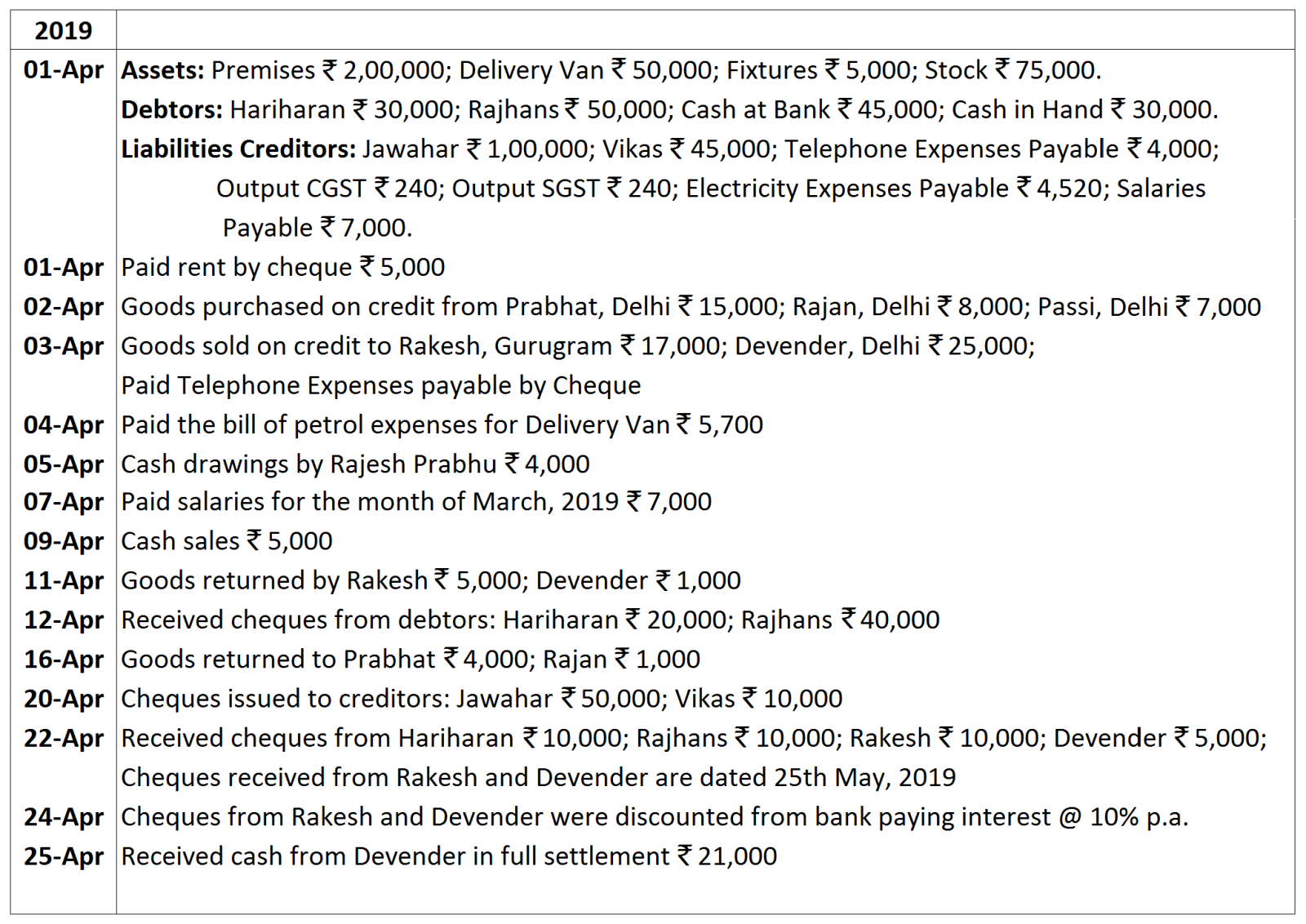
You are to open the books of Rajesh Prabhu, Gurugram (Haryana) a trader, through the Journal to record the assets and liabilities and then post the transactions to the Ledger for the month of April, 2019.
Inter-state transactions are subject to levy of IGST @ 12% and Intra-state transactions are subject to levy of CGST and SGST @ 6% each. GST is not levied on transactions marked with (*).
Rectify the following errors:
  1. Total of one page of the Sales Book was carried forward to the next page as ₹ 2,785 instead of ₹ 2,587.
  2. A cheque of ₹ 400 received from Mohan was dishonoured and had been posted to the debit side of the ‘Allowance Account’.
  3. Return of goods worth ₹ 5,000 by a customer was entered in the Purchases Return Book.
  4. Sum of ₹ 200 owed by ‘X’ has been included in the list of Sundry Creditors.
  5. Sale of old furniture worth ₹ 430 was credited to the Sales Account as ₹ 340.
On 1st April, 2015, A Ltd. purchased a machine for ₹ 2,40,000 and spent ₹ 10,000 on its erection. On 1st October, 2015 an additional machinery costing ₹ 1,00,000 was purchased. On 1st October, 2017, the machine purchased on 1st April, 2015 was sold for ₹ 1,43,000 and on the same date, a new machine was purchased at cost of ₹ 2,00,000.
Show the Machinery Account for the first four financial years after charging Depreciation at 5% p.a. by the Straight Line Method.
Explain basic factors affecting the amount of depreciation.
Define provision. What is the importance of creating a provision? (any three points of importance).