Question
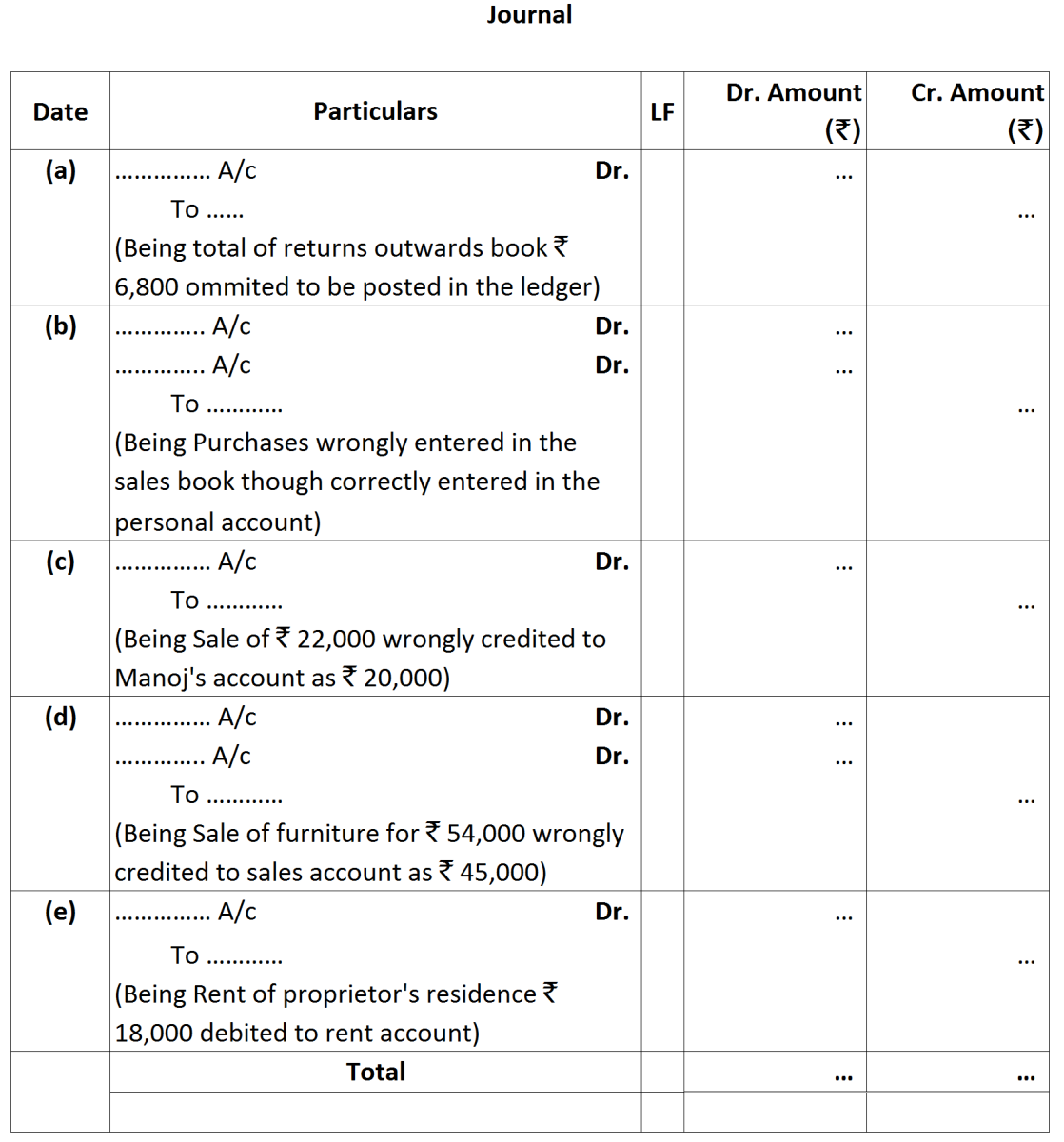
Fill up the missing information in the following rectifying entries:
Answer

Get the step-by-step solution for this question inside the Vidyadip app.

Get the answer in the app

Need a full question paper?

Generate a complete, print-ready paper with questions like this in minutes — across 16+ boards, with answer keys.

Start Generating Free

Similar questions

Enter the following transactions in the Journal of Manohar Lal & Sons:
2019
 
Jan. 6
Sold goods for cash
36,000
Jan. 8
Sold goods to Hari
30,000
Jan. 14
Received cash from Hari
18,000
Jan. 26 Received Commission
750
Jan. 27
Paid Salary to Gopal
1,200
Jan. 28
Received cash from Hari
12,000
Jan. 29
Withdrew cash from office for personal use
4,000
Jan. 30
Wages paid
7,200
Jan. 30 Bought Machinery for Cash 8,000
Asha sold goods worth ₹ 19,000 to Nisha on March 02, 2017. ₹ 4,000 were paid by Nisha immediately and for the balance she accepted a bill of exchange drawn upon her by Asha payable after three months. Asha discounted the bill immediately with her bank. On the due date Nisha dishonoured the bill and the bank paid ₹ 30 as noting charges. Record the necessary journal entries in the books of Asha and Nisha.
Explain the meaning of any three of the following terms:
Full Disclosure.
Enter the following transactions in a Two Column Cash Book:
Purchased goods for ₹ 1,00,000; IGST 18%; Payment made by Cheque
2016  
Dec. 1 Started business with cash 50,000
Dec. 2 Pays into Bank 29,000
Dec. 3 Received cheque from Raja & Co. 800
Discount allowed 20
Dec. 5 Withdrew cash from bank for private use 240
Dec. 12 Sold goods for ₹ 1,50,000; Trade Discount 20%; IGST 18%; Payment received by Cheque  
Dec. 14 Received cheque from Kamla 395
Discount allowed 15
Dec. 16 Kamla's cheque endorsed to Bala in full settlement of her account of ₹ 425  
Dec. 29 Paid rent by cheque 1,000
Dec. 30 Deposited into bank, balance of cash in excess of 450
Prepare a Cash Book with Cash and Bank columns from the following information for the month of December 2011 in the Books of O'Neil:
2016  
Dec. 1 Cash in Hand ₹ 2,780; Bank Overdraft ₹ 3,125
Dec. 2 Cheque worth ₹ 400 issued to the petty cashier
Dec. 5 ₹ 350 was paid to Hari & Sons for the supply of stationery on this day
Dec. 7 Received a cheque worth ₹ 600 from Pramod against sale of goods
Dec. 10 Received ₹ 1,200 for sale of goods
Dec. 11 The cheque which was received from Pramod on 7th December was endorsed as favour of Morgan together with ₹ 1,400 in cash
Dec. 15 Received ₹ 950 from Sheila
Dec. 23 Murarilal paid ₹ 2,000 in cash and ₹ 3,000 in cheque after receiving a discount of ₹ 200 for goods sold to him in November. The cheque was immediately deposited into the Bank
Dec. 26 Bought goods worth ₹ 1,700 from Rustom and paid by cheque after receiving a discount of ₹ 170
Dec. 30 Interest on overdraft ₹ 50 was charged by the Bank
Dec. 30 Cash in excess of ₹ 1,000 was deposited into the Bank
What do you mean by an asset and what are different types of assets?
Babu purchased on 1st April, 2017, a machine for ₹ 6,000. On 1st October, 2017, he also purchased another machine for ₹ 5,000. On 1st October, 2018, he sold the machine purchased on 1st April, 2017 for ₹ 4,000.
It was decided that Depreciation @ 10% p.a. was to be written off every year under Diminishing Balance Method.
Assuming the accounts were closed on 31st March every year, show the Machinery Account for the years ended 31st March, 2018 and 2019.
What is the objective behind preparing an Account? What is meant by recording on debit and credit sides of any Account? Explain with examples.
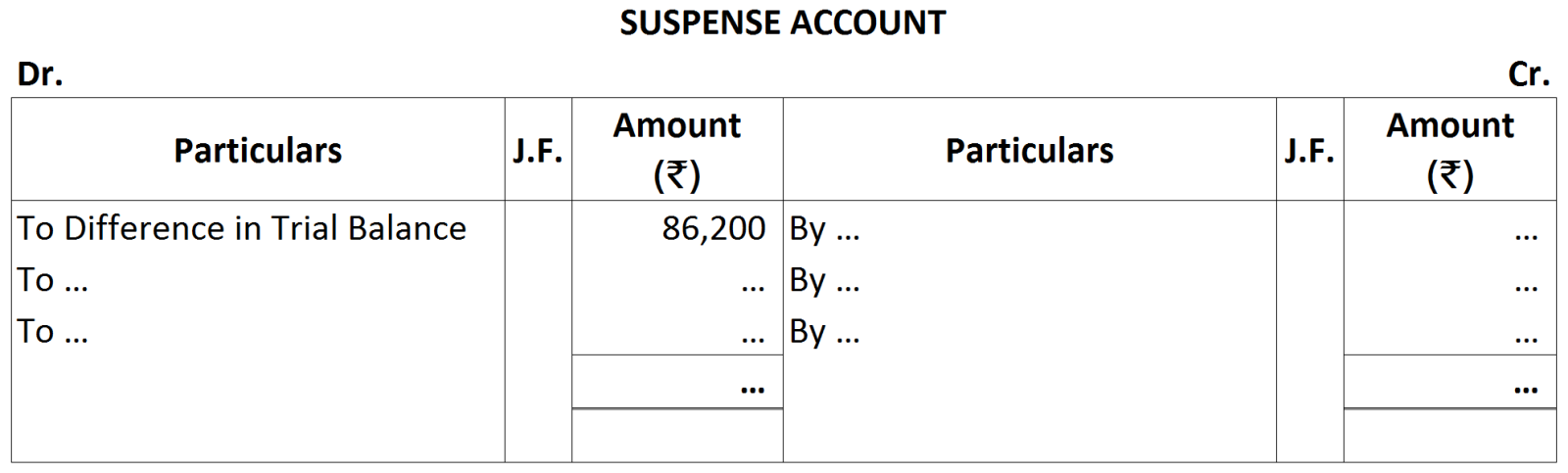
During the course of an accounting year, an Accountant found a difference in the tiral balance. He puts this difference in a newly opened suspense account. Subsequently, he located the following errors in his books of account:
  1. Goods purchased from Shiv for ₹ 10,000, but entered in sales book.
  2. Received a bill receivable for ₹ 18,000 from Ganesh, but recorded in bills payable book.
  3. An item of ₹ 4,000 in respect of purchases returns, wrongly debited to purchases account.
  4. An item of ₹ 2,000 relating to pre-paid salary account omitted to be brought forward.
  5. Paid ₹ 1,000 on account of repair of furniture, but wrongly debited to furniture account.
Pass journal entries to rectify the above mentioned errors and prepare suspense account assuming that no error remained undetected.
Bobby opened a consulting firm and completed these transactions during November, 2017:
  1. Invested ₹ 4,00,000 cash and office equipment with ₹ 1,50,000 in a business called Bobbie Consulting.
  2. Purchased land and a small office building. The land was worth ₹ 1,50,000 and the building worth ₹ 3,50,000. The purchase price was price was paid with ₹ 2,00,000 cash and a long term note payable for ₹ 3,00,000.
  3. Purchased office supplies on credit for ₹ 12,000.
  4. Bobbie transferred title of motor car to the business. The motor car was worth ₹ 90,000.
  5. Purchased for ₹ 30,000 additional office equipment on credit.
  6. Paid ₹ 75,00 salary to the office manager.
  7. Provided services to a client and collected ₹ 30,000
  8. Paid ₹ 4,000 for the month’s utilities.
  9. Paid supplier created in transaction c.
  10. Purchase new office equipment by paying ₹ 93,000 cash and trading in old equipment with a recorded cost of ₹ 7,000.
  11. Completed services of a client for ₹ 26,000. This amount is to be paid within 30 days.
  12. Received ₹ 19,000 payment from the client created in transaction k.
  13. Bobby withdrew ₹ 20,000 from the business.
Analyse the above stated transactions and open the following T-accounts: Cash, client, office supplies, motor car, building, land, long term payables, capital, withdrawals, salary, expense and utilities expense.