Questions · Page 1 of 3

6 Marks Question

🎯

Test yourself on this topic

50 questions · timed · auto-graded

Question 16 Marks
What kinds of errors would cause difference in the trial balance. Also list examples that would not be revealed by a trial balance?
Answer
The errors that lead to the differences in the Trial Balance are termed as one-sided errors. These are those errors that affect only one account. Below are given the errors that cause differences in the Trial Balance.
  • Wrong casting of any account, this is termed as the error of casting.
  • Wrong carrying forward of the balances from previous year’s books or from one end of page to another. These types of errors are termed as the errors in carrying forward.
  • If entries are posted in the wrong side of accounts.
  • Posting of a wrong amount in account, this is termed as the error of posting.
  • If entries are recorded partially, i.e., the entries are not recorded completely, then due to the error of partial omission, Trial Balance does not agree.
Here are a few examples that would not be revealed in a Trial Balance:
  • Sales to Mr. X, omitted to be recorded in the Sales Day Book.
  • Purchases made from Mukesh, recorded in Mahesh’s Account, who is an other creditor.
  • Wages paid for construction of building, recorded in the Wages Account.
View full question & answer
Question 26 Marks
Rectify the following errors assuming that a suspense account was opened. Ascertain the difference in trial balance.
  1. Credit sales to Mohan ₹ 7,000 were posted to the credit of his account.
  2. Credit purchases from Rohan ₹ 9,000 were posted to the debit of his account as ₹ 6,000.
  3. Goods returned to Rakesh ₹ 4,000 were posted to the credit of his account.
  4. Goods returned from Mahesh ₹ 1,000 were posted to the debit of his account as ₹ 2,000.
  5. Cash sales ₹ 2,000 were posted to the debit of sales account as ₹ 5,000.
View full question & answer
Question 36 Marks
Rectify the following errors:
  1. Credit Sales to Mohan ₹ 7,000 were recorded in purchases book.
  2. Credit Purchases from Rohan ₹ 9,00 were recorded in sales book.
  3. Goods returned to Rakesh ₹ 4,000 were recorded in the sales return book.
  4. Goods returned from Mahesh ₹ 1,000 were recorded in purchases return book.
  5. Goods returned from Nahesh ₹ 2,000 were recorded in purchases book.
View full question & answer
Question 46 Marks
What is Trial Balance? Does the balancing of this ensure accuracy of books of accounts.
Answer
Trial Balance: It is a statement prepared with the help of ledger balances at the end of financial year to test the arithmetical accuracy of books of accounts.
Balancing of Trial Balance does not ensure the accuracy of books of Accounts..
Errors which remain undetected even if trial balance agrees:
  1. Errors of omission: If a transaction remains unrecorded in Journal or subsidiary books.
  2. Errors of comission: When wrong amount is entered either in journa! or subsidiary books.
  3. Compensating Errors: If the effect of one error is neutralised by the effect of some other error.
  4. Errors of principle: When fundamental principle of accountancy is violated while recording a transaction.
View full question & answer
Question 56 Marks
Pass the Journal entries rectifying the following errors:
  1. Purchases of ₹ 10,000 was omitted to be recorded.
  2. Purchases of office furniture of ₹ 10,000 was recorded in Purchases Book.
  3. Office Rent of ₹ 15,000 was debited to the Personal Account of the landlord.
  4. Old machine sold for ₹ 5,000 was credited to Sales Account.
  5. Bill for ₹ 800 received from Mukesh for repair of machinery was entered in the Purchases Book as ₹ 700.
Answer
Coming Soon
View full question & answer
Question 66 Marks
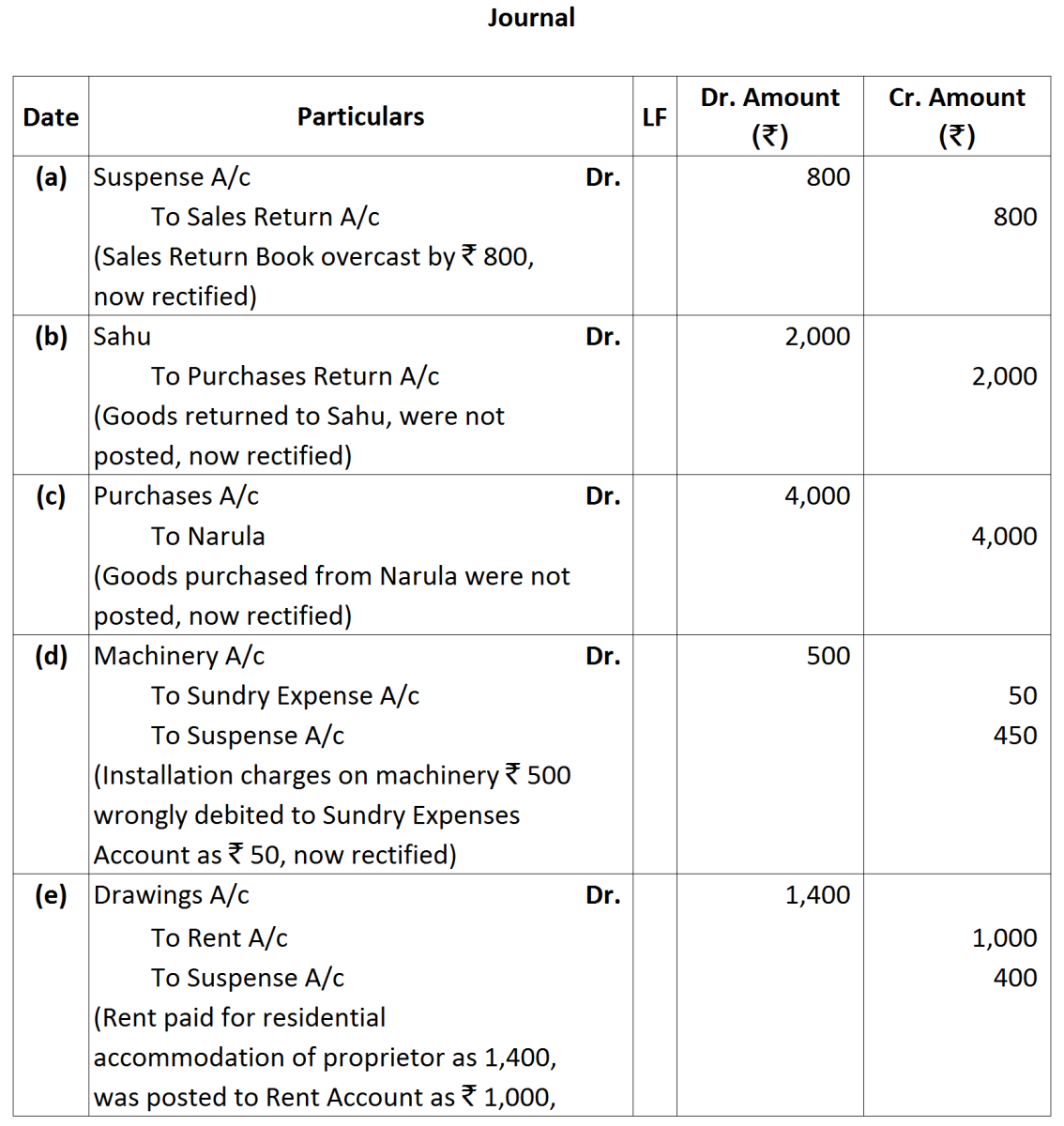
Trial balance of Madan did not agree and he put the difference to suspense account. He discovered the following errors:
  1. Sales return book overcast by ₹ 800.
  2. Purchases return to Sahu ₹ 2,000 were not posted.
  3. Goods purchased on credit from Narula ₹ 4,000 though taken into stock, but no entry was passed in the books.
  4. Installation charges on new machinery purchased ₹ 500 were debited to sundry expenses account as ₹ 50.
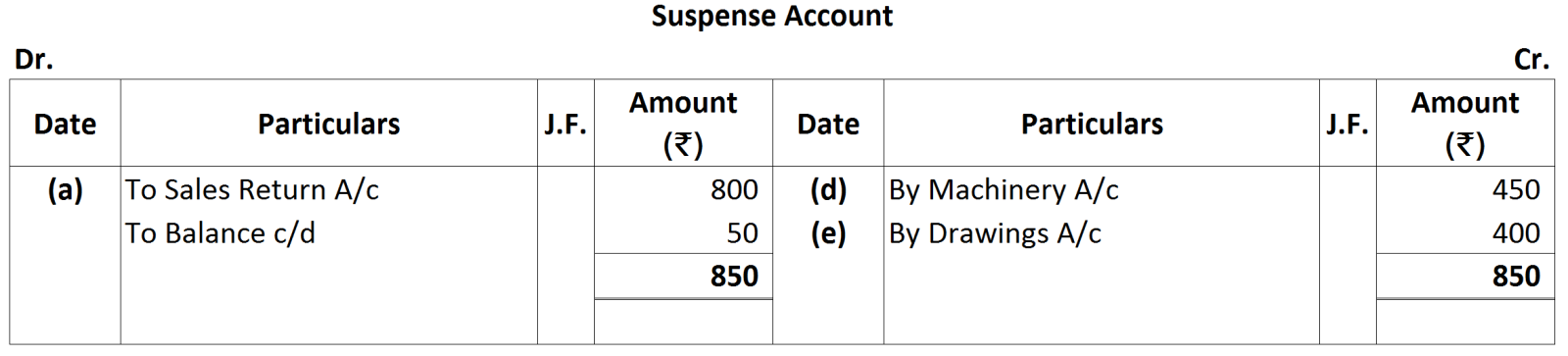
  5. Rent paid for residential accommodation of madam (the proprietor) ₹ 1,400 was debited to Rent account as ₹ 1,000. Rectify the errors and prepare suspense account to ascertain the difference in trial balance.
Answer


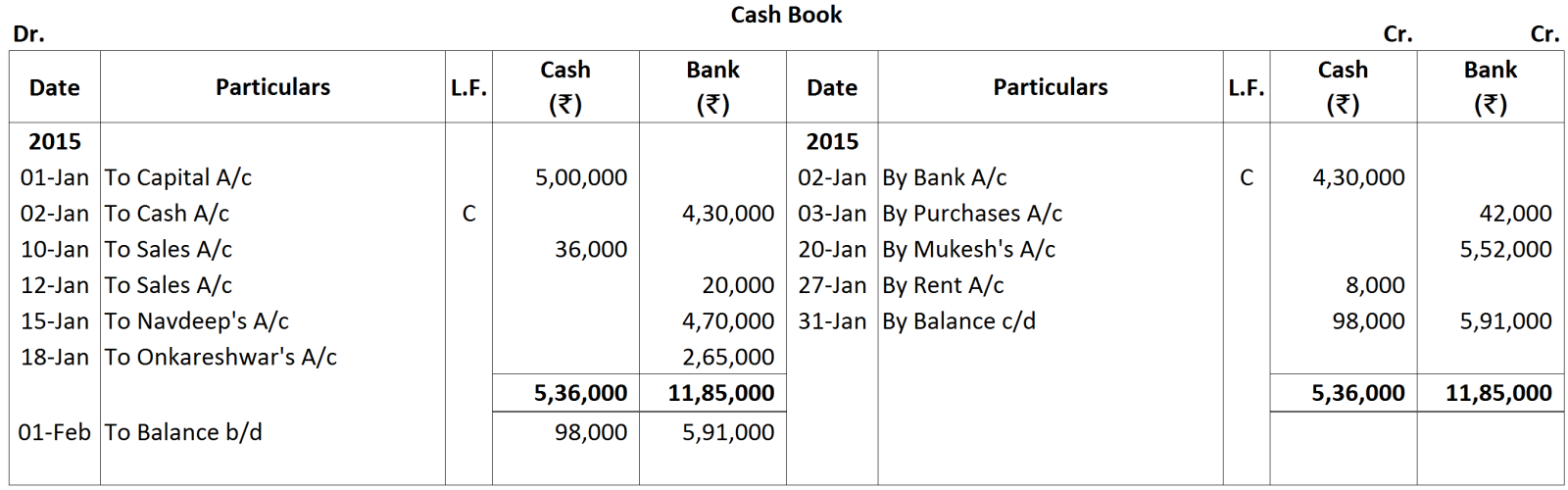
Note: As per the solution Suspense Account shows a credit balance of ₹ 50. However, as per the answer given in the book, it is a credit balance of ₹ 2050. In order to match answer with the book item (b) is taken as, ‘Purchases return to Sahu ₹ 2,000 were not posted to Sahu’s Account.’ Thus, the rectifying entry for this error will be as:
Sahu’s A/c
Dr.
2,000
To Suspense A/c
 
2,000
View full question & answer
Question 76 Marks
Pass journal entries to rectify the following errors. The trial balance had ₹ 1,260 excess credit. The difference has been posted to a suspense account:
  1. The total of returns inwards book has been cast ₹ 2,000 short.
  2. The purchase of an office table costing ₹ 6,000 has been passed through the purchases day book.
  3. A sum of ₹ 7,500 paid to workman for wages for making showcases has been charged to wages account.
  4. A purchase of ₹ 1,340 has been posted to the creditor's account as ₹ 600.
  5. A cheque of ₹ 4,000 received from Y has been dishonoured; it has been posted to the debit of allowances account.
After passing journal entries, prepare the suspense account.
View full question & answer
Question 86 Marks
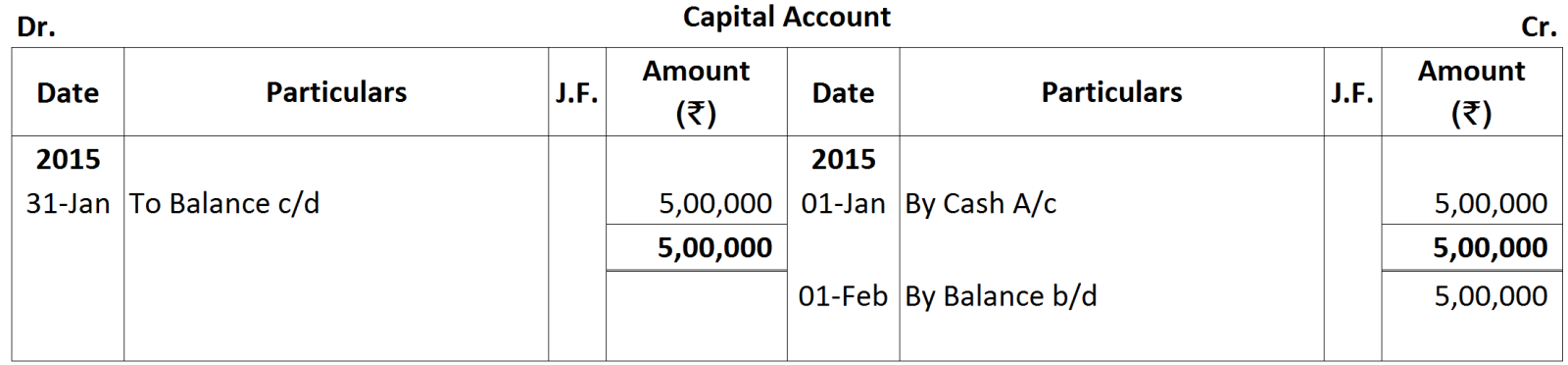
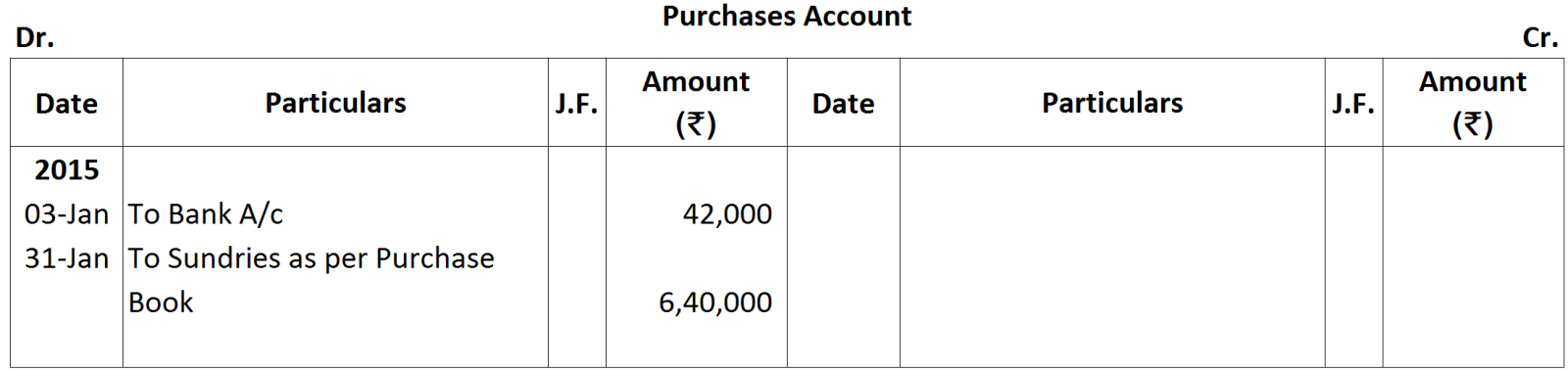
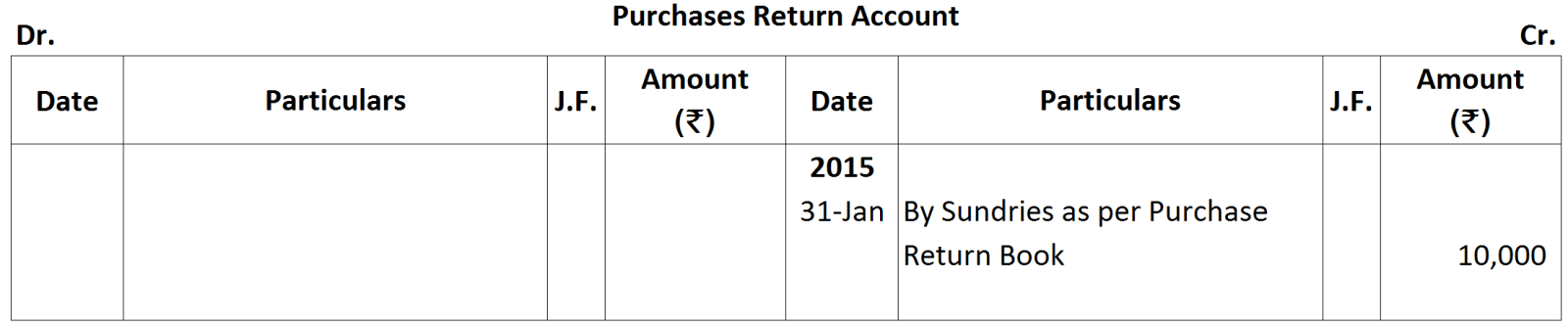
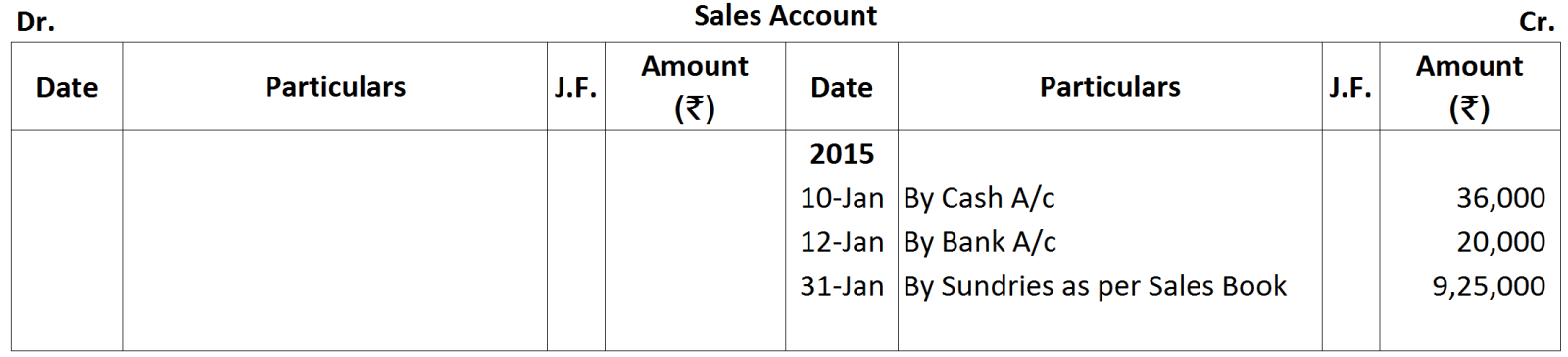
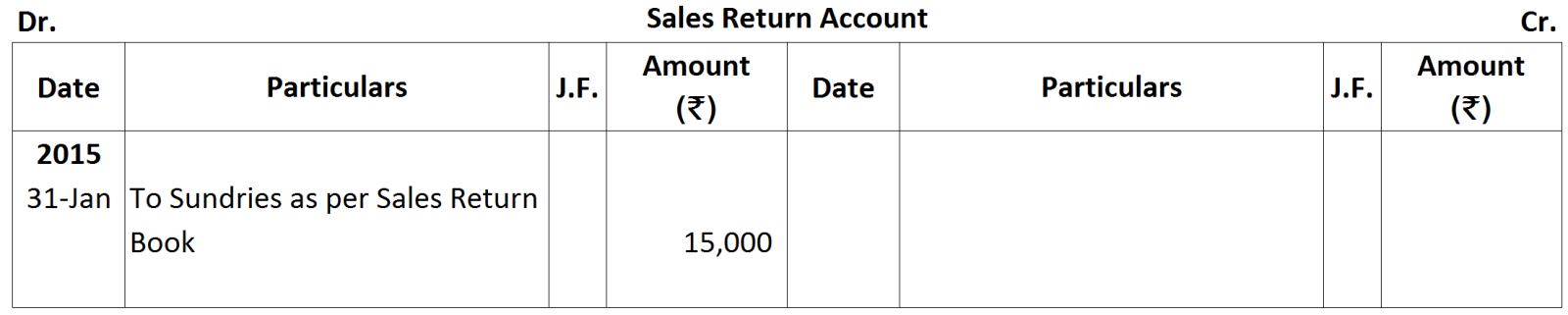
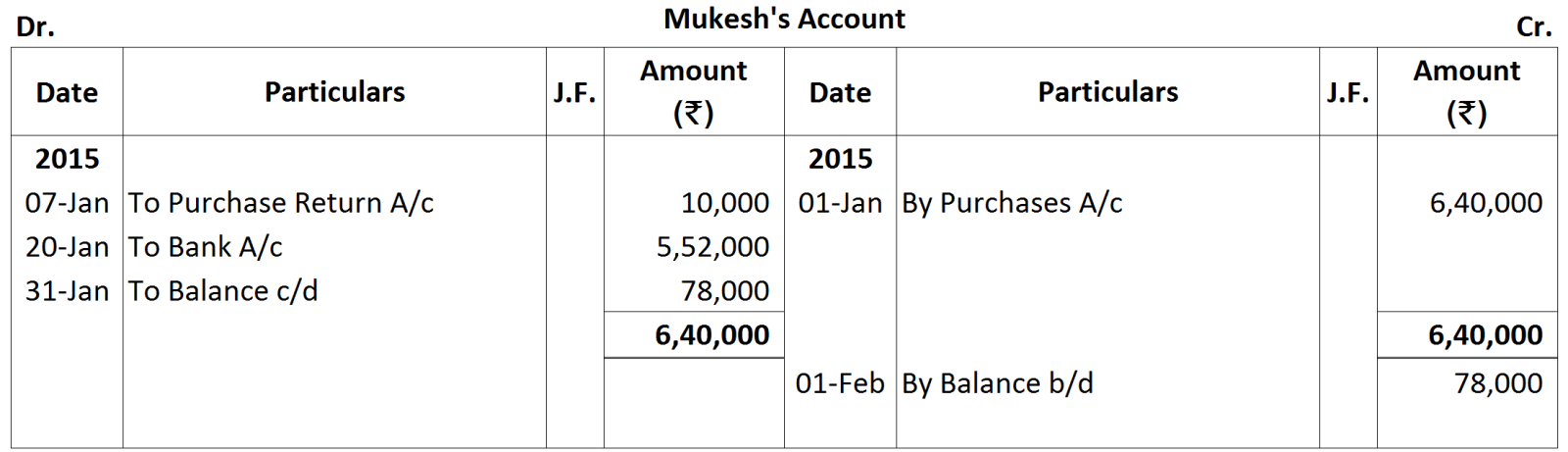
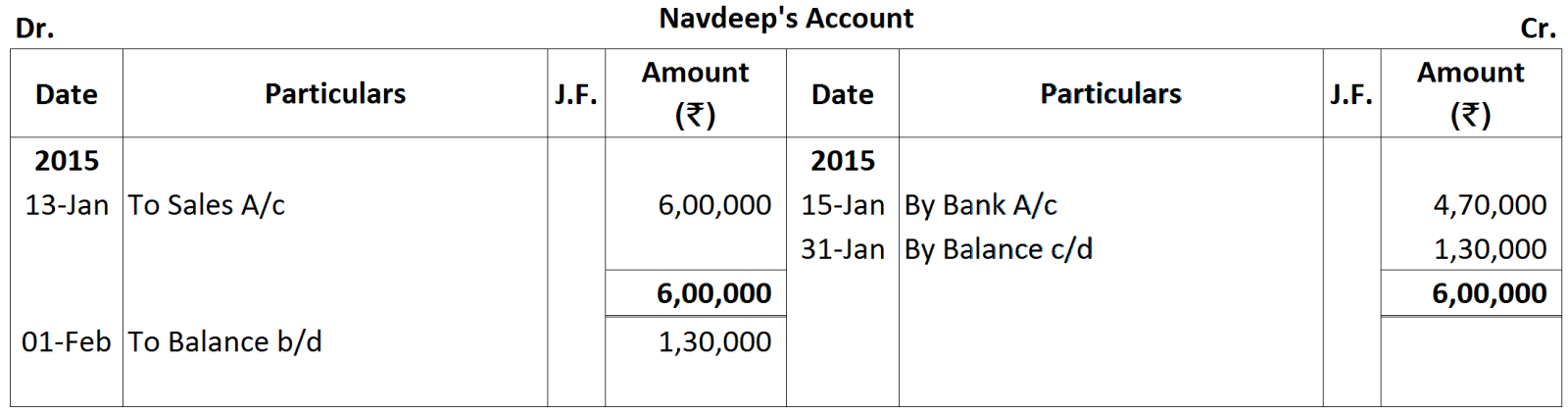
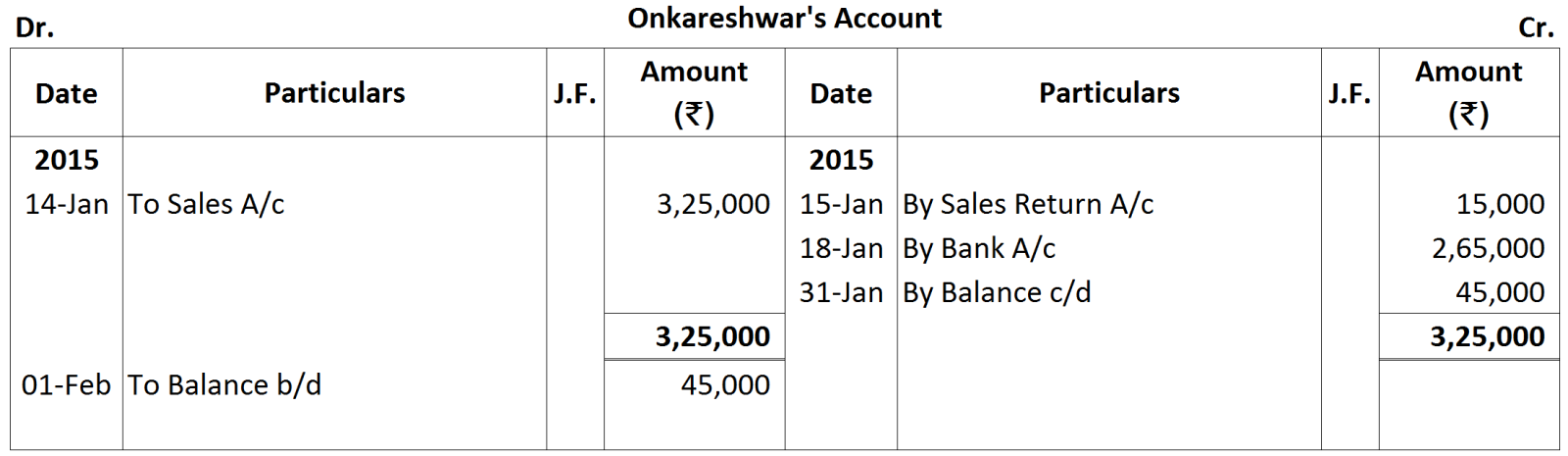
Given below is a Cash Book and Ledger extracts relating to the books of M/s Ram Chander & Sons as at 31st January 2015. You are required to prepare a Trial Balance.


View full question & answer
Question 96 Marks
Give rectifying journal entries for the following errors:
  1. Sale of goods to Madan ₹ 6,000 were entered in the sales book as ₹ 600.
  2. A credit purchase of ₹ 1,500 from Ajay has been wrongly passed through the sales book.
  3. Repairs to building ₹ 300 were debited to building account.
  4. ₹ 2,050 paid to Rohit is posted to the debit of Mohit's account as ₹ 5,020.
  5. Purchase return book is overcast by ₹ 400.
View full question & answer
Question 106 Marks
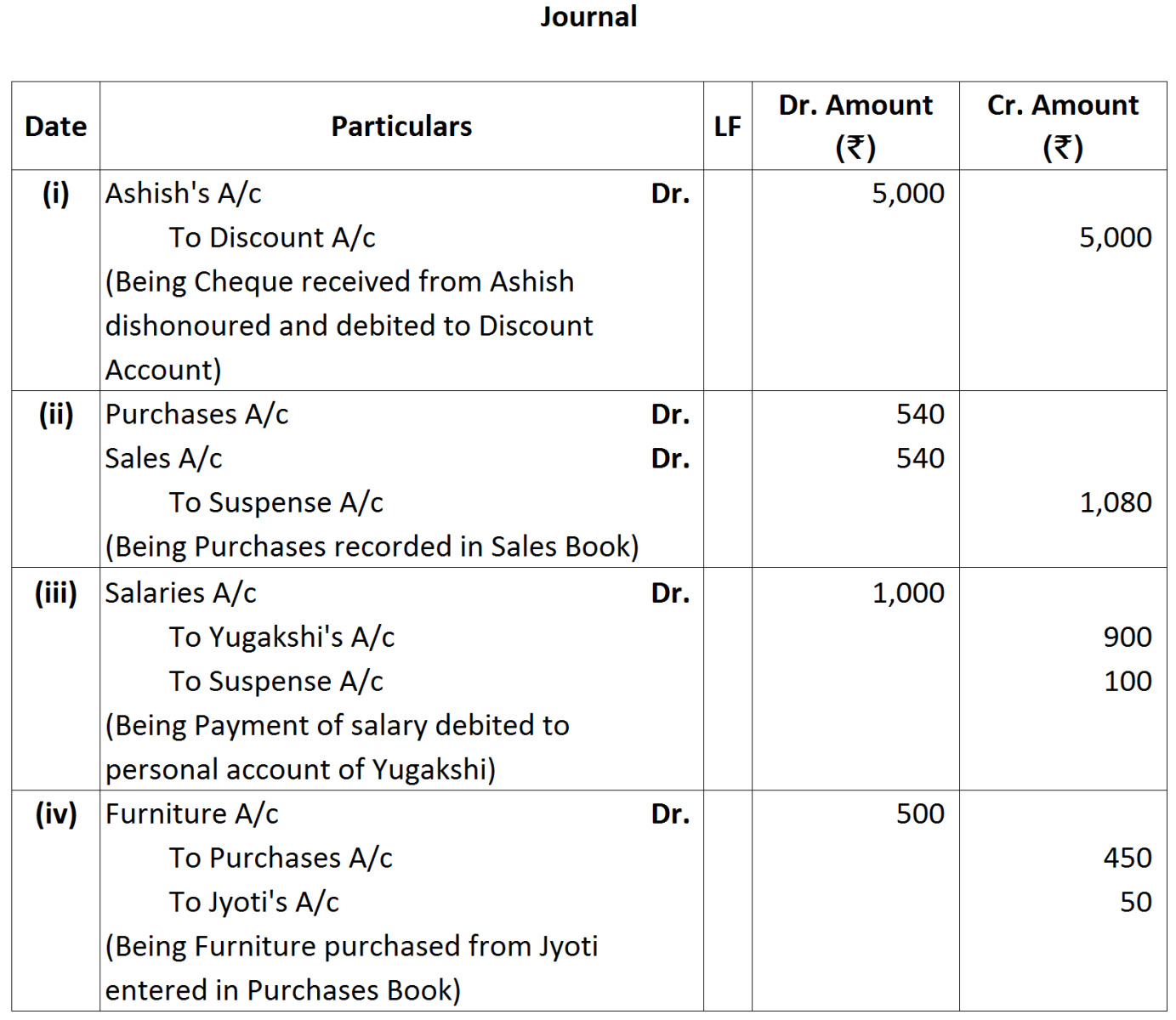
Rectify the following errors by means of Journal entries:
  1. A cheque of ₹ 5,000 received from Ashish was dishonoured and was debited to Discount Account.
  2. Purchase of ₹ 540 from Ramneek was written in Sales day book, but was correctly posted to correct side of Ramneek’s Account.
  3. Salary paid to Miss Yugakshi ₹ 1,000 was debited to her personal account as ₹ 900.
  4. Furniture costing ₹ 500, purchased from Jyoti, was wrongly entered in Purchase book as ₹ 450.
Answer
Solution is as follows.
View full question & answer
Question 116 Marks
The books of Ramesh did not agree. The difference of ₹ 12,700 in trial balance was placed to the debit of suspense account. Subsequently, the following errors were located. Pass journal entries to rectify the errors and prepare the suspense account:
  1. The total of the purchases returns book, ₹ 2,100 has not been posted.
  2. A sale of ₹ 4,300 to Ram has been credited to his account as ₹ 3,400.
  3. A purchase from Suresh for ₹ 4,000 has been entered in the sales book. However, Suresh has been correctly credited with ₹ 4,000.
  4. Old furniture sold on credit for ₹ 5,400 has been recorded in the sales account as ₹ 4,500.
  5. Goods taken away by Ramesh, the proprietor for his personal use worth ₹ 750 has not been recorded in the books of accounts at all.
View full question & answer
Question 126 Marks
During the course of an accounting year, an Accountant found a difference in the tiral balance. He puts this difference in a newly opened suspense account. Subsequently, he located the following errors in his books of account:
  1. Goods purchased from Shiv for ₹ 10,000, but entered in sales book.
  2. Received a bill receivable for ₹ 18,000 from Ganesh, but recorded in bills payable book.
  3. An item of ₹ 4,000 in respect of purchases returns, wrongly debited to purchases account.
  4. An item of ₹ 2,000 relating to pre-paid salary account omitted to be brought forward.
  5. Paid ₹ 1,000 on account of repair of furniture, but wrongly debited to furniture account.
Pass journal entries to rectify the above mentioned errors and prepare suspense account assuming that no error remained undetected.
View full question & answer
Question 136 Marks
Give rectifying Journal entries for the following errors:
  1. Sales of goods to Madan ₹ 6,000 were entered in the Sales Book as ₹ 600.
  2. Credit purchase of ₹ 1,500 from Ajay has been wrongly passed through the Sales Book.
  3. Repairs to building ₹ 300 were debited to Building Account.
  4. ₹ 2,050 paid to Rohit is posted to the debit of Mohit’s Account as ₹ 5,020.
  5. Purchases Return Book is overcasted by ₹ 400.
View full question & answer
Question 146 Marks
Rectify the following errors assuming that a suspense account was opened. Ascertain the difference in trial balance.
  1. Credit sales to Mohan ₹ 7,000 were posted to Karan as ₹ 5,000.
  2. Credit purchases from Rohan ₹ 9,000 were posted to the debit of Gobind as ₹ 10,000.
  3. Goods returned to Rakesh ₹ 4,000 were posted to the credit of Naresh as ₹ 3,000.
  4. Goods returned from Mahesh ₹ 1,000 were posted to the debit of Manish as ₹ 2,000.
  5. Cash sales ₹ 2,000 were posted to commission account as ₹ 200.
View full question & answer
Question 156 Marks
What are the different classes of errors? Which of them do not affect a Trial Balance?
Answer
Keeping in view their nature, errors can be classified into following four categories:
  1. Errors of Omission.
  2. Errors of Commission.
  3. Errors of Principle.
  4. Compensating Errors.
Errors not affecting the Trial Balance or Two-sided Errors are those errors which do not affect the agreement of Trial Balance. Such errors are not disclosed by the Trial Balance. Following are the examples of such errors:
  1. Errors of Principle, i.e., errors which arise due to incorrect application of principles of accounting. Suppose on purchase of a typewriter or printer, Office Expenses Account is debited, Trial Balance will still match.
  2. Compensating Errors: If the effect of one error is cancelled by the effect of some other error or errors, Trial Balance will still match. Suppose, an amount of ₹ 10 received from A is not credited to his account and the total of the Sales Book is ₹ 10 in excess, the omission of credit to A's Account will be made up by the increased credit to the Sales Account; the Trial Balance will still match.
  3. Errors of complete omission.
  4. Posting correct amount on the correct side but in wrong account.
  5. Recording wrong amount in the books of original entry (but the recorded amount is correctly debited and credited).
  6. Recording both aspects of a transaction twice in the books of account.
View full question & answer
Question 166 Marks
Rectify the following errors and ascertain the amount of difference in trial balance by preparing suspense account:
  1. Credit sales to Mohan ₹ 7,000 were posted as ₹ 9,000.
  2. Credit purchases from Rohan ₹ 9,000 were posted as ₹ 6,000.
  3. Goods returned to Rakesh ₹ 4,000 were posted as Rs. 5,000.
  4. Goods returned from Mahesh ₹ 1,000 were posted as ₹ 3,000.
  5. Cash sales ₹. 2,000 were posted as ₹ 200.
View full question & answer
Question 176 Marks
What is a suspense account? Is it necessary that is suspense account will balance off after rectification of the errors detected by the accountant? If not, then what happens to the balance still remaining in suspense account?
Answer
When Trial Balance does not agree, i.e., when the total of the debit column does not match that of the credit column, then the difference of the Trial Balance is transferred to a temporary account in order to avoid delay in preparation of the financial statements. This temporary account is termed as Suspense Account. If the debit column falls short of the credit column, then the Suspense Account is debited and if the credit column falls short of the debit column then the Suspense Account is credited.
If all the errors are detected and rectified, then the Suspense Account automatically gets closed (i.e. becomes zero). However, if still there exists any difference, then it should be transferred to the Balance Sheet. If the Suspense Account shows a debit balance, then it is shown in the Assets side and if the Suspense Account shows a credit balance, then it is shown in the Liabilities side of the Balance Sheet.
View full question & answer
Question 186 Marks
Rectify the following errors:
  1. Wages paid for the construction of office debited to the Wages Account, ₹ 5,000.
  2. Machinery purchased for ₹ 35,000 was passed through the Purchases Book.
  3. Old furniture sold for ₹ 1,000, passed through the Sales Book.
  4. ₹ 2,000 paid to Mehta Bros. against acceptance were debited to Malhotra Bros. Account.
  5. Sales of ₹ 204 to Ram debited to his account as ₹ 402 and purchases of ₹ 1,012 from Shyam credited to his account as ₹ 1,210.
View full question & answer
Question 196 Marks
Correct the following errors in Hari’s Books:
  1. Credit sale of ₹ 132 to R. Krishan correctly entered in Sales Journal but posted to his account as ₹ 312.
  2. The total of the credit side of Ramesh’s Account was overcasted by ₹ 2,000.
  3. Total of the Purchases Journal of ₹ 5,250 has been posted to Purchases Account as ₹ 5,205.
  4. Printer purchased from R. Ltd. for ₹ 4,000 on credit was entered in the Purchases Book.
  5. An item of ₹ 2,000 entered in the Sales Return Book was posted to the debit of Pandey who had returned the goods.
View full question & answer
Question 206 Marks
  1. What are the different causes that make a Trial Balance incorrect?
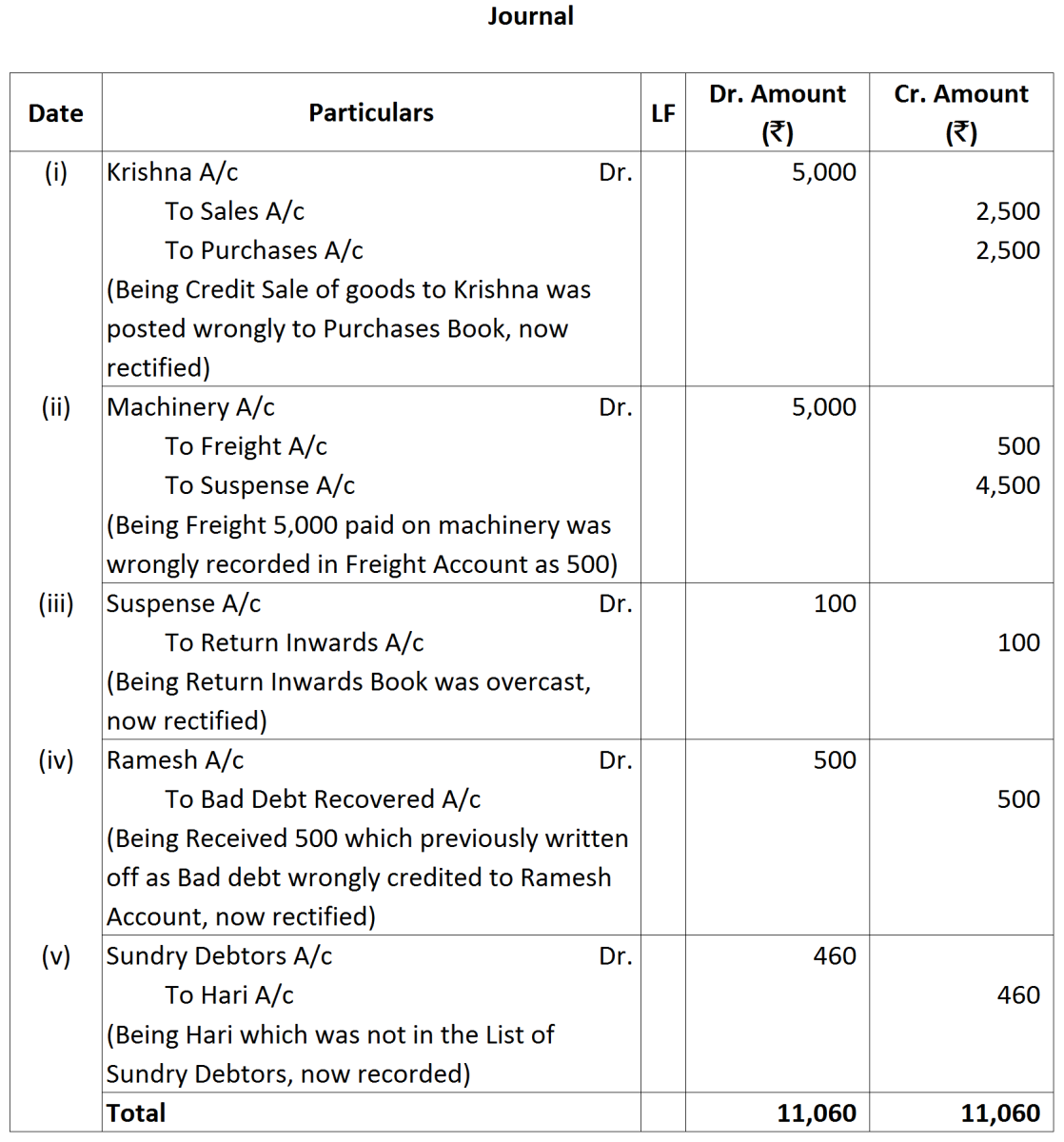
  2. Pass the rectifying Journal entries:
  1. A credit sale of goods for ₹ 2,500 to Krishna has been wrongly passed through the Purchases Book.
  2. ₹ 5,000 paid for freight on machinery purchased was debited to the Freight Account as ₹ 500.
  3. The Returns Inward Book has been wrongly overcasted by ₹ 100.
  4. An amount of ₹ 500 due from Ramesh which had been written off as bad debt in previous year was recovered and had been posted to the Personal Account of Ramesh.
  5. A sum of ₹ 460 owed by Hari had not been included in the list of debtors.
Answer
  1. The following are the causes that make a Trial Balance incorrect.
  1. Incomplete posting of Journal Entry.
  2. Posting in the wrong side of Account.
  3. Wrong totalling of Subsidiary Books.
  4. Wrong balance of Account.
  5. Omission of total of Subsidiary book into Account.
  6. Wrong totalling of the Trial Balance.
  1.  
View full question & answer
Question 216 Marks
Correct the following errors in Mohan Lal’s Book:
  1. A payment of ₹ 5,000 for salaries (to Mr. Ram) has been posted twice to the Salaries Account.
  2. ₹ 750 received from Rajesh are entered on the debit side of the Cash Book. No posting was done in Rajesh’s Account.
  3. Sales Book was overcasted by ₹ 3,000.
  4. Goods (Cost ₹ 2,000, Sales Price ₹ 2,500) distributed as samples among prospective customers were not recorded anywhere.
  5. A sum of ₹ 1,500 written off as depreciation on furniture was not debited to Depreciation Account.
Answer
Coming Soon
View full question & answer
Question 226 Marks
Define Trial Balance. Give any four functions of Trial Balance. What are the two methods of preparation of Trial Balance?
Answer
''A Trial Balance is a statement, prepared with the debit and credit balances of the Ledger Accounts to test the arithmetical accuracy of the books.'' -J.R. Batliboi ''A Trial Balance is the list of debit and credit balances, taken out from the Ledger. It also includes the balances of cash and bank taken from the Cash Book.'' -CarterObjectives or Functions of Trial Balance:
  1. To Ascertain the Arithmetical Correctness of Ledger Accounts: The Trial Balance enables one to establish whether posting and other accounting processes have been carried out without committing arithmetical errors.
  2. To Help Prepare the Final Accounts: Financial Statements are prepared from the Trial Balance. Preparation of Financial Statements, therefore, is the second objective of preparing a Trial Balance.
  3. Summary of Each Account: The Trial Balance is a summary of each Ledger Account. The ledger account may have to be referred only when more detail is required in respect of an account.
  4. To Help in Locating Errors: The Trial Balance helps in locating errors in maintaining Book of Account. It should, however, be kept in mind that it does not disclose, i.e., show all the errors in Book Keeping except the arithmetical inaccuracies.
Two methods of preparation of Trial Balance:
  1. Totals Method.
  2. Balances Method.
View full question & answer
Question 236 Marks
Explain errors of principle and give two examples with measures to rectify them.
Answer
The important purposes for the preparation of Trial Balance are explained with the help of the following points.
  1. Ascertaining the arithmetical accuracy: When the total of all debit balance accounts are equal to all credit balance accounts, it is assumed that at least posting from journal to the respective accounts is arithmetically correct.
  2. Summarising the ledger accounts: Trial Balance acts as a consolidated statement, providing a comprehensive list of all the accounts. Thus, a Trial Balance provides a summarised version of each account.
  3. Preparing final accounts: As the Trial Balance provides a summarised version of each account, so different accounts can be directly transferred to Trading, Profit and Loss Account, and Balance Sheet without referring to different ledgers.
  4. Locating and rectifying errors: If the Trial Balance does not agree, it indicates the occurrence of arithmetical error, which can be easily located. However, Trial Balance only helps in locate and rectify arithmetical error and not other types of errors.
View full question & answer
Question 246 Marks
Rectify the following errors:-
  1. A sale of goods to Raja Ram for ₹ 2,500 was passed through the Purchases Book.
  2. Salary of ₹ 800 paid to Hari Babu was wrongly debited to his personal account.
  3. Furniture purchased on credit from Mohan Singh for ₹ 1,000 was entered in the Purchases Book.
  4. ₹ 5,000 spent on the extension of buildings was debited to Buildings Repairs Account.
  5. Goods returned by Mani Ram ₹ 1,200 were entered in the Returns Outwards Book.
View full question & answer
Question 256 Marks
Rectify the following errors:
  1. Total of one page of the Sales Book was carried forward to the next page as ₹ 2,785 instead of ₹ 2,587.
  2. A cheque of ₹ 400 received from Mohan was dishonoured and had been posted to the debit side of the ‘Allowance Account’.
  3. Return of goods worth ₹ 5,000 by a customer was entered in the Purchases Return Book.
  4. Sum of ₹ 200 owed by ‘X’ has been included in the list of Sundry Creditors.
  5. Sale of old furniture worth ₹ 430 was credited to the Sales Account as ₹ 340.
View full question & answer
Question 266 Marks
What is a suspense account? When is it opened?
Answer
Suspense Account: Sometimes, in spite of best efforts of an accountant, all the errors are not located and the Trial Balance does not tally. In such a situation, to avoid the delay in the preparation of final accounts, the difference in the Trial Balance is placed to a newly opened account known as “Suspense Account”' and the Trial Balance tallies. If the debit side of the Trial Balance exceeds the credit side, the difference will be put on the credit side of the suspense account and if the credit side of the Trial Balance exceeds the debit side, suspense account will be debited. After including the balance of suspense account in the Trial Balance, it will appear to be tallied.
View full question & answer
Question 276 Marks
What are the different types of errors that are usually committed in recording business transaction.
Answer
According to the nature of errors committed, errors are classified into the following four categories:
  1. Errors of Commission: The errors that are committed because of wrong posting of transactions, wrong balancing of accounts, wrong casting of subsidiary books, wrong totaling or wrong recording of amount in the books are all error of commission. These errors affect the agreement of the trial balance.
  2. Errors of Omission: These errors are of two types and are committed when a transactions is partially or completely omitted to be recorded in the books.
  1. Error of complete omission: When a transaction is completely omitted to be recorded in the books of accounts or to be posted in the respective ledgers, it is an error of complete omission. Such errors do not affect the agreement of the trial balance.
  2. Error of partial omission: When a transaction is partially omitted while recording in the books or amounts or partially omitted from posting in the ledger, it is an error of partial omission. Such errors affect the agreement of the trial balance.
  1. Errors of Principle: Accounting transactions are to be recorded following certain principles. If any of the principle of accounting entries are violated or ignored and the error occurring due to such violation is called error of principle.
  2. Compensating errors: When two or more errors are committed in such a way that the net effect of these errors on the debits and credits of accounts is nil, such errors are called compensating errors.
View full question & answer
Question 286 Marks
Following is the Trial Balance as at 31st March, 2015: Having prepared the Trial Balance, it was discovered that following transactions remained unrecorded:

  1. Goods were sold on credit amounting to ₹ 40,000.
  2. Paid to creditors ₹ 22,000 by cheque.
  3. Goods worth ₹ 7,000 were returned to a supplier.
  4. Paid salary ₹ 15,000 by cheque.
Required:
  1. Pass Journal entries for the above mentioned transactions and post them into Ledger.
  2. Redraft the Trial Balance.
View full question & answer
Question 296 Marks
Explain the errors of commission and give two examples with measures to rectify them.
Answer
Errors of commission refer to those errors that are committed when transactions are recorded with wrong amounts, wrong balancing is done, wrong posting and/or wrong carrying forwarded is done. The following examples will illustrate the process of understanding and rectification of such errors.
  1. Let us consider the first example. Sales made to Mr. X of ₹ 10,000 recorded as 1,000 from invoice.
In this case, Mr. X’s account has been debited with ₹ 1,000 instead of ₹ 10,000; hence, the error of commission is committed. This requires a further debit of ₹ 9,000, in order to rectify this error of commission. This will be rectified by passing the following entry:


(Goods sold to Mr X of ₹ 10,000 was wrongly posted as ₹ 1,000,now rectified)
  1. Purchase book was undercast by ₹ 10,000.
This error can be rectified in any of the following two stages:
  1. If an error is located before preparing trial balance, then ₹ 10,000 should be recorded in the debit side of Purchases Account.
  2. If an error is located after preparing Trial Balance, then the following entry need to be recorded.
​​​​​​​
View full question & answer
Question 306 Marks
Rectify the following errors which were detected before preparing the Trial Balance:
  1. Purchase book has been overcast by ₹ 1,000.
  2. Purchase from Ram ₹ 20,000 has been omitted to be posted to his account.
  3. Purchase from Shyam ₹ 15,000 has been posted to the debit side of his account.
  4. Purchase from Ghanshyam ₹ 10,000 has been posted to his account as ₹ 1,000.
  5. Purchase from Sita Ram ₹ 5,000 has been posted to his account as ₹ 50,000.
Answer
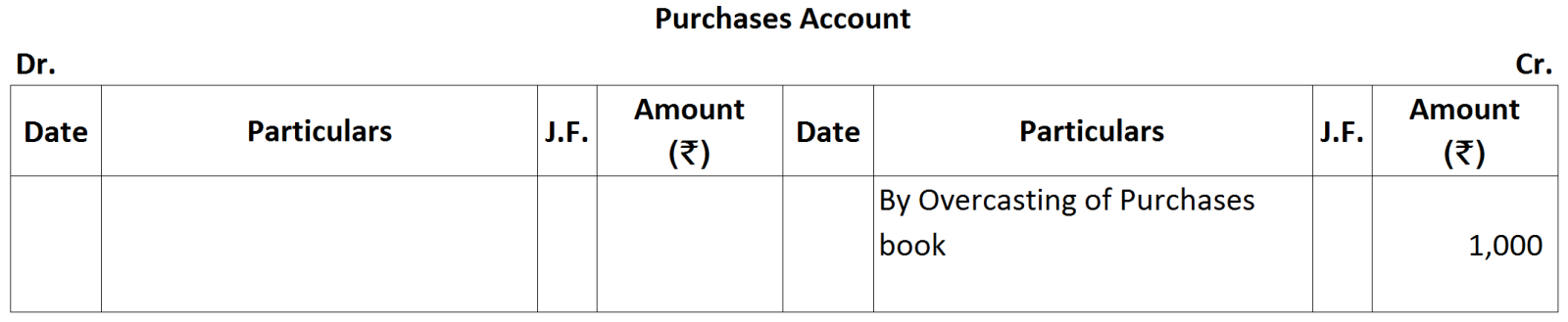
  1. Purchases Book has been overcasted by ₹ 1,000. Since it is an error of casting that means individual creditors accounts have been posted correctly and only the total of purchases book has been posted incorrectly to the debit side of Purchases Account. Thus, Purchases Account will be rectified by recording ₹ 1,000 on the credit side of Purchases Account.
  1. Purchases from Ram ₹ 20,000 has been omitted to be posted to his account. This mistake is happened only in Ram’s Account which means that the total of Purchases Book is correct. Thus, in order to rectify this error ₹ 20,000 should be posted on the credit side of Ram’s Account.
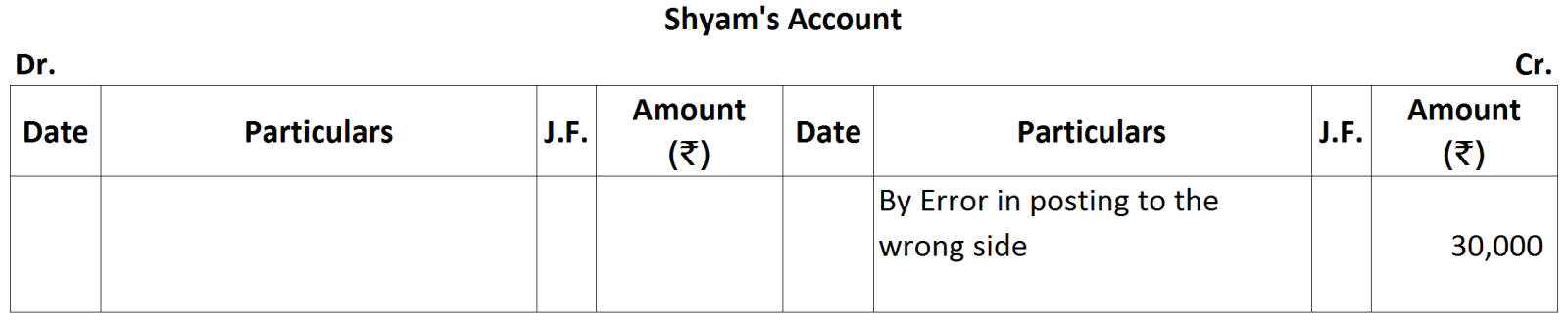
  1. Purchase from Shyam ₹ 15,000 has been posted to the debit side of his account. It implies that there is no mistake in Purchases account, however, Shyam’s account has been wrongly debited with ₹ 15,000 instead of crediting. Thus, rectification will be done by posting the double amount (₹ 30,000) on the credit side of Shyam’s Account.
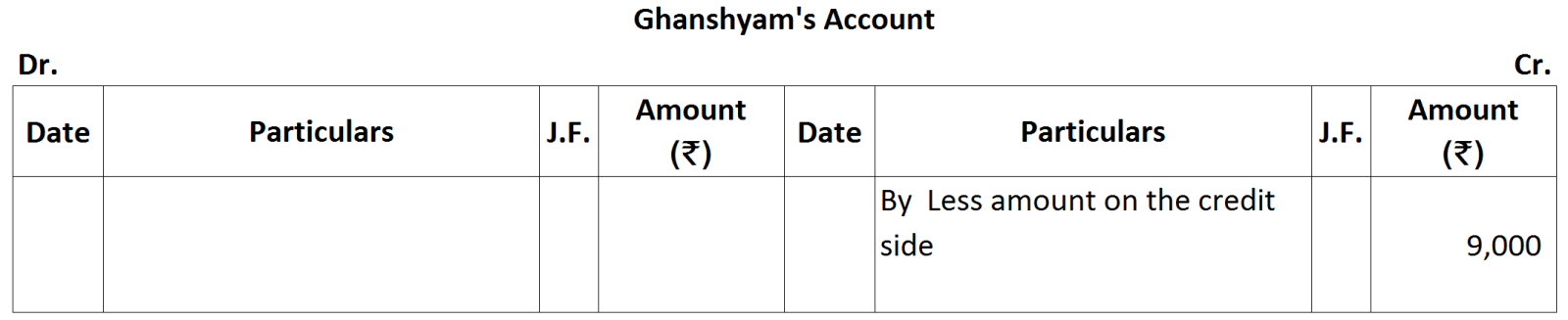
  1. Purchases made from Ghanshayam ₹ 10,000 have been posted to his account as ₹ 1,000. It is a mistake at the time of posting in the ledger account which implies that there is no mistake in the Purchases Account. In this case, Ghanshyam’s Account was credited with lesser amount. So, ₹ 9,000 more will be credited to his account for rectification of this error.
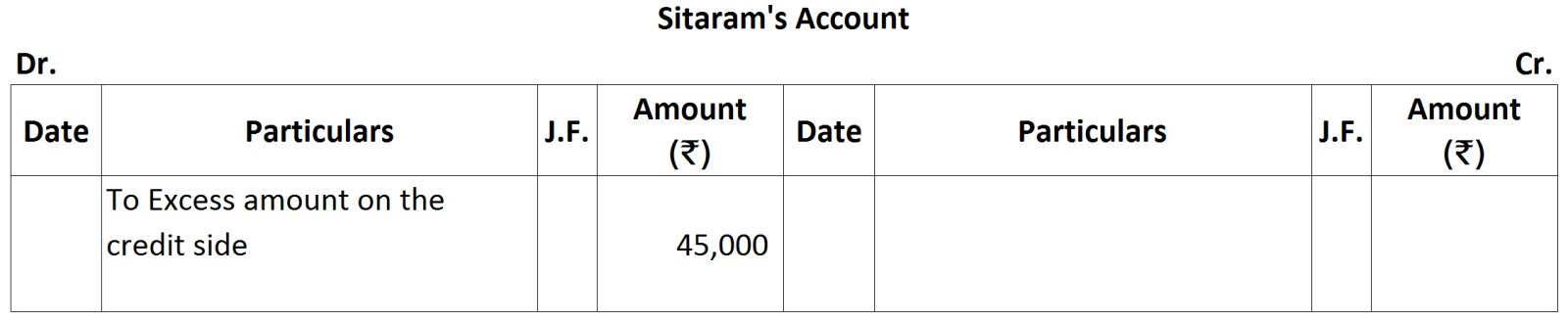
  1. Purchases made from Sitaram ₹ 5,000 have been posted to his account as ₹ 50,000. It implies that his account is credited with an excess amount of ₹ 45,000 (50,000 - 5,000). Thus, in order to rectify this error ₹ 45,000 is debited to Sitaram’s Account.
View full question & answer
Question 316 Marks
Trial Balance of Madan did not agree and he put the difference to Suspense Account. He discovered the following errors:
  1. Sales Returns book overcast by ₹ 800.
  2. Purchases returns to Sahu ₹ 2,000 were not posted to his account.
  3. Goods purchased on credit from Narula ₹ 4,000 though taken into stock, but no entry was passed in the books.
  4. Installation charges on new machinery purchased ₹ 500 were debited to sundry expenses account as ₹ 50.
  5. Rent paid for residential accommodation of Madan (the proprietor) ₹ 1,400 was debited to Rent A/c as ₹ 1,000.
Rectify the errors and prepare Suspense Account to ascertain the difference in Trial Balance.
View full question & answer
Question 326 Marks
Rectify the following errors found in the books of Mr. Aryan by passing entries:
  1. The purchase of ₹ 610 from Kabir was entered into sales book but Kabir's personal account was rightly credited.
  2. Sale of old furniture of ₹ 2,500 was credited to sales account as ₹ 250.
  3. An item of ₹ 500 relating to prepaid insurance account was omitted to be brought forward from the previous year's books.
  4. ₹ 220 discount received from a creditor had been duly entered in his account but not posted to discount received account.
View full question & answer
Question 336 Marks
Discuss the method of preparation of Trial Balance.
Answer
We can prepare the Trial Balance in the following three ways:
  1. Totals Method:
In this totals method, we ascertain the total of each side in the ledger i.e. debit and credit, separately and show them in the respective columns in the Trial Balance. Here also the total of the column with debit totals should tally with the total of the column of the credit totals. The dual aspect concept holds true in this case also.

However, totals method is not in use widely as it does not determines the accurate balances of the accounts and thus, also does not help in the preparation of the Financial statements or final accounts.
  1. Balances Method:
In this method, we total the debit side and the credit side of the accounts and balance them. We then write these debit or credit balances of the ledger accounts in the respective debit and credit columns in the Trial Balance. A trial balance tallies when the total of the debit column is equal to the total of the credit column.

This method is the most common method as it shows the net effect and also helps in the preparation of the financial statements. Usually, in the trial balance instead of showing the individual accounts of the debtors and creditors, we show Sundry Debtors and Sundry Creditors accounts, respectively.
  1. Totals-cum-Balances Method:
In this method, we prepare four columns. In two columns we write debit and credit totals of accounts and in the other two columns, we write the debit and credit balances of accounts. This method consumes a lot of time and is a duplicate of work. Hence, it is rarely in use.
View full question & answer
Question 346 Marks
Trial balance of Kohli did not agree and showed an excess debit of ₹ 16,300. He put the difference to a suspense account and discovered the following errors:
  1. Cash received from Rajat ₹ 5,000 was posted to the debit of Kamal as ₹ 6,000.
  2. Salaries paid to an employee ₹ 2,000 were debited to his personal account as ₹ 1200.
  3. Goods withdrawn by proprietor for personal use ₹ 1,000 were credited to sales account as ₹ 1,600.
  4. Depreciation provided on machinery ₹ 3,000 was posted to Machinery account as ₹ 300.
  5. Sale of old car for ₹ 10,000 was credited to sales account as ₹ 6,000. Rectify the errors and prepare suspense account.
View full question & answer
Question 356 Marks
Rectify the following errors:
  1. Credit sales to Mohan ₹ 7,000 were posted to Karan.
  2. Credit purchases from Rohan ₹ 9,000 were posted to Gobind.
  3. Goods returned to Rakesh ₹ 4,000 were posted to Naresh.
  4. Goods returned from Mahesh ₹ 1,000 were posted to Manish.
  5. Cash sales ₹ 2,000 were posted to commission account.
View full question & answer
Question 366 Marks
State the limitations of trial balance?
Answer
If the Trial Balance agrees, then it should not be taken for granted, that there is absolutely no errors. In fact, there do exist some errors that are not revealed by a Trial Balance. Such ineffectiveness of the Trial Balance is termed as the limitations of Trial Balance. The various limitations of the Trial Balance are given below:
  1. It does not assist to detect errors that arise if an entry is not recorded in the Journal. Such errors are termed as the Errors of Complete Omission.
  2. If the effect of one error is cancelled by the effect of another error, then it cannot be ascertained by the Trial Balance. Such types of errors are termed as Compensatory Errors, which are rare to find.
  3. If correct amount is posted in the correct side; however, in the wrong account and if wrong amount is posted in the wrong side, but in the correct account, then the Trial Balance fails to reflect these errors.
  4. If there arises any error of principle, like capital expenditure mistakenly regarded as revenue expenditure or vice-versa, then such errors may not be revealed in form of mismatch between the two columns of the Trial Balance.
  5. If any transaction is recorded wrongly in the books of original entry, then such mistakes lead to the errors of recording which are not revealed by Trial Balance.
View full question & answer
Question 376 Marks
Rectifying the following errors:
  1. Sales Book has been totalled ₹ 1,000 short.
  2. Goods worth ₹ 1,500 returned by Green & Co. have not been recorded anywhere.
  3. Goods purchased worth ₹ 2,500 have been posted to the debit of the supplier, Gupta & Co.
  4. Furniture purchased from Gulab & Co. worth ₹ 10,000 has been entered in Purchases Book.
  5. Cash received from A ₹ 2,500 has not been posted in his account.
View full question & answer
Question 386 Marks
There was an error in the Trial Balance of Mr. Steel on 31st March, 2015, and the difference in Books was carried to a Suspense Account. On going through the Books you find that:
  1. ₹ 5,400 received from Mr. A was posted to the debit of his account.
  2. ₹ 1,000 being purchases return were posted to the debit of Purchases Account.
  3. Discount received ₹ 2,000 was posted to the debit of Discount Account.
  4. ₹ 2,740 paid for Repairs to Motor Car was debited to Motor Car Account as ₹ 1,740.
  5. ₹ 4,000 paid to B was debited to A's Account.
Give Journal Entries to rectify the above errors and ascertain the amount transferred to Suspense Account on 31st March, 2015 by showing the Suspense Account, assuming that the Suspense Account is balanced after the above corrections.
View full question & answer
Question 396 Marks
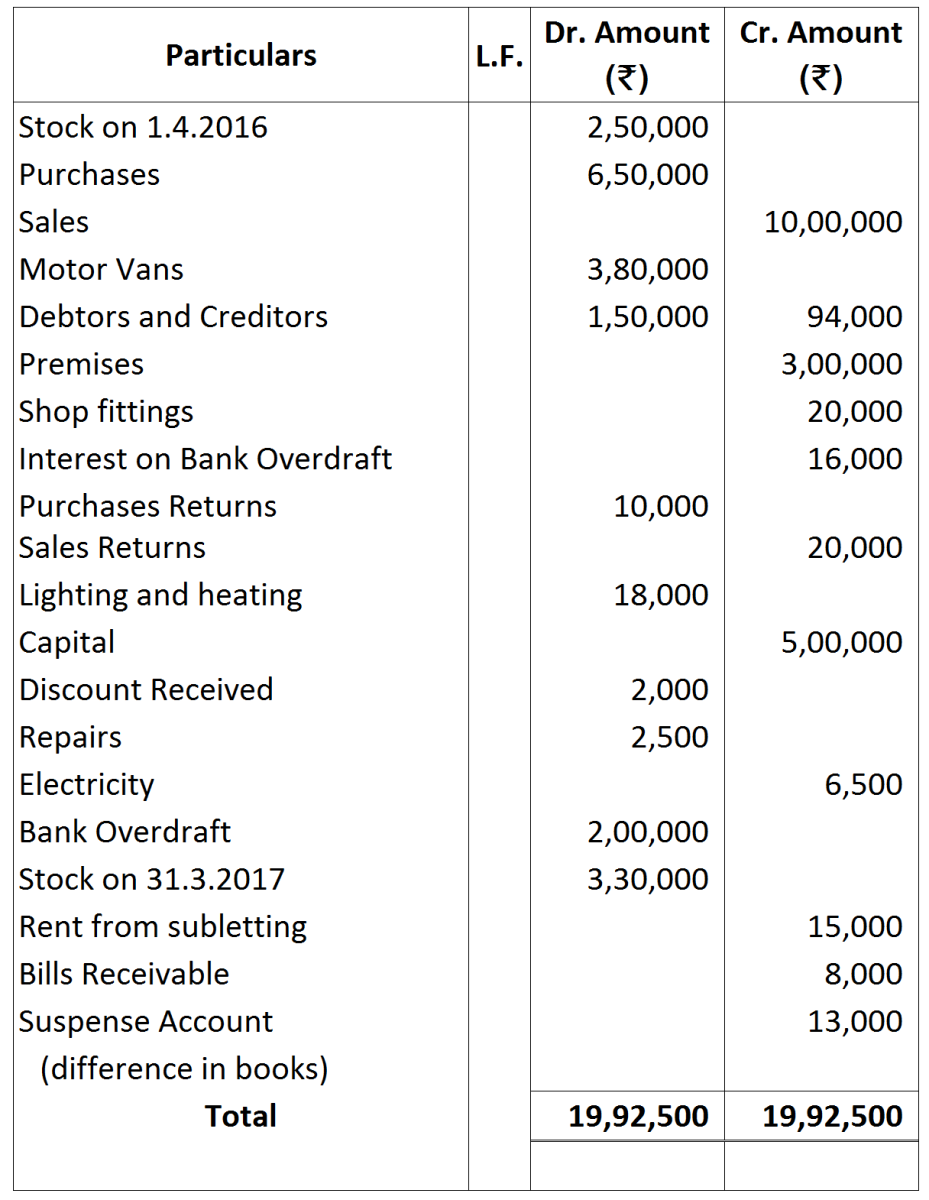
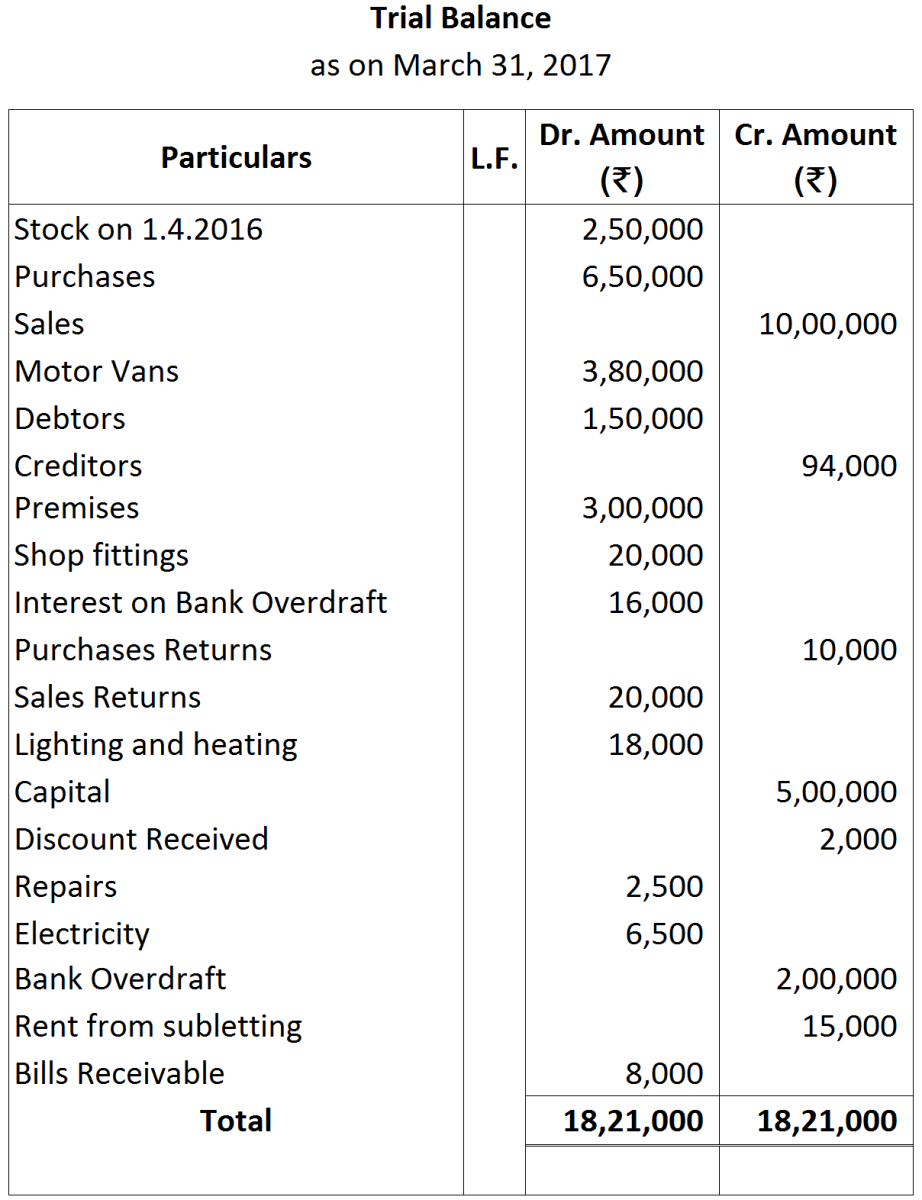
A book-keeper extracted the following Trial Balance as at 31st March, 2017:
Answer


Note: Closing Stock of ₹ 3,30,000 will not appear in Trial Balance, because it has not been accounted yet.
View full question & answer
Question 406 Marks
Trial Balance of Anuj did not agree. It showed an excess credit of ₹ 6,000. He put the difference to Suspense Account. He discovered the following errors.
  1. Cash received from Ravish ₹ 8,000 posted to his account as ₹ 6,000.
  2. Returns Inwards book overcast by ₹ 1,000.
  3. Total of Sales Book ₹ 10,000 was not posted to Sales Account.
  4. Credit purchases from Nanak ₹ 7,000 were recorded in Sales Book. However, Nanak's Account was correctly credited.
  5. Machinery purchased for ₹ 10,000 was posted to Purchases Account as ₹ 5,000.
Rectify the errors and prepare Suspense Account.
View full question & answer
Question 416 Marks
There was an error in the Trial Balance of Ram Gopal on 31st March, 2018 and the difference in books was carried to the Suspense Account. On going through the books, you find that:
  1. ₹ 540 received from Mayank was posted to the debit side of his account.
  2. ₹ 100 being purchases return was posted to the debit of the Purchases Account.
  3. Discount of ₹ 300 received was posted to the debit of the Discount Account.
  4. ₹ 374 paid for motor car repairs was debited to the Motor Car Account as ₹ 174.
  5. ₹ 400 paid to Naman was debited to the account of Manan.
Pass the Journal entries to rectify the above errors and state what amount was carried to the Suspense Account.
View full question & answer
Question 426 Marks
Pass the rectifying entries for the following:
  1. Sales of goods ₹ 6,000 to Madan were recorded as ₹ 600 in the Sales Book.
  2. Credit purchase of goods from Mohan amounting to ₹ 2,000 has been wrongly passed through the Sales Book.
  3. Return of goods worth ₹ 500 by a customer was entered in ‘Purchases Return Book’.
  4. Cheque of ₹ 400 received from Ranjan was dishonoured and debited to the Discount Account.
  5. Bill for ₹ 820 received from Ramesh for repair of machinery was entered in the Purchases Book as ₹ 720.
View full question & answer
Question 446 Marks
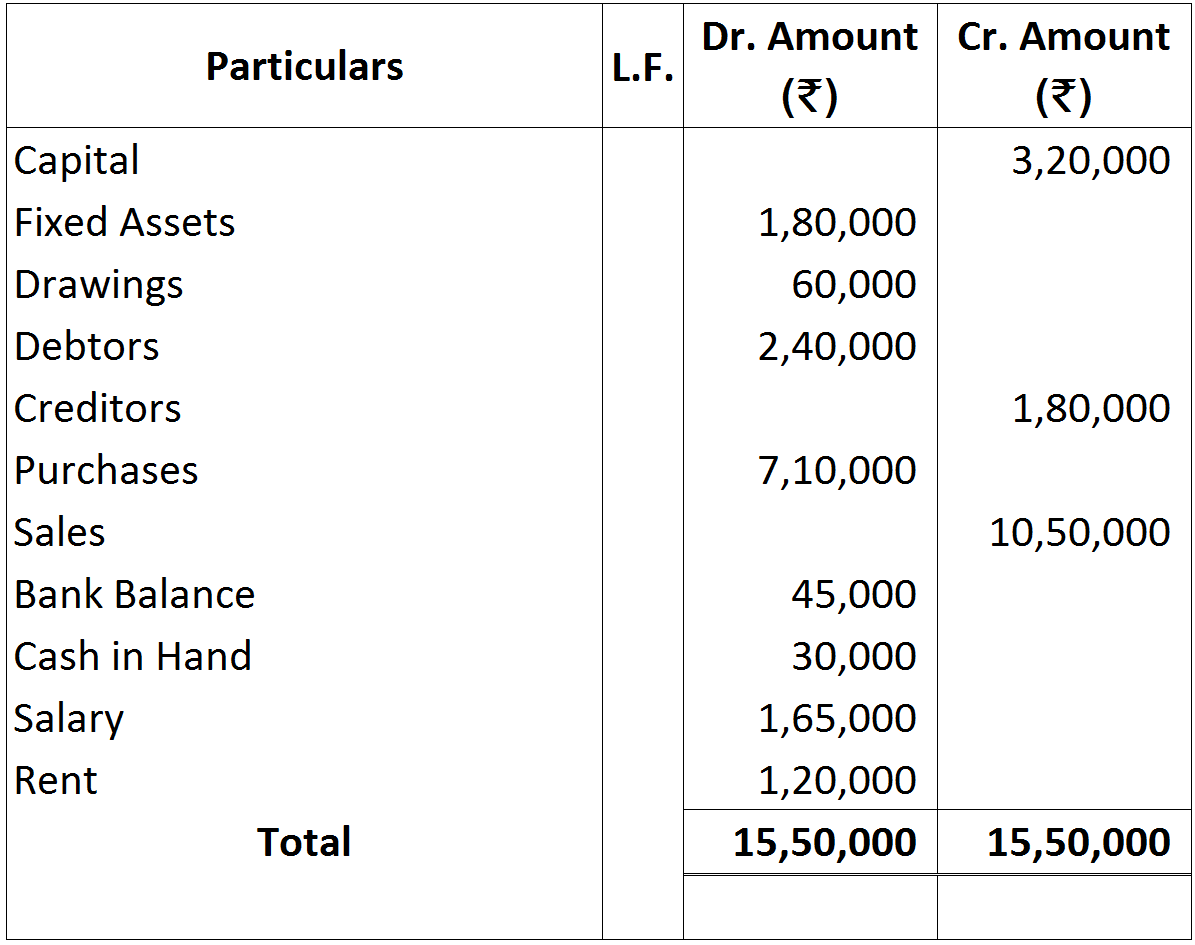
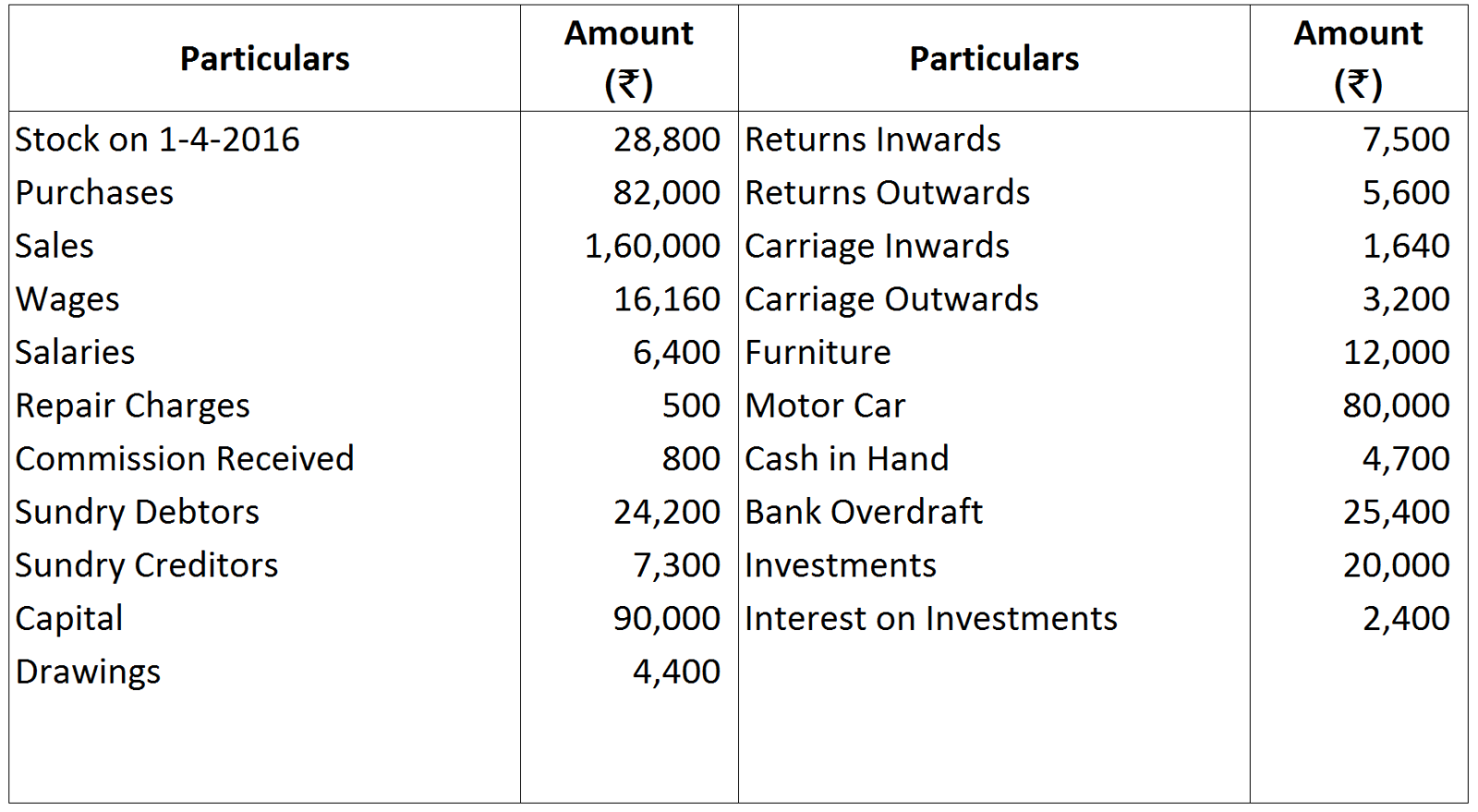
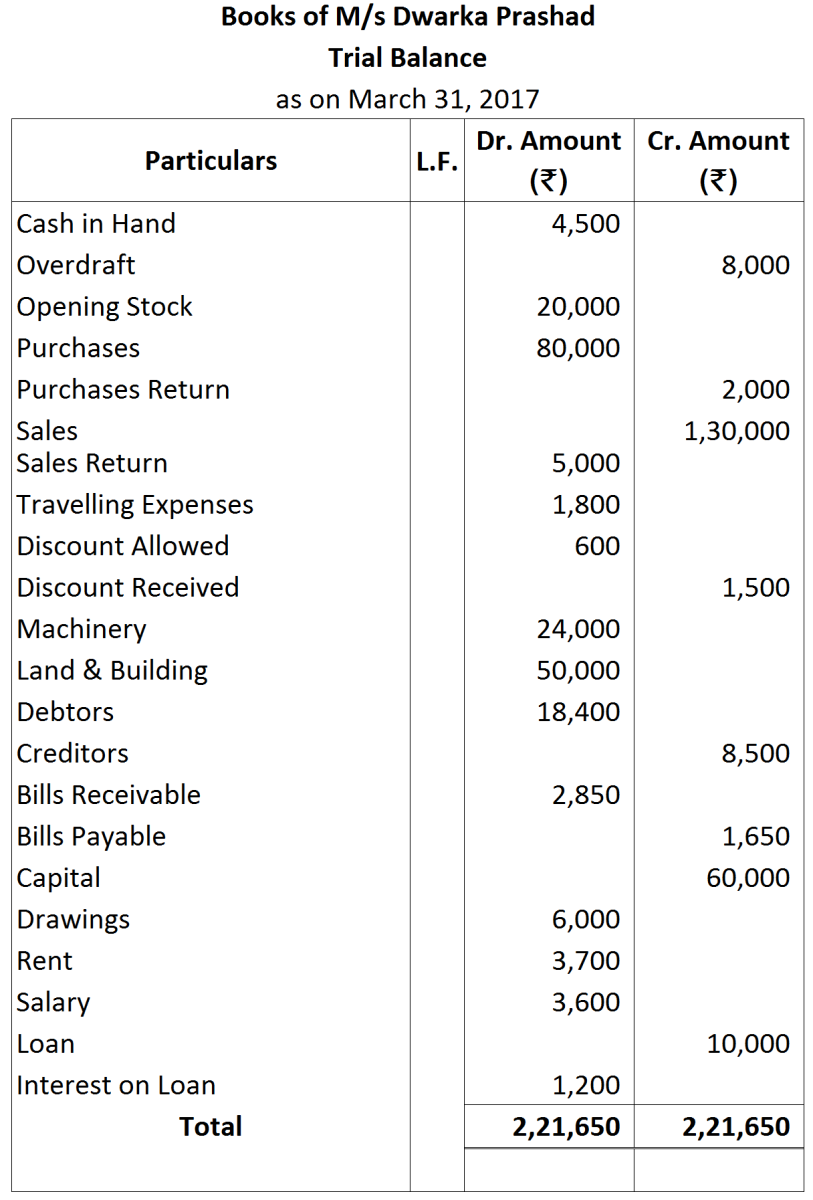
From the following balances, taken from the books of M/s Dwarka Parshad & Sons as at 31st March 2017, prepare a Trial Balance in proper form:−
Answer
Solution is as follow:
View full question & answer
Question 456 Marks
Rectify the following errors:
  1. Depreciation provided on machinery ₹ 4,000 was not posted.
  2. Bad debts written off ₹ 5,000 were not posted.
  3. Discount allowed to a debtor ₹ 100 on receiving cash from him was not posted.
  4. Discount allowed to a debtor ₹ 100 on receiving cash from him was not posted to discount account.
  5. Bill receivable for ₹ 2,000 received from a debtor was not posted.
View full question & answer
Question 466 Marks
What are objectives or functions of a Trial Balance?
Answer
Objectives or Functions of Trial Balance:
  1. To Ascertain the Arithmetical Correctness of Ledger Accounts: The Trial Balance enables one to establish whether posting and other accounting processes have been carried out without committing arithmetical errors.
  2. To Help Prepare the Final Accounts: Financial Statements are prepared from the Trial Balance. Preparation of Financial Statements, therefore, is the second objective of preparing a Trial Balance.
  3. Summary of Each Account: The Trial Balance is a summary of each Ledger Account. The ledger account may have to be referred only when more detail is required in respect of an account.
  4. To Help in Locating Errors: The Trial Balance helps in locating errors in maintaining Book of Account. It should, however, be kept in mind that it does not disclose, i.e., show all the errors in Book Keeping except the arithmetical inaccuracies.
View full question & answer
Question 476 Marks
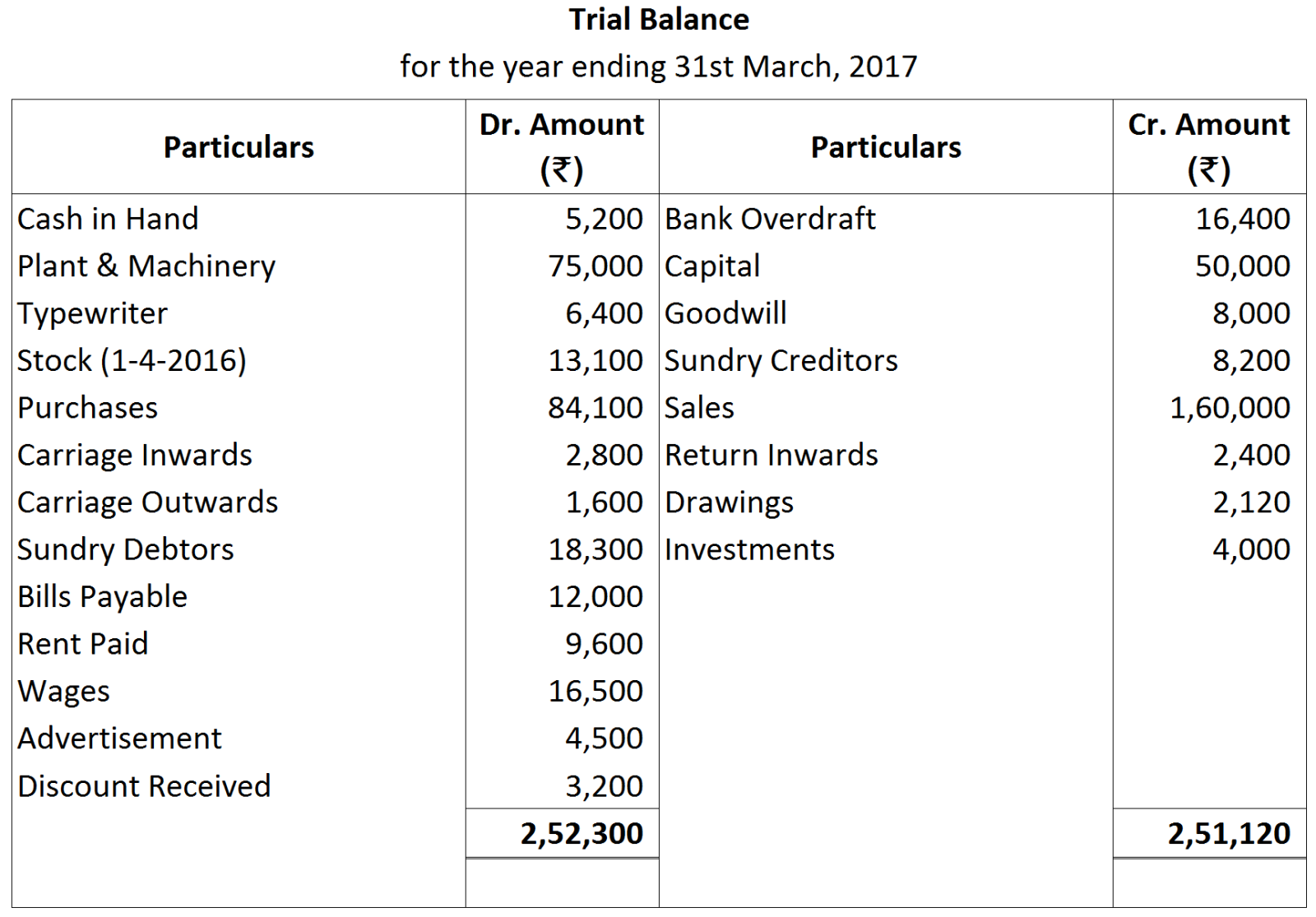
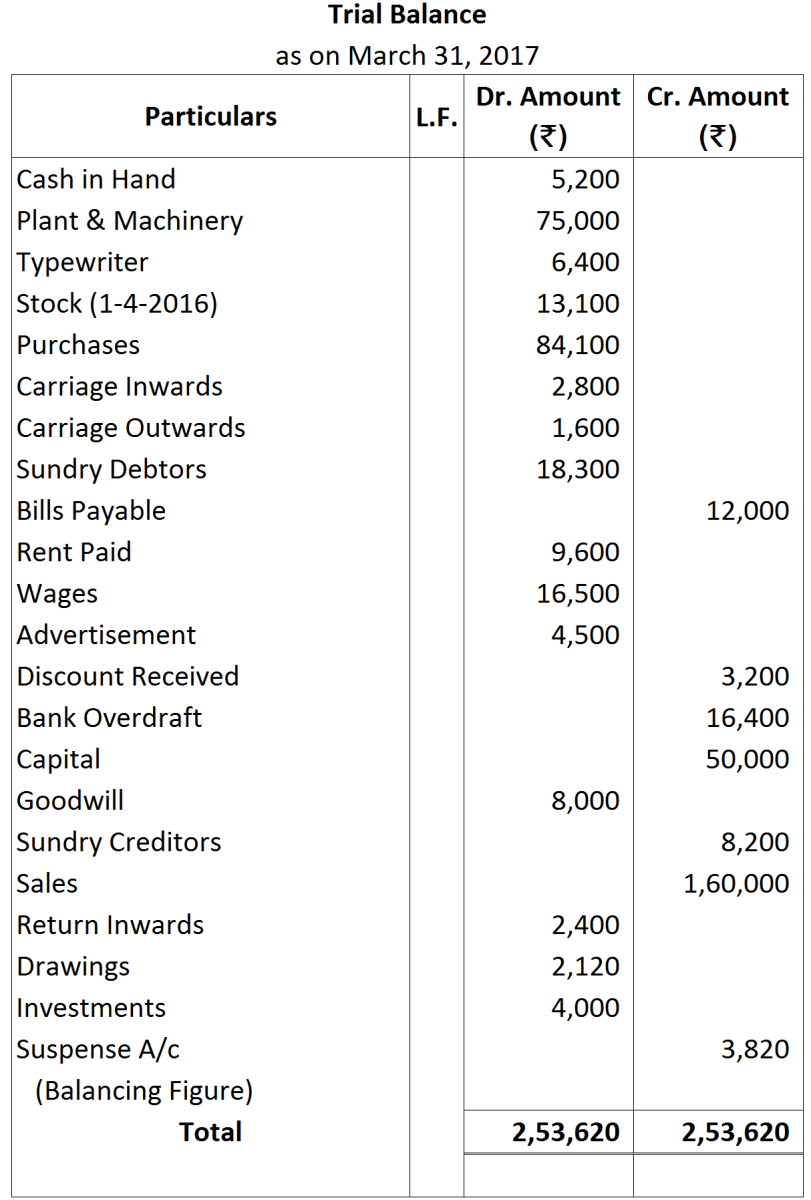
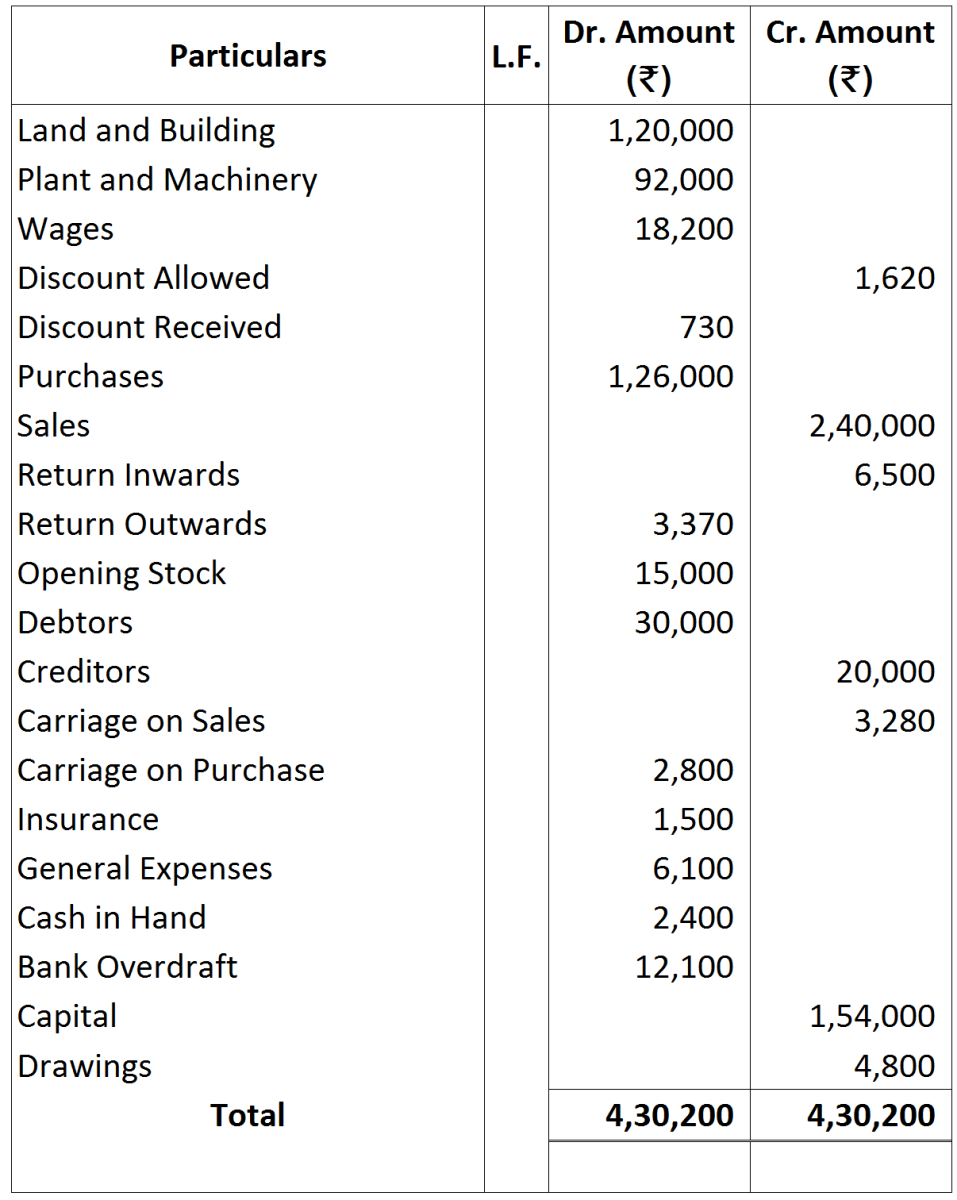
The following is the Trial Balance prepared by an inexperienced accountant. Redraft it in a correct form and give necessary notes :-
Answer

Note: Since, the Trial Balance does not tally, thus, the difference of ₹ 3,820 is transferred to the Credit Balance Column of Trial Balance.
View full question & answer
Question 486 Marks
Rectify the following errors assuming that suspense account was opened. Ascertain the difference in trial balance.
  1. Depreciation provided on machinery ₹ 4,000 was not posted to Depreciation account.
  2. Bad debts written-off ₹ 5,000 were not posted to Debtors account.
  3. Discount allowed to a debtor ₹ 100 on receiving cash from him was not posted to discount allowed account.
  4. Goods withdrawn by proprietor for personal use ₹ 800 were not posted to Drawings account.
  5. Bill receivable for ₹ 2,000 received from a debtor was not posted to Bills receivable account.
View full question & answer
Question 496 Marks
A book-keeper finds that the debit side of the trial balance is short of ₹ 308 and so for the time being, he balances the side by putting the difference to suspense account. Subsequently, the following errors were disclosed:
  1. An entry for sale of goods for ₹ 102 to Madhav was posted to his account as ₹ 120.
  2. ₹ 100 being the discount allowed to customers were credited to discount received account in the ledger.
  3. ₹ 275 paid by Madhav were credited to Jadav's account.
  4. ₹ 26 appearing in the cash book as paid for the purchase of stationery for office use have not been posted to ledger.
  5. The debit side of purchases account was under-cast by ₹ 100.
You are required to make the necessary journal entries and the suspense account.
View full question & answer
Question 506 Marks
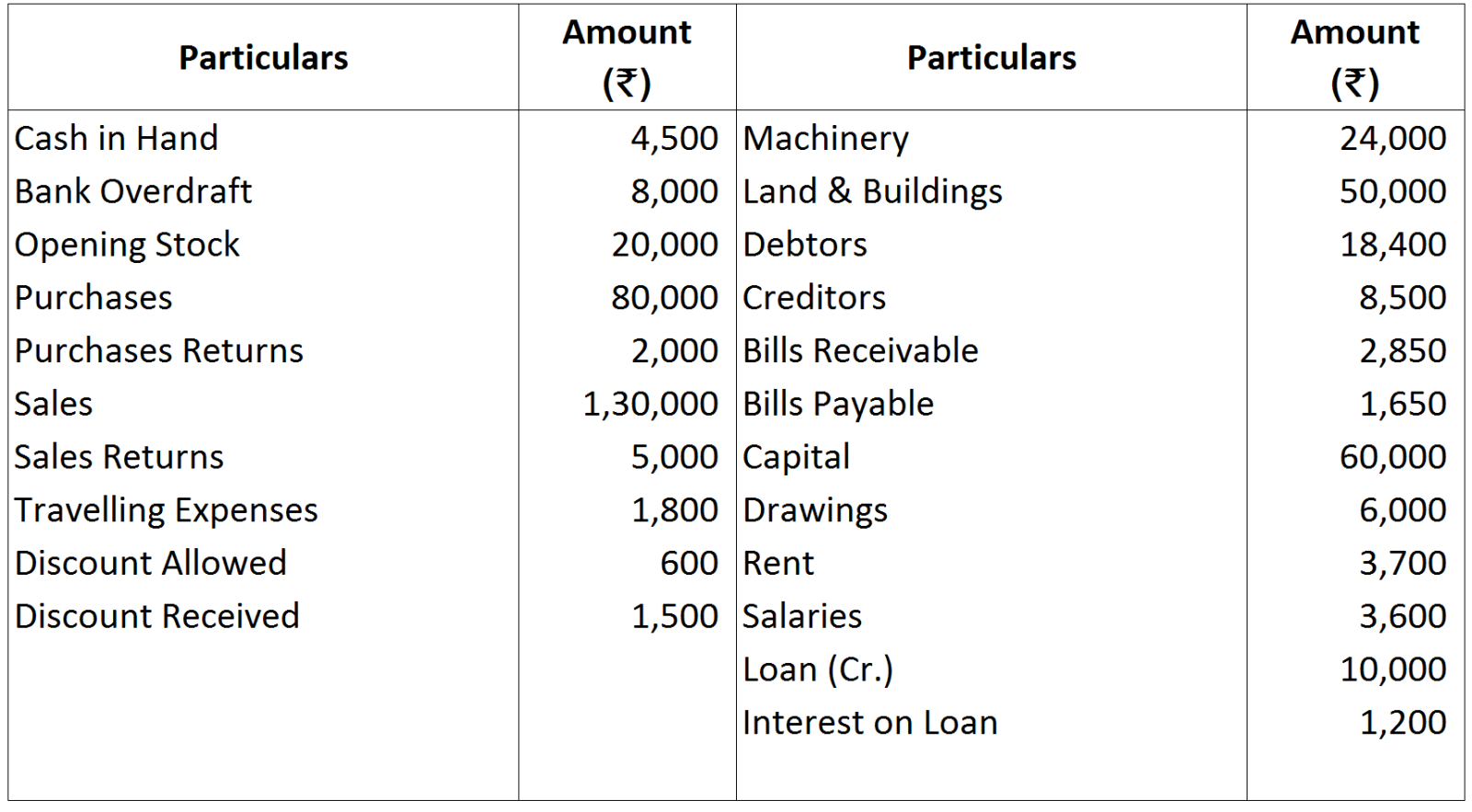
The following trial balance has been prepared by an inexperienced accountant. Redraft it in a correct form:−
View full question & answer
6 Marks Question - Account STD 11 Commerce Questions - Vidyadip