MCQ
Find out the equivalent resistance between the points $a$ and $b$
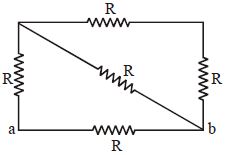
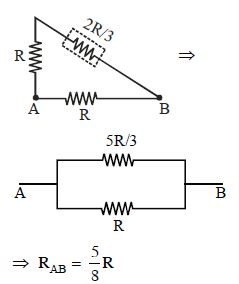
- ✓$\frac{5}{8}\,R$
- B$\frac{5}{3}\,R$
- C$\frac{R}{2}$
- D$\frac{5}{7}\,R$
Generate a complete, print-ready paper with questions like this in minutes — across 16+ boards, with answer keys.
|
column $I$ |
column $II$ | column $III$ |
| $(I)$ Electron with $\overrightarrow{\mathrm{v}}=2 \frac{\mathrm{E}_0}{\mathrm{~B}_0} \hat{\mathrm{x}}$ | $(i)$ $\overrightarrow{\mathrm{E}}=\mathrm{E}_0^2 \hat{\mathrm{Z}}$ | $(P)$ $\overrightarrow{\mathrm{B}}=-\mathrm{B}_0 \hat{\mathrm{x}}$ |
| $(II)$ Electron with $\overrightarrow{\mathrm{v}}=\frac{\mathrm{E}_0}{\mathrm{~B}_0} \hat{\mathrm{y}}$ | $(ii)$ $\overrightarrow{\mathrm{E}}=-\mathrm{E}_0 \hat{\mathrm{y}}$ | $(Q)$ $\overrightarrow{\mathrm{B}}=\mathrm{B}_0 \hat{\mathrm{x}}$ |
| $(III)$ Proton with $\overrightarrow{\mathrm{v}}=0$ | $(iii)$ $\overrightarrow{\mathrm{E}}=-\mathrm{E}_0 \hat{\mathrm{x}}$ | $(R)$ $\overrightarrow{\mathrm{B}}=\mathrm{B}_0 \hat{\mathrm{y}}$ |
| $(IV)$ Proton with $\overrightarrow{\mathrm{v}}=2 \frac{\mathrm{E}_0}{\mathrm{~B}_0} \hat{\mathrm{x}}$ | $(iv)$ $\overrightarrow{\mathrm{E}}=\mathrm{E}_0 \hat{\mathrm{x}}$ | $(S)$ $\overrightarrow{\mathrm{B}}=\mathrm{B}_0 \hat{\mathrm{z}}$ |
($1$) In which case will the particle move in a straight line with constant velocity?
$[A] (II) (iii) (S)$ $[B] (IV) (i) (S)$ $[C] (III) (ii) (R)$ $[D] (III) (iii) (P)$
($2$) In which case will the particle describe a helical path with axis along the positive $z$ direction?
$[A] (II) (ii) (R)$ $[B] (IV) (ii) (R)$ $[C] (IV) (i) (S)$ $[D] (III) (iii)(P)$
($3$) In which case would be particle move in a straight line along the negative direction of y-axis (i.e., more along $-\hat{y}$ )?
$[A] (IV) (ii) (S)$ $[B] (III) (ii) (P)$ $[C]$ (II) (iii) $(Q)$ $[D] (III) (ii) (R)$