Question
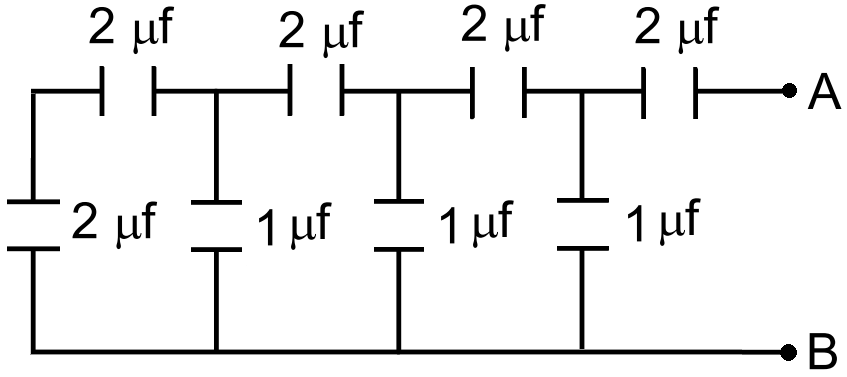
Find the capacitance of the combination shown in figure between $A$ and $B.$

Answer


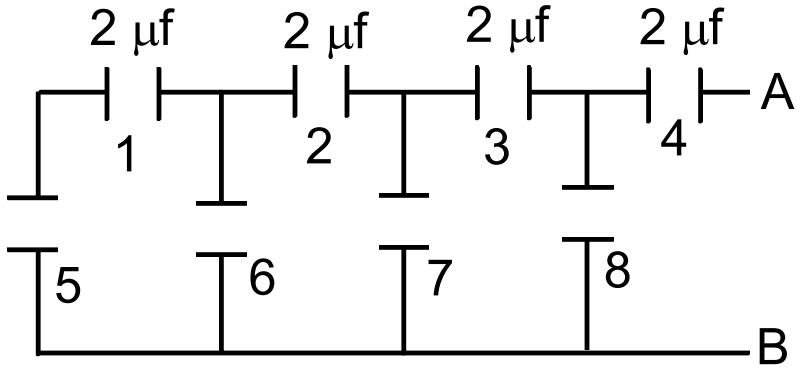
$= C_5$ and $C_1$ are in series
$\text{C}_{\text{eq}}=\frac{2\times2}{2+2}=1$
This is parallel to $C_6 = 1 + 1 = 2$
Which is series to $\text{C}_{\text{2}}=\frac{2\times2}{2+2}=1$
Which is parallel to $C_7 = 1 + 1 = 2$
Which is series to $\text{C}_{\text{3}}=\frac{2\times2}{2+2}=1$
Which is parallel to $C_8 = 1 + 1 = 2$
This is series to $\text{C}_{\text{4}}=\frac{2\times2}{2+2}=1$

Need a full question paper?

Generate a complete, print-ready paper with questions like this in minutes — across 16+ boards, with answer keys.
Start Generating Free

Similar questions

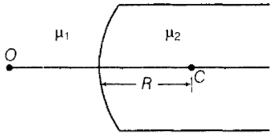
Figure shows a convex spherical surface with centre of curvature $C$ separating the two media of refractive indices $\mu_1$ and $\mu_2$. Draw a ray diagram showing the formation of the image of a point object $O$ lying on the principal axis. Derive the relationship between the object and image distance in terms of refractive indices of the media and the radius of curvature $R$ of the surface.
Image
Ajit had a high tension tower erected on his farm land. He kept complaining to the authorities to remove it as it was occupying a large portion of his land. His uncle, who was a teacher, explained to him the need for erecting these towers for efficient transmission of power. As Ajit realised its significance, he stopped complaining. 
Answer the following questions:
  1. Why is it necessary to transport power at high voltage?
  2. A low power factor implies large power loss. Explain.
  3. Write two values each displayed by Ajit and his uncle.
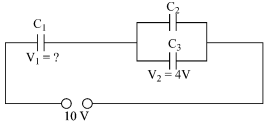
Define capacitor. Obtain the relation of equivalence in series combination of capacitors by making a circuit diagram. Write the value of voltage $V_1$ in the given circuit.
Image
  1. Obtain lens makers formula using the expression
  1. $\frac{\text{n}_{2}}{\text{v}} - \frac{\text{n}_{1}}{\text{u}} = \frac{(\text{n}_{2} - \text{n}_{1})}{\text{R}}$
    Here the ray of light propagating from a rare medium of refractive index $(n_1)$ to a denser medium of refractive index $(n_2)$ is incident on the convex side of spherical refracting surface of radius of curvature $R.$
  2. Draw a ray diagram to show the image formation by a concave mirror when the object is kept between its focus and the pole. Using this diagram, derive the magnification formula for the image formed.
  1. Draw the ray diagram of an astronomical telescope when the final image is formed at infinity. Write the expression for the resolving power of the telescope.
  2. An astronomical telescope has an objective lens of focal length 20m and eyepiece of focal length 1cm.
  1. Find the angular magnification of the telescope.
  2. If this telescope is used to view the Moon, find the diameter of the image formed by the objective lens. Given the diameter of the Moon is $3.5 \times 10^6m$ and radius of lunar orbit is $3.8 \times 10^8m.$
A long solenoid of radius $2\ cm$ has $100\ turns/cm$ and carries a current of $5A.$ A coil of radius $1\ cm$ having $100$ turns and a total resistance of $2\Omega$ is placed inside the solenoid coaxially. The coil is connected to a galvanometer. If the current in the solenoid is reversed in direction, find the charge flown through the galvanometer.
Use Moseley's law with $b = 1$ to find the frequency of the $\text{K}_\alpha X-$ray of $La(Z = 57)$ if the frequency of the $\text{K}_\alpha X-$ray of $Cu(Z = 29)$ is known to be $1.88 \times 10^{18}Hz$.
Solve the previous problem if the friction coefficient between the $2.0\ kg$ block and the plane below it is $0.5$ and the plane below the $4.0\ kg$ block is frictionless.
What is rivetted galvanometer? What is the function of shunt in a galvanometer?
On the basis of band theory, differentiate between conductors, insulators and conductors.