Question
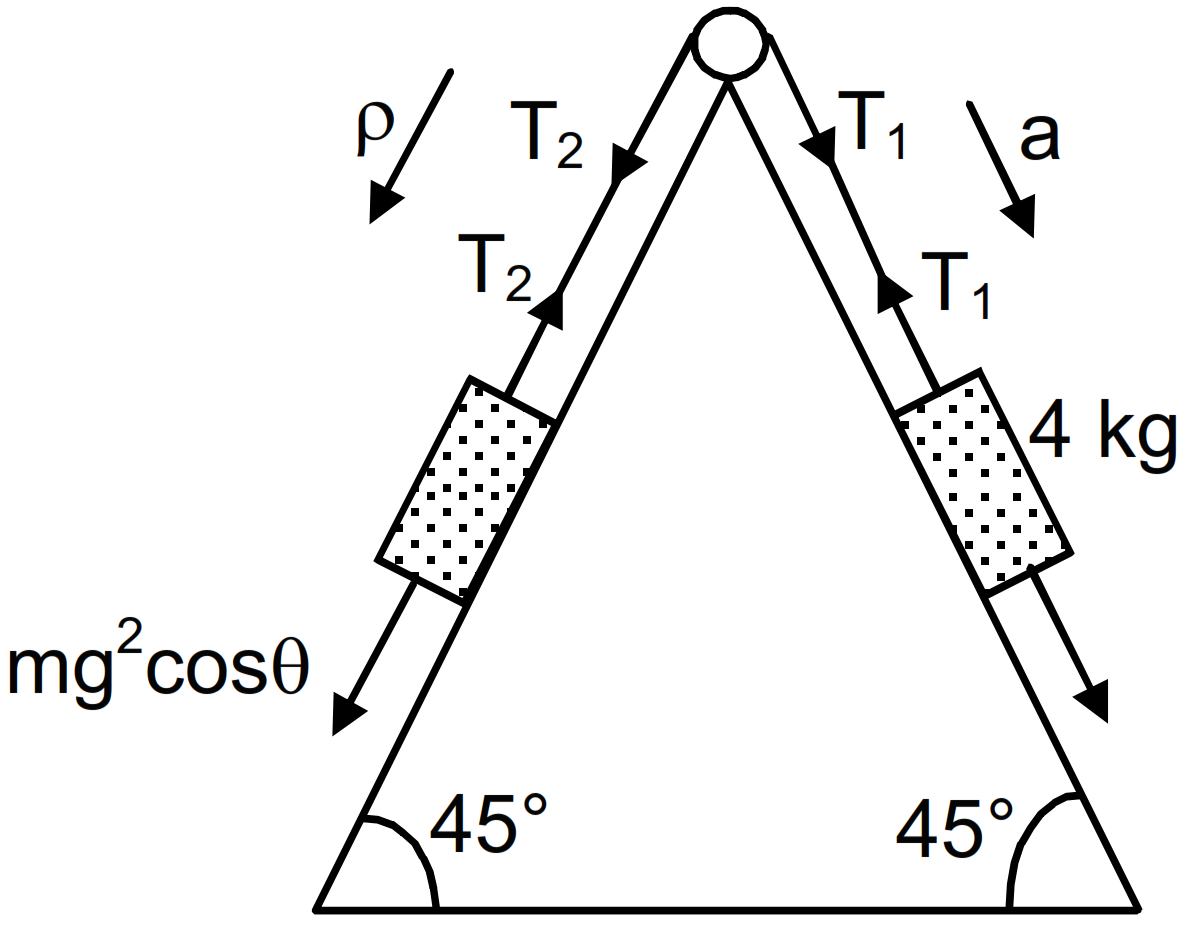
Solve the previous problem if the friction coefficient between the $2.0\ kg$ block and the plane below it is $0.5$ and the plane below the $4.0\ kg$ block is frictionless.
Answer


$m_1 = 4\ kg, m_2 = 2\ kg$
Frictional co $-$ efficient between $2\ kg$ block and surface $= 0.5$
$R = 10\ cm = 0.1m$
$I = 0.5\ kg-m^2$
$\text{m}_1\text{g}\sin\theta-\text{T}_1=\text{m}_1\text{a}\ \dots(1)$
$\text{T}_2-(\text{m}_2\text{g}\sin\theta+\mu\text{m}_2\text{g}\cos\theta)=\text{m}_2\text{a}\ \dots(2)$
$(\text{T}_1-\text{T}_2)=\frac{\text{la}}{\text{r}^2}$
Adding equation $(1)$ and $(2)$ we will get
$\text{m}_1\text{g}\sin\theta-(\text{m}_2\text{g}\sin\theta+\mu\text{m}_2\text{g}\cos\theta)+(\text{T}_1+\text{T}_2)=\text{m}_1\text{a}+\text{m}_2\text{a}$
$\Rightarrow4\times9.8\times\Big(\frac{1}{\sqrt2}\Big)-\Big\{\Big(2\times9.8\times\Big(\frac{1}{\sqrt2}\Big)+0.5\times2\times9.8\times\Big(\frac{1}{\sqrt2}\Big)\Big\}$
$=\Big(4+2+\frac{0.5}{0.01}\Big)\text{a}$
$\Rightarrow27.80-(13.90+6.95)=65\text{a}$
$\Rightarrow\text{a}=0.125\text{ms}^{-2}$

Need a full question paper?

Generate a complete, print-ready paper with questions like this in minutes — across 16+ boards, with answer keys.
Start Generating Free

Similar questions

A spherical ball $A$ of surface area $20\ cm^2$ is kept at the centre of a hollow spherical shell $B$ of area $80\ cm^2.$ The surface of $A$ and the inner surface of $B$ emit as blackbodies. Both $A$ and $B$ are at $300K.$
  1. How much is the radiation energy emitted per second by the ball $A?$
  2. How much is the radiation energy emitted per second by the inner surface of $B$
  3. How much of the energy emitted by the inner surface of $B$ falls back on this surface itself?
Sketch the electric field lines for a uniformly charged hollow cylinder shown in Fig.
An electrical technician requires a capacitance of $2\mu F$ in a circuitacross a potential difference of $1kV. A$ large number of $1\mu F$ capacitors are available to him each of which can withstand a potential difference of not more than $400V$. Suggest a possible arrangement that requires the minimum number of capacitors.
A square-shaped copper coil has edges of length 50cm and contains 50 turns. It is placed perpendicular to a 1.0T magnetic field. It is removed from the magnetic field in 0·25s and restored in its original place in the next 0·25s. Find the magnitude of the average emf induced in the loop during:
  1. Its removal.
  2. Its restoration.
  3. Its motion.
Before the neutrino hypothesis, the beta decay process was throught to be the transition,
$\text{n}\rightarrow\ \text{p}+\overline{\text{e}}$
If this was true, show that if the neutron was at rest, the proton and electron would emerge with fixed energies and calculate them.Experimentally, the electron energy was found to have a large range.
Consider a circular current $-$ carrying loop of radius $R$ in the $x-y$ plane with centre at origin. Consider the line intergral $\Im(\text{L})=\begin{vmatrix}\int\limits_{-\text{L}}^{\text{L}}\text{B.dl} \end{vmatrix}$ taken along $z-$ axis.
  1. Show that $\Im(\text{L})$ monotonically increases with $L$.
  2. Use an appropriate Amperian loop to show that $\Im(\infty)=\mu_0\text{I}$, where I is the current in the wire.
  3. Verify directly the above result.
  4. Suppose we replace the circular coil by $a$ square coil of sides $R$ carrying the same current $I$. What can you say about $\Im(\text{L})$ and $\Im(\infty)$?
A copper wire of radius 0.1mm and resistance $1\text{k}\Omega$ is connected across a power supply of 20V.
(a) How many electrons are transferred per second between the supply and the wire at one end? (b) Write down the current density in the wire.
A proton and an $\alpha -$particle are accelerated, using the same potential difference. How are the de$-$Broglie wavelengths $\lambda _p$ and $\lambda _a$ related to each other?
Critically analyse bar magnet and solenoid and calculate the value of magnetic field generated on the axial point of the solenoid.
Determine the 'effective focal length' of the combination of the two lenses having focal lengths $30 \ cm$ and $-20\ cm$ if they are placed $8.0 \ cm$ apart with their principal axes coincident. Does the answer depend on which side of the combination a beam of parallel light is incident? Is the notion of effective focal length of this system useful at all?