MCQ
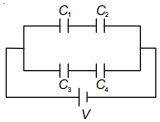
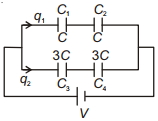
Find the charge on capacitor $C_3$

Given, that $C_1=C_2=C$ and $C_3=C_4=3 C$.
  • $\frac{3}{2} CV$
  • B
    $\frac{C V}{2}$
  • C
    $3 CV$
  • D
    $2 CV$

Answer

Correct option: A.
$\frac{3}{2} CV$
a
(a)

$C_{\text {net }}=2 C$

$q=2 C V$

$\frac{q_1}{q_2}=\frac{1}{3}$

$3 q_1=q_2$

$q_1+q_2=2 CV$

$q_1=\frac{C V }{2}$

$q_2=\frac{3 CV }{2}$
Need a full question paper?

Generate a complete, print-ready paper with questions like this in minutes — across 16+ boards, with answer keys.
Start Generating Free

Similar questions

Two identical short bar magnets, each having magnetic moment of $10\, Am^2$, are arranged such that their axial lines are perpendicular to each other and their centres be along the same straight line in a horizontal plane. If the distance between their centres is $0.2 \,m$ , the resultant magnetic induction at a point midway between them is$({\mu _0} = 4\pi \times {10^{ - 7}}\,H{m^{ - 1}})$
Two conducting spheres of radii $R_1$ and $R_2$ are charged with charges $Q_1$ and $Q_2$ respectively. On bringing them in contact there is
A bullet when fired at a target with a velocity of $100\,\,m/sec$ penetrates one metre into it. If the bullet is fired at a similar target with a thickness $0.5\,\,metre,$  then it will emerge from it with a velocity of
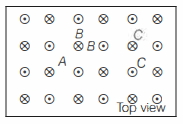
Consider the regular array of vertical identical current carrying wires (with direction of current flow as indicated in the figure alongside) protruding through a horizontal table. If we scatter some diamagnetic particles on the table, then they are likely to accumulate
$Assertion :$ Fahrenheit is the smallest unit measuring temperature.
$Reason :$ Fahrenheit was the first temperature scale used for measuring temperature.
Cyclotron is used to accelerate
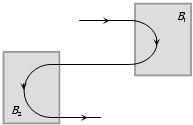
Following figure shows the path of an electron that passes through two regions containing uniform magnetic fields of magnitudes $B_1$ and $B_2$. It's path in each region is a half circle, choose the correct option
A vector in $x-y$ plane makes an angle of $30^{\circ}$ with $y$-axis The magnitude of $y$-component of vector is $2 \sqrt{3}$. The magnitude of $x$-component of the vector will be
An infinite number of masses, each of one $kg$ are placed on the $+ve\, X$ axis at $1\,m, 2\,m, 4\,m,$ origin. The magnitude of the gravitational field at origin due to this distribution of masses is :
A filament bulb $(500 \,W,\,\, 100 \,V)$ is to be used in a $230\, V$ main supply. When a resistance $R$ is connected in series, it works perfectly and the bulb consumes $500\,W.$ The value of $R$ is .................. $\Omega$