MCQ
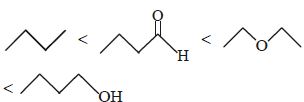
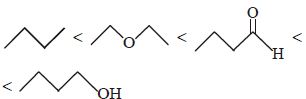
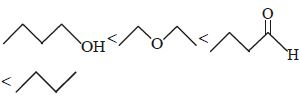
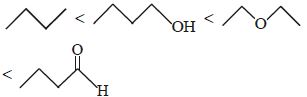
Find the correct order boiling point among the following
  • A


  • C

  • D

Answer

Correct option: B.

b

Need a full question paper?

Generate a complete, print-ready paper with questions like this in minutes — across 16+ boards, with answer keys.
Start Generating Free

Similar questions

Positive and negative point charges of equal magnitude are kept at $\left(0,0, \frac{a}{2}\right)$ and $\left(0,0, \frac{-a}{2}\right)$, respectively. The work done by the electric field when another positive point charge is moved from $(-a, 0,0)$ to $(0, a, 0)$ is
Convergence of concave mirror can be decreased by dipping in
Ice in a freezer is at $-7^{\circ} C .100 \,g$ of this ice is mixed with $200 \,g$ of water at $15^{\circ} C$. Take the freezing temperature of water to be $0^{\circ} C$, the specific heat of ice equal to $2.2 \,J / g { }^{\circ} C$, specific heat of water equal to $4.2 \,J / g ^{\circ} C$ and the latent heat of ice equal to $335 \,J / g$. Assuming no loss of heat to the environment, the mass of ice in the final mixture is closest to .......... $g$
For a dipole $q = 2 \times {10^{ - 6}}\,C$ and $d = 0.01\,m$. Calculate the maximum torque for this dipole if $E = 5 \times {10^5}\,N/C$
A particle in $SHM $ is described by the displacement equation $x(t) = A\cos (\omega t + \theta ).$ If the initial $(t = 0)$ position of the particle is $1 \,cm$ and its initial velocity is $\pi $cm/s, what is its amplitude? The angular frequency of the particle is $\pi {s^{ - 1}}$
An electron is moving with a speed of ${10^8}\,m/\sec $ perpendicular to a uniform magnetic field of intensity $B$. Suddenly intensity of the magnetic field is reduced to $B/2$. The radius of the path becomes from the original value of $r$
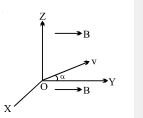
In a region of space, a uniform magnetic field $B$ exists in the $y-$direction.Aproton is fired from the origin, with its initial velocity $v$ making a small angle $\alpha$ with the $y-$ direction in the $yz$ plane. In the subsequent motion of the proton,
A body cools from a temperature $3T$ to $2T$ in $10$ minutes. The room temperature is $T.$ Assume that Newton's law of cooling is applicable. The temperature of the body at the end of next $10$ minutes will be
A solid cylinder $(i)$ rolls down $(ii)$ slides down an inclined plane. The ratio of the accelerations in these conditions 
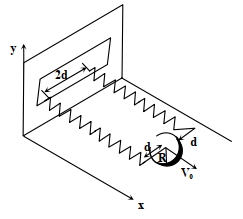
A uniform thin cylindrical disk of mass $\mathrm{M}$ and radius $\mathrm{R}$ is attached to two identical massless springs of spring constant $\mathrm{k}$ which are fixed to the wall as shown in the figure. The springs are attached to the axle of the disk symmetrically on either side at a distance $\mathrm{d}$ from its centre. The axle is massless and both the springs and the axle are in horizontal plane. The unstretched length of each spring is $L$. The disk is initially at its equilibrium position with its centre of mass $(CM)$ at a distance $L$ from the wall. The disk rolls without slipping with velocity $\overrightarrow{\mathrm{V}}_0=\mathrm{V}_0 \hat{\mathrm{i}}$. The coefficient of friction is $\mu$. Figure:$Image$

$1.$ The net external force acting on the disk when its centre of mass is at displacement $\mathrm{x}$ with respect to its equilibrium position is

$(A)$ $-\mathrm{kx}$ $(B)$ $-2 k x$ $(C)$ $-\frac{2 \mathrm{kx}}{3}$ $(D)$ $-\frac{4 k x}{3}$

$2.$ The centre of mass of the disk undergoes simple harmonic motion with angular frequency $\omega$ equal to

$(A)$ $\sqrt{\frac{k}{M}}$ $(B)$ $\sqrt{\frac{2 \mathrm{k}}{\mathrm{M}}}$ $(C)$ $\sqrt{\frac{2 \mathrm{k}}{3 \mathrm{M}}}$ $(D)$ $\sqrt{\frac{4 \mathrm{k}}{3 \mathrm{M}}}$

$3.$ The maximum value of $\mathrm{V}_0$ for which the disk will roll without slipping is

$(A)$ $\mu g \sqrt{\frac{\mathrm{M}}{\mathrm{k}}}$ $(B)$ $\mu g \sqrt{\frac{M}{2 k}}$ $(C)$ $\mu g \sqrt{\frac{3 M}{k}}$ $(D)$ $\mu g \sqrt{\frac{5 \mathrm{M}}{2 \mathrm{k}}}$

Give the answer question $1,2$ and $3.$