Question
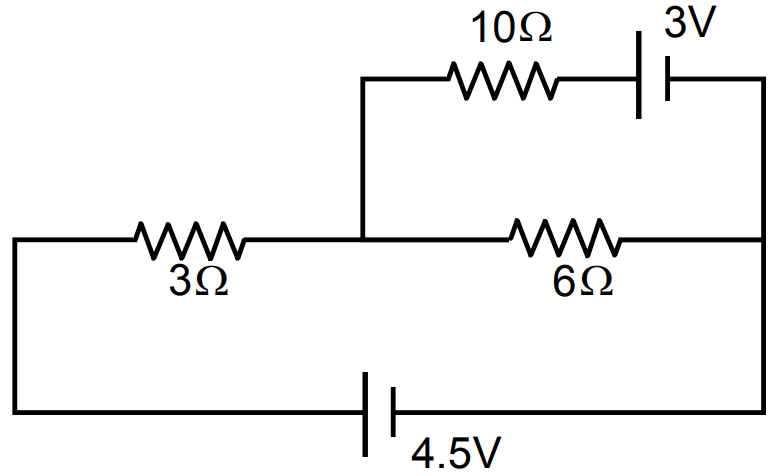
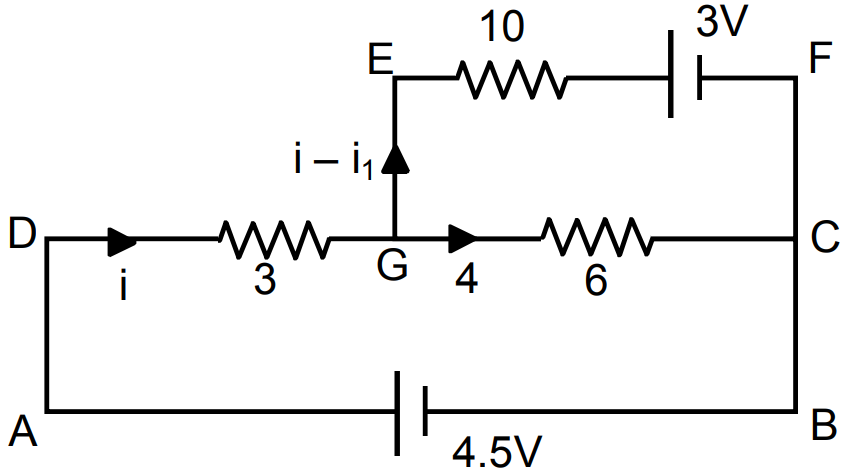
Find the current through the $10\Omega$ resistor shown in figure.
Answer

In the circuit ADCBA,

$3\text{i}+6\text{i}_1-4.5=0$
In the circuit GEFCG,
$3\text{i}+6\text{i}_1=4.5$
$=10\text{i}-10\text{i}_1-6\text{i}_1=-3$
$\Rightarrow[10\text{i}+16\text{i}_1=-3]3\ ...(1)$
$[3\text{i}+6\text{i}_1=4.5]10\ ...(2)$
From (1) and (2)
$-108\text{i}_1=-54$
$\Rightarrow\text{i}_1=\frac{54}{108}=\frac{1}{2}=0.5$
$3\text{i}+6\times\frac{1}{2}-4.5=0$
$3\text{i}-1.5=0\Rightarrow\text{i}=0.5$
Current through $10\Omega$ resistor = 0A.

Need a full question paper?

Generate a complete, print-ready paper with questions like this in minutes — across 16+ boards, with answer keys.
Start Generating Free

Similar questions

Figure. shows a cylindrical tube of length 30cm which is partitioned by a tight-fitting separator. The separator is very weakly conducting and can freely slide along the tube. Ideal gases are filled in the two parts of the vessel. In the beginning, the temperatures in the parts A and B are 400K and 100K respectively. The separator slides to a momentary equilibrium position shown in the figure. Find the final equilibrium position of the separator, reached after a long time.
By explaining magnetic field lines, write their characteristics.
Consider the situation shown in figure. The plates of the capacitor have plate area A and are clamped in the laboratory. The dielectric slab is released from rest with a length a inside the capacitor. Neglecting any effect of friction or gravity, show that the slab will execute periodic motion and find its time period.
The $\text{K}_\beta$ X-rays from certain elements are given below. Draw a Moseley-type plot of $\sqrt{\text{v}}$ versus Z for $\text{K}_\beta$ radiation.
Element
Ne
P
Ca
Mn
Zn
Br
Energy (keV)
0.858
2.14
4.02
6.51
9.57
13.3
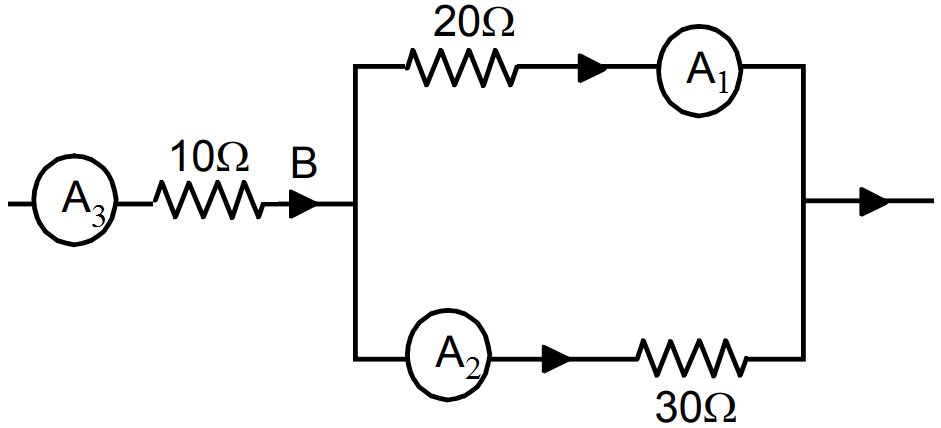
If the reading of the ammeter, $A_1$ in the figure. is 2.4A, what will be the readings of ammeters $A_2$ and $A_3?$ Neglect the resistances of the ammeters.
A capacitance C, a resistance R and an emf $\in$ are connected in series at t = 0. What is the maximum value of (a) the potential difference across the resistor (b) the current in the circuit (c) the potential difference across the capacitor (d) the energy stored in the capacitor (e) the power delivered by the battery and (f) the power converted into heat?
Two charged particles placed at a separation of 20cm exert 20N of Coulomb force on each other. What will be the force if the separation is increased to 25cm?
A converging lens of focal length 15cm and a converging mirror of focal length 10cm are placed 50cm apart with common principal axis. A point source is placed in between the lens and the mirror at a distance of 40cm from the lens. Find the locations of the two images formed.
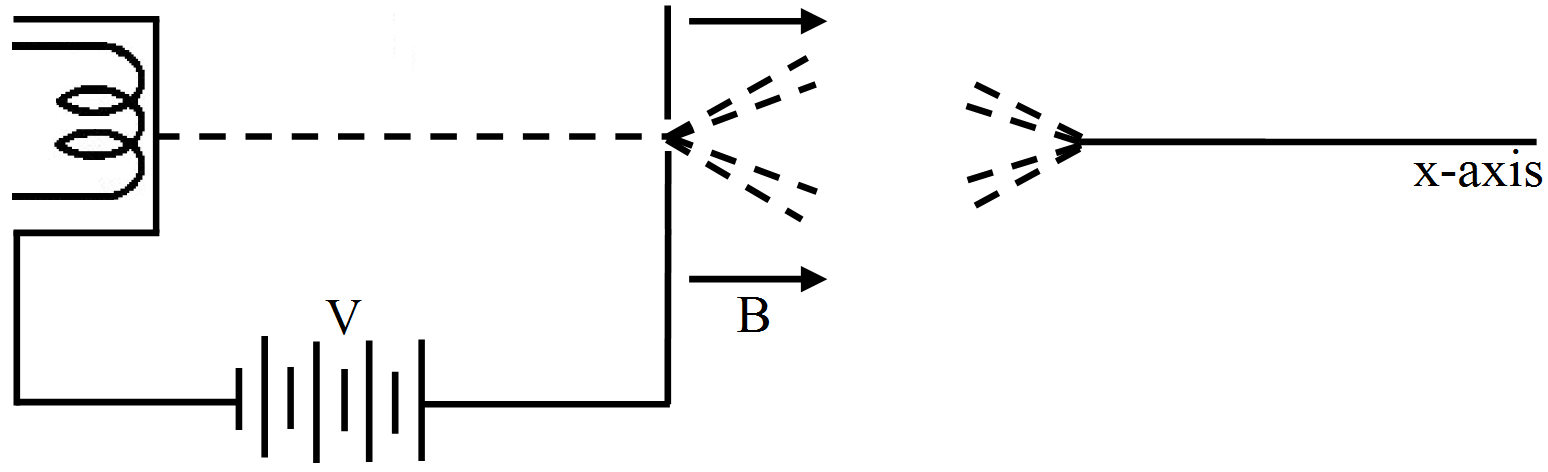
Electrons emitted with negligible speed from an electron gun are accelerated through a potential difference V along the x-axis. These electrons emerge from a narrow hole into a uniform magnetic field B directed along this axis. However, some of the electrons emerging from the hole make slightly divergent angles, as shown in the figure. Show that these paraxial electrons are refocussed on the x-axis at a distance $\sqrt{\frac{8\pi^2\text{mV}}{\text{eB}^2}}.$
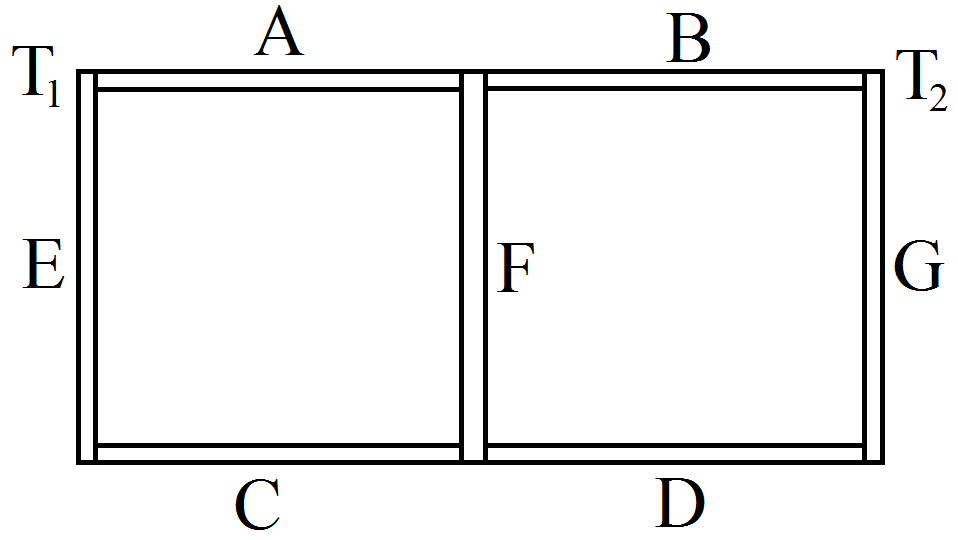
Seven rods A, B, C, D, E, F and G are joined as shown in figure. All the rods have equal cross-sectional area A and length l. The thermal conductivities of the rods are $K_A = K_c = K_0, K_B = K_D = 2K_0, K_E= 3K_{0,} K_F = 4K_0,$ and $K_G = 5K_0.$ The rod E is kept at a constant temperature $T_2$ and the rod G is kept at a constant temperature $T_2(T_2 > T_1).$
  1. Show that the rod F has a uniform temperature $\text{T}=\frac{(\text{T}_1+2\text{T}_2)}{3}.$
  2. Find the rate of heat flowing from the source which maintains the temperature $T_2.$