Question
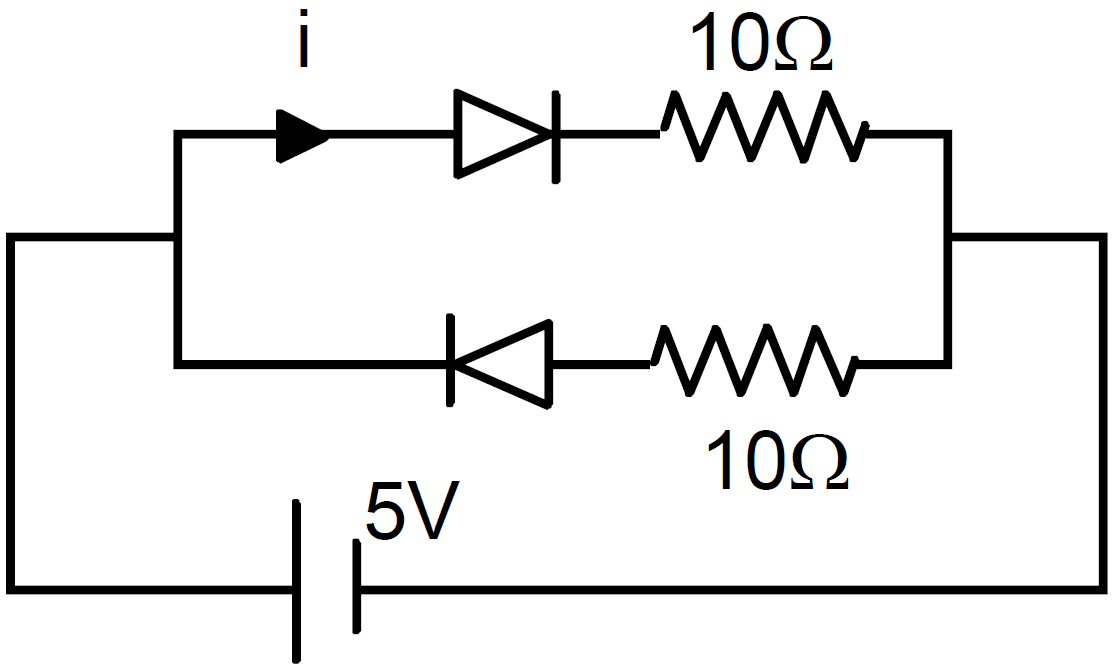
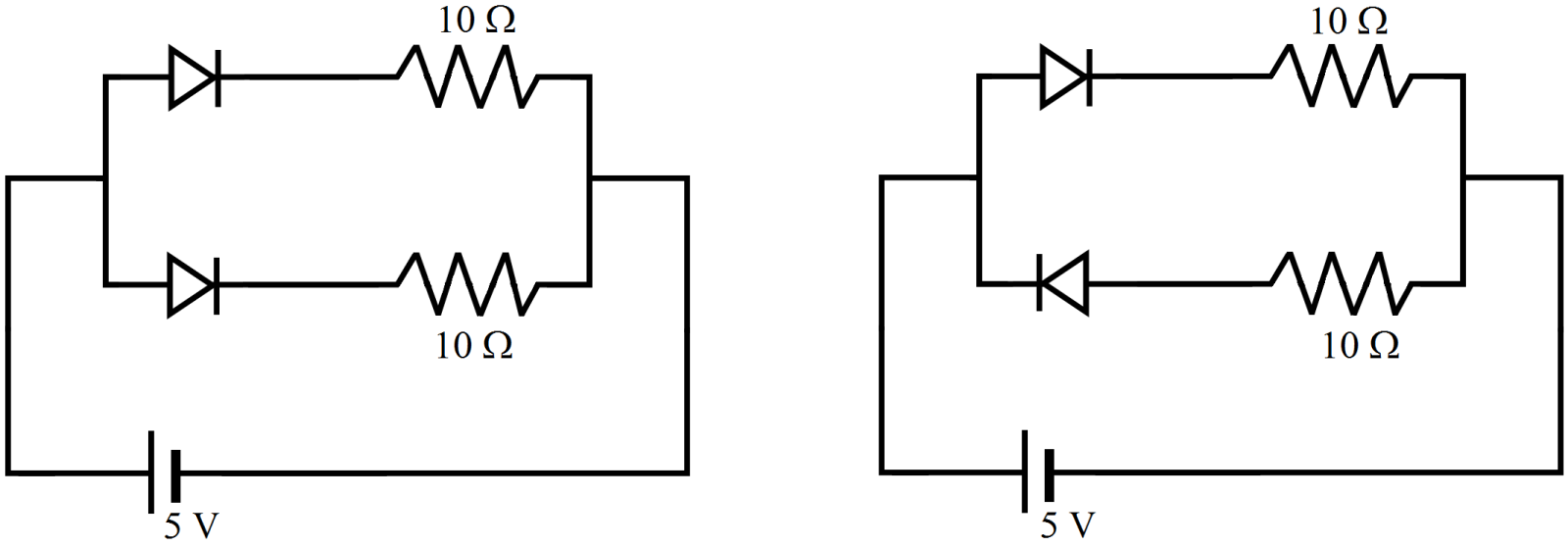
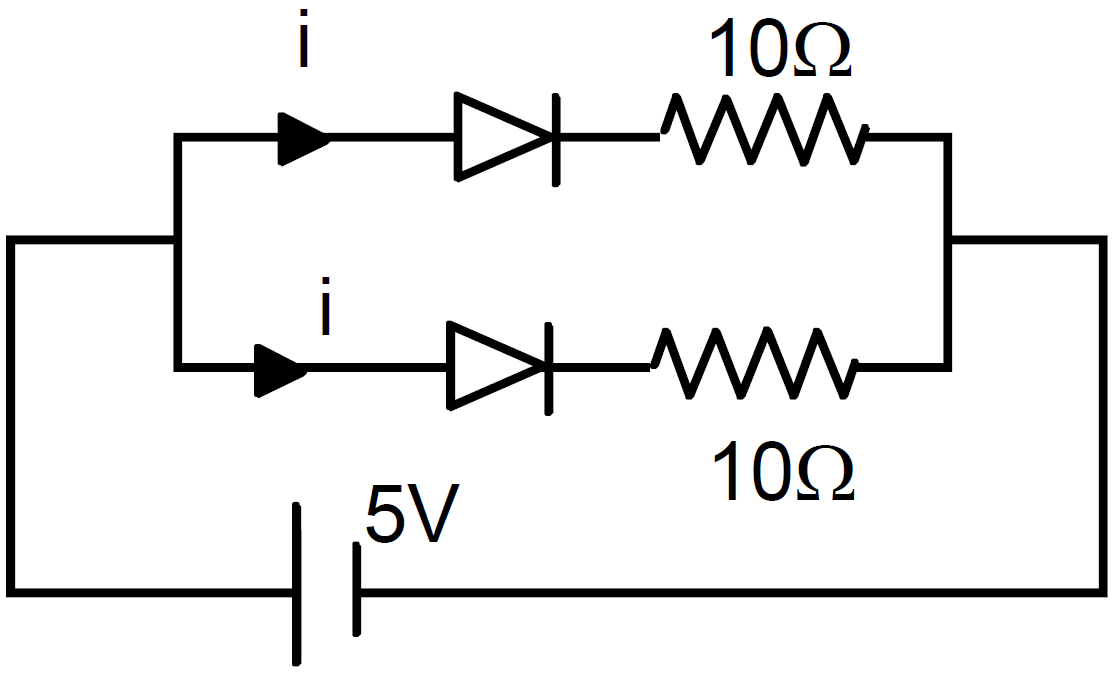
Find the current through the battery circuits shown in figure.

Answer

Both diodes are forward biased. Thus the net diode resistance is 0.

$\text{i}=\frac{5}{\frac{10\times10}{10+10}}=\frac{5}{5}=1\text{A}$
One diode is forward biased and other is reverse biased.

$\text{i}=\frac{\text{V}}{\text{R}_\text{net}}=\frac{5}{10+0}=\frac{1}{2}=0.5\text{A}$

Need a full question paper?

Generate a complete, print-ready paper with questions like this in minutes — across 16+ boards, with answer keys.
Start Generating Free

Similar questions

A container of volume 50cc contains air (mean molecular weight = 28.8g) and is open to atmosphere where the pressure is 100kPa. The container is kept in a bath containing melting ice (0°C).
  1. Find the mass of the air in the container when thermal equilibrium is reached.
  2. The container is now placed in another bath containing boiling water (100°C). Find the mass of air in the container.
  3. The container is now closed and placed in the melting-ice bath. Find the pressure of the air when thermal equilibrium is reached.
A metal ball of mass 1kg is heated by means of a 20W heater in a room at 20°C. The temperature of the ball becomes steady at 50°C.
  1. Find the rate of loss of heat to the surrounding when the ball is at 50°C.
  2. Assuming Newton's law of cooling, calculate the rate of loss of heat to the surrounding when the ball is at 30°C.
  3. Assume that the temperature of the ball rises uniformly from 20°c to 30°C in 5 minutes. Find the total loss of heat to the surrounding during this period.
  4. Calculate the specific heat capacity of the metal.
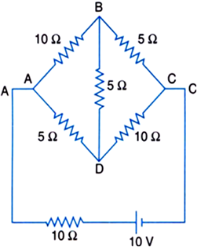
Determine the current in each branch of the network shown in Fig.:

It is 260km from Patna to Ranchi by air and 320km by road. An aeroplane takes 30 minutes to go from Patna to Ranchi whereas a delux bus takes 8 hours.
  1. Find the average speed of the plane.
  2. Find the average speed of the bus.
  3. Find the average velocity of the plane.
  4. Find the average velocity of the bus.
A ball is whirled in a circle by attaching it to a fixed point with a string. Is there an angular rotation of the ball about its centre? If yes, is this angular velocity equal to the angular velocity of the ball about the fixed point?
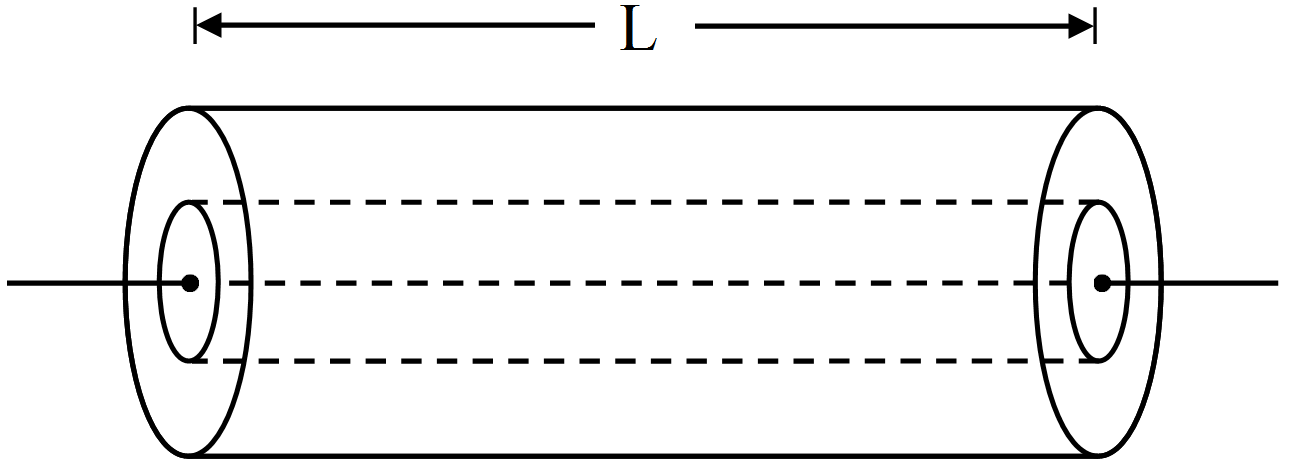
Figure shows two long coaxial solenoids, each of length ‘L’. The outer solenoid has an area of cross-section A1 and number of turns/ length n1 The corresponding values for the inner solenoid are A2 and n2 Write the expression for self-inductance L1, L2 of the two coils and their mutual inductance M. Hence show that $\text{M}<\sqrt{\text{L}_2\text{L}_2}.$

It is found that yellow light does not eject photoelectrons from a metal. Is it advisable to try with orange light? With green light?
With the help of a labelled diagram, state the underlying principle of a cyclotron.
Explain clearly how it works to accelerate the charged particles. Show that cyclotron frequency is independent of energy of the particle. Is there an upper limit on the energy acquired by the particle? Give reason.
Explain the experiments of Faraday and Henry for explaining and describing the phenomenon of electromagnetic induction.
Consider a uniformly charged ring of radius R. Find the point on the axis where the electric field is maximum.