Question
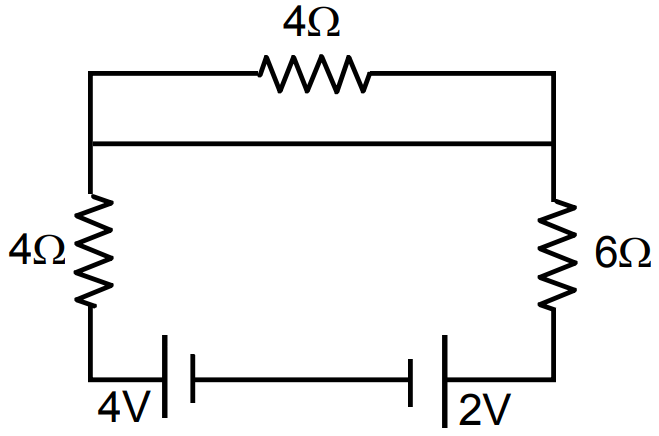
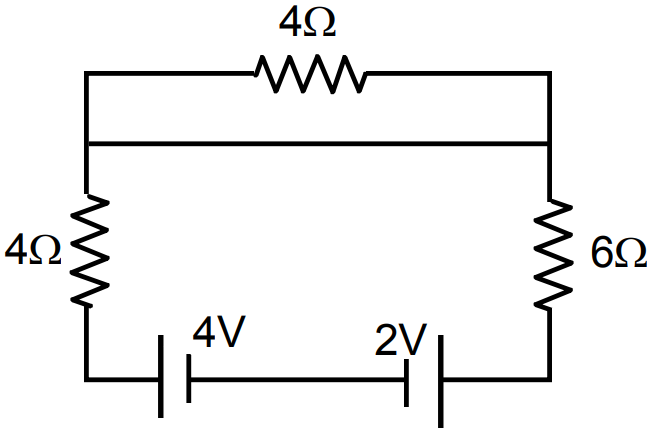
Find the currents through the three reaiators shown in figure.

Answer


  1. Current through (1) $4\Omega$ resistor = 0
  2. Current through (2) and (3)
net E = 4V - 2V = 2V

(2) and (3) are in series,

$\text{R}_\text{eff}=4+6=10\Omega$

$\text{i}=\frac{2}{10}=0.2\text{A}$

Current through (2) and (3) are 0.2A.

Need a full question paper?

Generate a complete, print-ready paper with questions like this in minutes — across 16+ boards, with answer keys.
Start Generating Free

Similar questions

A neutron initially at rest, decays into a proton, an electron and an antineutrino. The ejected electron has a momentum of $1.4 \times 10^{-26}$kg-m/s and the antineutrino $6.4 \times 10^{-27}$kg-m/s. Find the recoil speed of the proton:
  1. If the electron and the antineutrino are ejected along the same direction.
  2. If they are ejected along perpendicular directions. Mass of the proton $= 1.67 \times 10^{-27}$kg.
  1. Derive an expression for drift velocity of electrons in a conductor. Hence, deduce Ohm's law.
  2. A wire whose cross-sectional area is increasing linearly from its one end to the other, is connected across a battery of V volts.
Which of the following quantities remain constant in the wire?
  1. Drift speed.
  2. Current density.
  3. Electric current.
  4. Electric field.
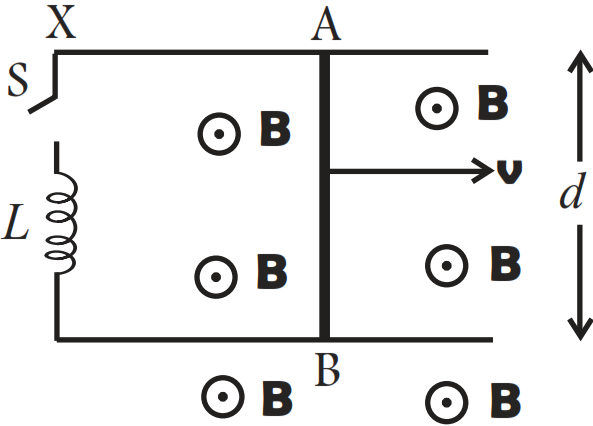
Find the current in the sliding rod AB (resistance = R) for the arrangement shown in Fig. B is constant and is out of the paper. Parallel wires have no resistance. v is constant. Switch S is closed at time t = 0.
On the basis of Bohr's postulates, derive the expression for orbital speed of electron for $n ^{\text {th }}$ stable orbit in hydrogen atom. Energy in ground state of hydrogen atom is $(-) XeV$. What will be the kinetic energy in this state?
The half-life of $^{40}K$ is $1.30 \times 10^9y$. A sample of 1.00g of pure KCI gives 160 counts/ s. Calculate the relative abundance of $^{40}K$ (fraction of $^{40}K$ present) in natural potassium.
A glass tube, sealed at both ends, is 100cm long. It lies horizontally with the middle 10cm containing mercury. The two ends of the tube contain air at 27°C and at a pressure 76cm of mercury. The air column on one side is maintained at 0°C and the other side is maintained at 127°C. Calculate the length of the air column on the cooler side. Neglect the changes in the volume of mercury and of the glass.
A long, straight wire is fixed horizontally and carries a current of 50.0A. A second wire having linear mass density $1.0 \times 10^{-4}kg/m$ is placed parallel to and directly above this wire at a separation of 5.0mm. What current should this second wire carry such that the magnetic repulsion can balance its weight?
A boy riding on a bicycle going at 12km/h towards a vertical wall whistles at his dog on the ground. If the frequency of the whistle is 1600Hz and the speed of sound in air is 330m/s, find
  1. The frequency of the whistle as received by the wall.
  2. The frequency of the reflected whistle as received by the boy.
The current−voltage characteristic of an ideal p-n junction diode is given by $\text{i}=\text{i}_0\Big(\text{e}^{\frac{\text{eV}}{\text{kT}}}-1\Big)$ where, the drift current $i_0$ equals $10\mu\text{A}.$ Take the temperature T to be 300K.
  1. Find the voltage $V_0$ for which $\text{e}^{\frac{\text{eV}}{\text{KT}}}=100.$ One can neglect the term 1 for voltages greater than this value.
  2. Find an expression for the dynamic resistance of the diode as a function of V for $V > V_0.$
  3. Find the voltage for which the dynamic resistance is $0.2\Omega.$
The magnetic field inside a long solenoid having 50 turns/cm is increased from $2.5 × 10.3T$ to $2.5T$ when an iron core of cross-sectional area $4cm^2$ is inserted into it. Find:
  1. The current in the solenoid.
  2. The magnetization I of the core.
  3. The pole strength developed in the core.