Question
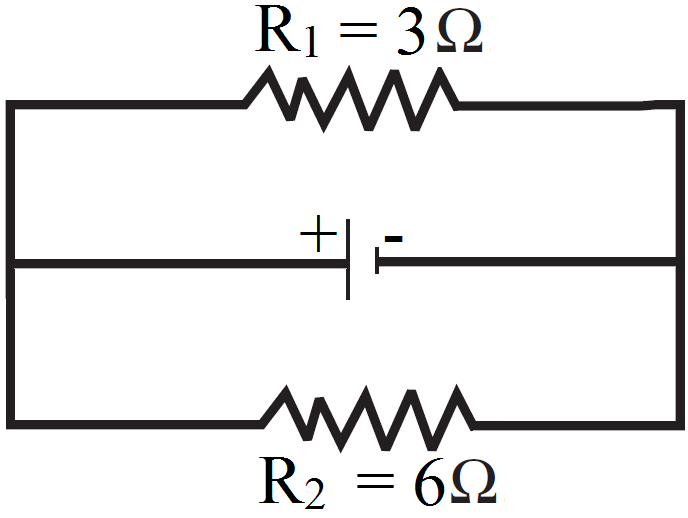
Find the effective resistance of the combination.
Answer

$\text{R}_1=4\Omega$

$\text{R}_2=8\Omega$

Potential sifference = V

$\text{I}_1=\frac{\text{V}_1}{\text{R}_1}=\frac{\text{V}}{4\Omega}$

$\text{I}_2=\frac{\text{V}}{\text{R}_2}=\frac{\text{V}}{8\Omega}$

$\frac{\text{I}_1}{\text{I}_2}=\frac{\text{V}}{\text{V}}=\frac{4\Omega}{8\Omega}$

$\Rightarrow\frac{\text{I}_1}{\text{I}_2}= \frac{8}{4}$

$\Rightarrow\frac{\text{I}_1}{\text{I}_2}= \frac{2}{1}$

$\therefore \text{I}_1:\text{I}_?=2:\text{I}$

Need a full question paper?

Generate a complete, print-ready paper with questions like this in minutes — across 16+ boards, with answer keys.
Start Generating Free

Similar questions

Calculate the ratio of the equivalent resistance of the above two wires in parallel combination to that in series combination.
Why are coils of electric toasters and electric irons made of an alloy rather than a pure metal?
A current-carrying straight wire is held in exactly vertical position. If the current passes through this wire in the vertically upward direction, what is the direction of magnetic field produced by it? Name the rule used to find the direction of magnetic field.
Why does a ray of light passing through the centre of curvature of a concave mirror gets reflected along same path after reflection?
A coil of insulated wire is connected to a galvanometer. What would be seen if a bar magnet with its north pole towards one face of the coil is:
  1. Moved quickly towards it.
  2. Moved quickly away from the coil.
  3. Placed near its one face?
  4. Name the phenomenon involved.
Draw ray diagrams showing the image formation by a concave lens when an object is placed:
At the focus of the lens.
The figure below shows a variable resistor in a dimmer switch.

How would you turn the switch to make the lights: (a) brighter, and(b) dimmer? Explain your answer.
It is desired to obtain an erect image of an object, using concave mirror of focal length of 12cm.
Where will the image of this object be, if it is placed 24cm in front of the mirror? Draw ray diagram for this situation also to justify your answer.
Show the positions of pole, principal focus and the centre of curvature in the above ray diagrams.
A doctor has prescribed a corrective lens of power, -1.5D. Find the focal length of the lens. Is the prescribed lens diverging or converging?
Define:
  1. Principal focus of a concave mirror.
  2. Focal length of a concave mirror.