MCQ
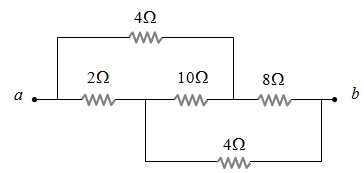
Find the equivalent resistance between the points $a$ and $b$
  • A
    $2 \Omega$
  • $4 \Omega$
  • C
    $8 \Omega$
  • D
    $16 \Omega$

Answer

Correct option: B.
$4 \Omega$
$4 \Omega$

Need a full question paper?

Generate a complete, print-ready paper with questions like this in minutes — across 16+ boards, with answer keys.

Start Generating Free

Similar questions

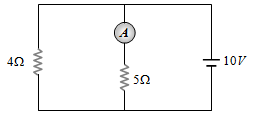
In the circuit, the reading of the ammeter is $($assume internal resistance of the battery be zero$)$
A magnet of magnetic moment $20 \ \ce{C.G.S}.$ units is freely suspended in a uniform magnetic field of intensity $0.3\ \ce{C.G.S}.$ units. The amount of work done in deflecting it by an angle of $30^{\circ}$ in $\ce{C.G.S}.$ units is
If $\mu_0$ and $\epsilon_0$ be permeability and electrical permittivity of vacuum respectively, then velocity of electromagnetic waves in vacuum is :
Mark out the correct options.
  1. Diamagnetism occurs in all materials.
  2. Diamagnetism results from the partial alignment of permanent magnetic moment.
  3. The magnetizing field intensity H is always zero in free space.
  4. The magnetic field of induced magnetic moment is opposite to the applied field.
The magnetic flux linked with a coil is given by an equation $\emptyset ($in webers$) = 8 t^2+3 t+5.$ The induced $e.m.f.$ in the coil at the fourth second will be
The eye can detect $5 \times 10^4$ photons per square metre per $\sec$ of green light $(l = 5000 \mathring A)$ while the ear can detect $10^{-13} (W/m^2)$. The factor by which the eye is more sensitive as a power detector than the ear is close to
$1.6 \ mA$ current is flowing in conducting wire then the number of electrons flowing per second is
An electron in the n = 1 orbit of hydrogen atom is bound by 13.6 eV. If a hydrogen atom is in the n = 3 state, how much energy is required to ionize it(a) 13.6 eV(b) 4.53 eV(c) 3.4 eV (d) 1.51 eV
       
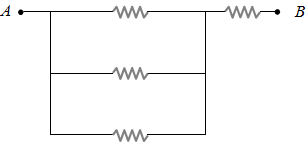
If all the resistors shown have the value $2$ ohm each, the equivalent resistance over $AB$ is
A transformer increases ac voltage supply from 220 V to 2200 V. If there are 2000 turns in the second- ary coil, then number of turns in the primary coil is: