The resistance of a coil is $4.2 \Omega$ at $100^{\circ} \mathrm{C}$ and the temperature coefficient of resistance of its material is $0.004 /{ }^{\circ} \mathrm{C}$. Its resistance at $0^{\circ} \mathrm{C}$ is
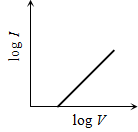
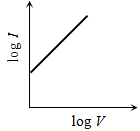
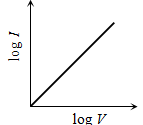
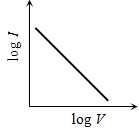
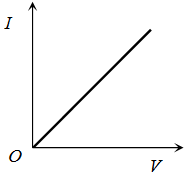
When a current $I$ is passed through a wire of constant resistance, it produces a potential difference $V$ across its ends. The graph drawn between $\log I$ and $\log V$ will be
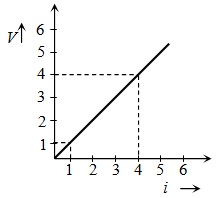
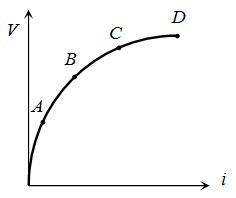
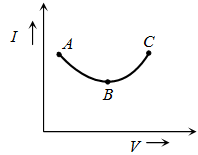
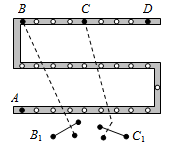
Variation of current passing through a conductor as the voltage applied across its ends as varied is shown in the adjoining diagram. If the resistance $(R)$ is determined at the points $A, B, C$ and $D,$ we will find that
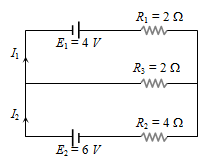
In the circuit shown below $\mathrm{E}_1=4.0 \mathrm{~V}, \mathrm{R}_1=2 \Omega, \mathrm{E}_2=6.0 \mathrm{~V}, \mathrm{R}_2=4 \Omega$ and $\mathrm{R}_3=2 \Omega$. The current $\mathrm{I}_1$ is
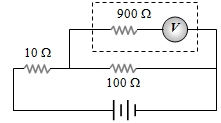
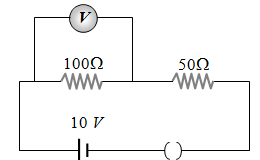
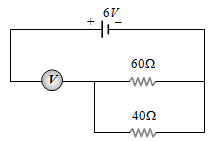
The potential difference across the $100\Omega$ resistance in the following circuit is measured by a voltmeter of $900\Omega$ resistance. The percentage error made in reading the potential difference is
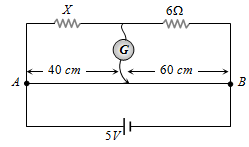
In the circuit shown, a meter bridge is in its balanced state. The meter bridge wire has a resistance $0.1\ ohm/cm$. The value of unknown resistance $X$ and the current drawn from the battery of negligible resistance is
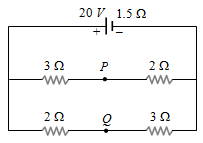
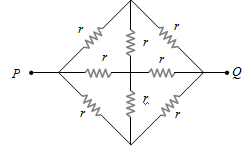
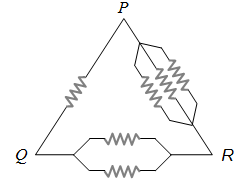
If in the circuit shown below, the internal resistance of the battery is $1.5 \Omega$ and $\mathrm{V}_{\mathrm{P}}$ and $\mathrm{V}_{\mathrm{Q}}$ are the potentials at $P$ and $Q$ respectively, what is the potential difference between the points $P$ and $Q$
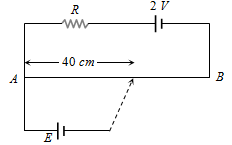
$AB$ is a potentiometer wire of length $100 \ cm$ and its resistance is $10$ ohms. It is connected in series with a resistance $R = 40$ ohms and a battery of $\text{e.m.f.}\ 2 V$ and negligible internal resistance. If a source of unknown $\text{e.m.f.} \ E$ is balanced by $40 \ cm$ length of the potentiometer wire, the value of $E$ is
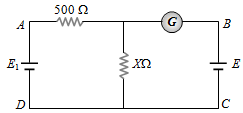
In the adjoining circuit, the battery $E_1$ has an $\text{e.m.f}$ of $12$ volt and zero internal resistance while the battery $E$ has an $\text{e.m.f}$ of $2$ volt. If the galvanometer $G$ reads zero, then the value of the resistance $X$ in ohm is
An electron $($charge $=1.6 \times 10^{-19}$ coulomb$)$ is moving in a circle of radius $5.1 \times 10^{-11} \mathrm{~m}$ at a frequency of $6.8 \times 10^{15}$ revolutions $/ \mathrm{sec}$. The equivalent current is approximately
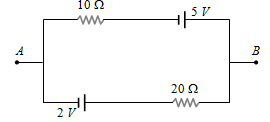
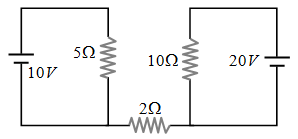
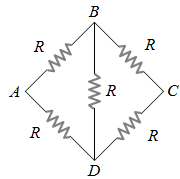
In the circuit shown here, $E_1=E_2=E_3=2 \mathrm{~V}$ and $R_1=R_2=4 \ \ce{ohms}.$ The current flowing between points $A$ and $B$ through battery $E_2$ is
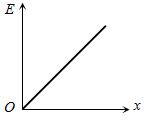
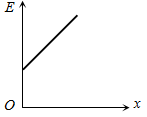
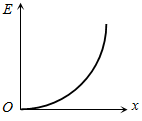
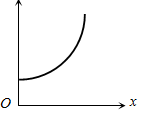
A cylindrical conductor has uniform cross$-$section. Resistivity of its material increase linearly from left end to right end. If a constant current is flowing through it and at a section distance $x$ from left end, magnitude of electric field intensity is $E,$ which of the following graphs is correct
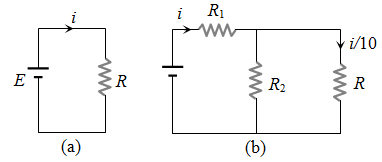
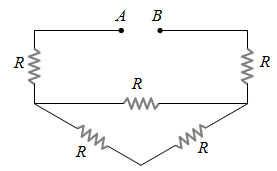
Consider the circuits shown in the figure. Both the circuits are taking same current from battery but current through $R$ in the second circuit is $\frac{1}{10}^{th}$ of current through $R$ in the first circuit. If $R$ is $11 \Omega$, the value of $R_1$
A wire of length $100 \ cm$ is connected to a cell of emf $2\ V$ and negligible internal resistance. The resistance of the wire is $3\Omega$. The additional resistance required to produce a potential drop of $1$ milli volt per cm is
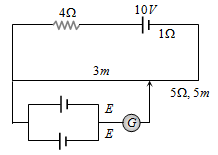
A resistance of $4 \Omega$ and a wire of length $5$ metres and resistance $5 \Omega$ are joined in series and connected to a cell of $\text{e.m.f.} 10 V$ and internal resistance $1 \Omega.$ A parallel combination of two identical cells is balanced across $300 \ cm$ of the wire. The $\text{e.m.f. E}$ of each cell is
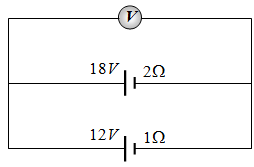
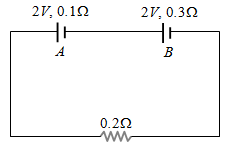
Two batteries, one of emf $18$ volts and internal resistance $2\Omega$ and the other of emf $12$ volt and internal resistance $1 \Omega,$ are connected as shown. The voltmeter $V$ will record a reading of
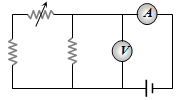
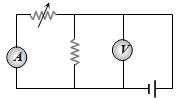
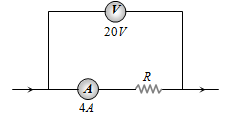
In the diagram shown, the reading of voltmeter is $20 V$ and that of ammeter is $4 A$. The value of $R$ should be $($Consider given ammeter and voltmeter are not ideal$)$
A
Equal to $5 \Omega$
B
Greater from $5 \Omega$
✓
Less than $5 \Omega$
D
Greater or less than $5 \Omega$ depends on the material of $R$
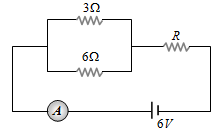
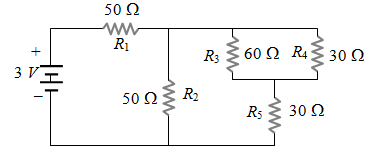
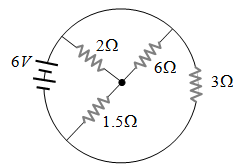
In circuit shown below, the resistances are given in $\ce{ohms}$ and the battery is assumed ideal with emf equal to $3$ volt. The voltage across the resistance $R_4$ is