Question
Find the general solution of the differential equation $\frac{\text{dy}}{\text{dx}}-{\text{y}}=\cos\text{x}$

Answer

We have,
$\frac{\text{dy}}{\text{dx}}-{\text{y}}=\cos\text{x}$
Clearly, it is a linear differential equation of the form
$\frac{\text{dy}}{\text{dx}}+\text{P}\text{y}=\text{Q}$
Where P = -1 and $\text{Q}=\cos\text{x}$
$\therefore\text{ I}.\text{F}.=\text{e}^{\int{\text{P}\text{dx}}}$
$=\text{e}^{-\int\text{dx}}$
$=\text{e}^{-\text{x}}$
Multiplying both sides of (1) by $\text{I.F.}=\text{e}^{-\text{x}},$ we get
$\text{e}^{-\text{x}}\Big(\frac{\text{dy}}{\text{dx}}-\text{y}\Big)=\text{e}^{-\text{x}}\cos\text{x}$
$\Rightarrow\text{e}^{-\text{x}}\frac{\text{dy}}{\text{dx}}-\text{e}^{-\text{x}}\text{y}=\text{e}^{-\text{x}}\cos\text{x}$
Integrating both sides with respect to x, we get
$\text{y}\text{e}^{-\text{x}}=\int \ \text{e}^{-\text{x}} \cos\text{x}\text{ dx} \ + \ \text{C}$
$\Rightarrow\text{ye}^{-\text{x}}=\text{I}+\text{C} \ ....(2)$
Here,
$\text{I}=\int\text{e}^{-\text{x}}\cos\text{x}\text{ dx}\ ..(3)$
$\Rightarrow\text{I}=\text{e}^{-\text{x}}\sin{\text{x}}-\int\big(-\text{e}^{-\text{x}}\sin\text{x}\big)\text{dx}$
$\Rightarrow\text{I}=\text{e}^{-\text{x}}\sin\text{x}+\int {\text{e}^{-\text{x}}}\sin\text{x}\text{ dx}$
$\Rightarrow\text{I}= \text{e}^{-\text{x}}\sin \text{x}-\text{e}^{-\text{x}}\cos\text{x}-\int[(-\text{e}^{-\text{x}})\times(-\cos\text{x})]\text{dx}$
$\Rightarrow\text{I}=\text{e}^{-\text{x}}\sin\text{x}-\text{e}^{-\text{x}}\cos\text{x}-\int\text{e}^{-\text{x}}\cos\text{x}\text{ dx}$
$\Rightarrow\text{I}=\text{e}^{-\text{x}}\sin\text{x} - \text{e}^{-\text{x}}\cos\text{x} - \text{I}$ [From (3)]
$ \Rightarrow2\text{I}=\text{e}^{-\text{x}}(\sin\text{x}-\cos\text{x})$
$\Rightarrow\text{I}=\frac{\text{e}^{-\text{x}}}{2}(\sin\text{x}-\cos{\text{x}})\ ...(4)$
From (2) and (4) we get
$\Rightarrow\text{y}\text{e}^{-\text{x}}=\frac{\text{e}^{-\text{x}}}{2}(\sin\text{x} - \cos\text{x})+\text{C}$
$\Rightarrow\text{y}=\frac{1}{2}(\sin\text{x} - \cos\text{x}) +\text{C}\text{e}^{\text{x}}$
Hence, $\text{y}=\frac{1}{2}(\sin\text{x} - \cos\text{x}) +\text{C}\text{e}^{\text{x}}$ is the requires solution.

Need a full question paper?

Generate a complete, print-ready paper with questions like this in minutes — across 16+ boards, with answer keys.
Start Generating Free

Similar questions

In what ratio deose the x-axies divide the area of the region bounded by the parabolas y = 4x - x2 and y = x2 - x?
Find the equation of the tangent to the curve $\text{y}=\sqrt{3}\text{x}-2$ which is parallel to the 4x − 2y + 5 = 0.
The adjacent sides of a parallelogram are represented by the vectors $\vec{\text{a}}=\hat{\text{i}}+\hat{\text{j}}-\hat{\text{k}}$ and $\vec{\text{b}}=-2\hat{\text{i}}+\hat{\text{j}}+2\hat{\text{k}}$. Find the unit vectors parallel to the diagonals of the parallelogram.
Using differentials, find the approximate values of the following:
$(0.009)^{\frac{1}{3}}$
A manufacturer of electronic circuits has a stock of 200 resistors, 120 transistors and 150 capacitors and is required to produce two types of circuits A and B. Type A requires 20 resistors, 10 transistors and 10 capacitors. Type B requires 10 resistors, 20 transistors and 30 capacitors. If the profit on type A circuit is Rs. 50 and that on type B circuit is Rs. 60, formulate this problem as a LPP so that the manufacturer can maximise his profit.
Find the matrix X satisfying the equation:
$\begin{bmatrix}2 & 1 \\5 & 3 \end{bmatrix}\text{X}\begin{bmatrix}5 & 3 \\3 & 2 \end{bmatrix}=\begin{bmatrix}1 & 0 \\0 & 1 \end{bmatrix}.$
Maximize Z = 5x + 3y
Subject to
$3\text{x}+5\text{y}\leq15$
$5\text{x}+2\text{y}\leq10$
$\text{x},\text{y}\geq0$
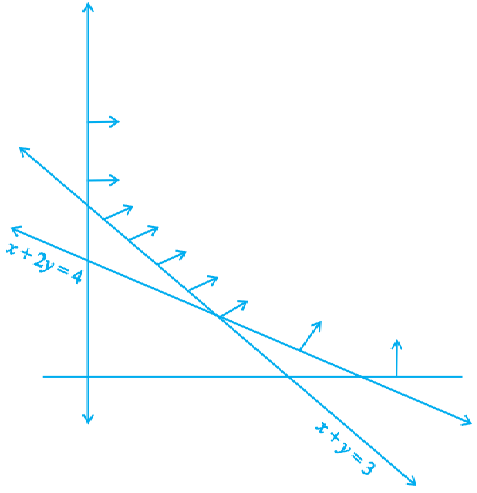
The feasible region for a LPP is shown in Evaluate Z = 4x + y at each of the corner points of this region. Find the minimum value of Z, if it exists.

Solve the following differential equations:

$\text{y}(1-\text{x}^2)\frac{\text{dy}}{\text{dx}}=\text{x}(1+\text{y}^2)$

Solve the following differential equations:
$\frac{\text{dy}}{\text{dx}}=1-\text{x + y}-\text{xy}$