Question
Find the intensity at a point on a screen in Young’s double slit experiment where the interfering waves of equal intensity have a path difference of (i) $\lambda/4$, and (ii) $\lambda/3$.

Answer

Path difference 𝜆/4 ⟹ phase difference 𝜋/2
Path difference 𝜆/3 ⟹ phase difference (2𝜋/3)
$I=4I_0\cos^2\Big(\frac{\theta}{2}\Big)$
  1. $I_1=4I_0\times\frac{1}{2}=2I_0$
  2. $I_2=4I_0\times\frac{1}{4}=I_0$

Need a full question paper?

Generate a complete, print-ready paper with questions like this in minutes — across 16+ boards, with answer keys.
Start Generating Free

Similar questions

A light bulb is rated at $100 W$ for a $220 V$ supply. Find (a) the resistance of the bulb; (b) the peak voltage of the source; and (c) the rms current through the bulb.
Using Bohr model, calculate the electric current created by the electron when the H-atom is in the ground state.
(a) Calculate the potential at a point $P$ located at a distance of 9 cm due to the charge $4 \times 10^{-7} C$.(b) Now, find the work done in bringing the charge $2 \times 10^{-9} C$ from infinity to point P . Does the answer depend on the path along which the charge is brought?
Write the function of a (i) Transducer and (ii) Repeater in a communication system.
Answer the following question:
You have learnt that plane and convex mirrors produce virtual images of objects. Can they produce real images under some circumstances? Explain.
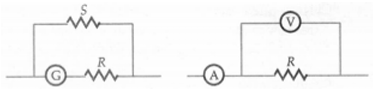
A galvanometer has a resistance of $8 \Omega$ . It gives a full scale deflection for a current of 10 mA. It is to be converted into an ammeter of range 5 A. The only shunt resistance available is of $0.02 \Omega$ , which is not suitable for this conversion. Find the value of resistance R that must be connected in series with the galvanometer (Fig.) to get ammeter of desired range.
Image
  1. Write the necessary conditions for the phenomenon of total internal reflection to occur.
  2. Write the relation between the refractive index and critical angle for a given pair of optical media.
Answer the following question:
In a single slit diffraction experiment, the width of the slit is made double the original width. How does this affect the size and intensity of the central diffraction band?
A transparent paper (refractive index = 1.45) of thickness 0.02mm is pasted on one of the slits of a Young's double slit experiment which uses monochromatic light of wavelength 620nm. How many fringes will cross through the centre if the paper is removed?
A different of 2.3 eV separates two energy levels in an atom. What is the frequency of radiation emitted when the atom make a transition from the upper level to the lower level?