Question
Find the maximum potential difference which may be applied across an X-ray tube with tungsten target without emitting any characteristic K or L X-ray. The energy levels of the tungsten atom with an electron knocked out are as follows.
Cell containing vacancy
K
L
M
Energy in keV
69.5
11.3
2.3

Answer

Let for, k series emission the potential required = v

$\therefore$ Energy of electrons = ev

This amount of energy ev = energy of L shell

The maximum potential difference that can be applied without emitting any electron is 11.3ev.

Need a full question paper?

Generate a complete, print-ready paper with questions like this in minutes — across 16+ boards, with answer keys.

Start Generating Free

Similar questions

Two cylinders A and B of equal capacity are connected to each other via a stop-cock. ‘A’contains a gas at S.T.P. 'B' is completely evacuated. The entire system is thermally insulated. The stop-cock is suddenly opened.

Answer the following:

  1. What is the change in internal energy of the gas?
  2. What is the change in the temperature of the gas?
The position of a particle is given by
$
r =3.0 t \hat{ i }+2.0 t^2 \hat{ j }+5.0 \hat{ k }
$
where $t$ is in seconds and the coefficients have the proper units for $r$ to be in metres. (a) Find $v (t)$ and $a(t)$ of the particle. (b) Find the magnitude and direction of $v (t)$ at $t=1.0 s$.
At depth $x$ from the earth's surface the value of $g^{\prime}$ remains half of that of at the surface. What will be the value of $g ^{\prime}$ obtained at the same height.
Calculate the number of atoms in 39.4g gold. Molar mass of gold is 197g mole–1.
When small drops of water are sprayed, why is cooling produced?
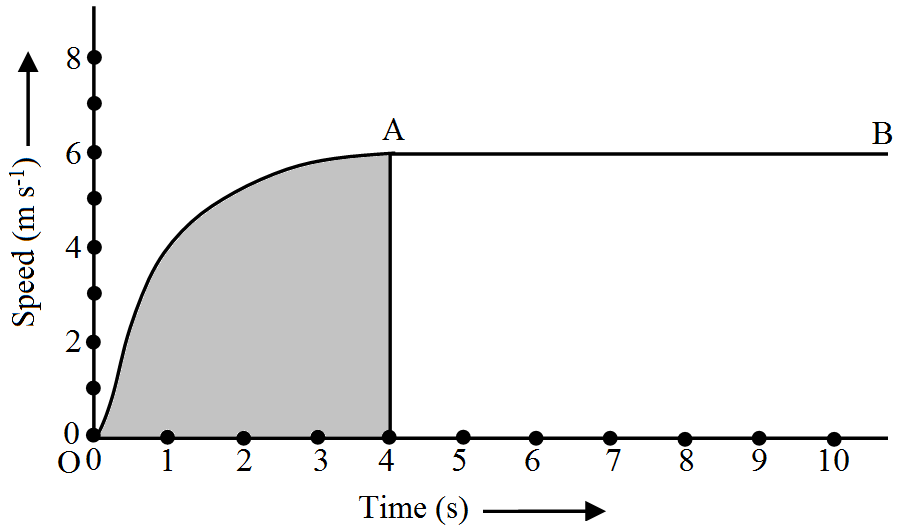
The speed time graph for a car is shown in Fig.

  1. Find how far does the car travel in the first 4 seconds. Shade the area on the graph that represents the distance travelled by the car during the period.
  2. Which part of the graph represents uniform motion of the car?
Prove that the motion of the particle system relative to the center of mass the total mass moment of the particle is zero.
Find the dimensions of:

  1. Angular speed $\omega.$
  2. Angular acceleration $\alpha.$
  3. Torque $\tau$ and
  4. Moment of interia I.
Some of the equations involving these quantities are

$\omega=\frac{\theta_2-\theta_1}{\text{t}_2-\text{t}_1},\alpha=\frac{\omega_2-\omega_1}{\text{t}_2-\text{t}_1},\tau=\text{F.r}$ and $\text{I = mr}^2.$

The symbols have standard meanings.

The outer surface of a cylinder containing a gas is rubbed vigorously by a polishing machine. The cylinder and its gas become warm. Is the energy transferred to the gas heat or work?
Two liquids of specific gravity 1.2 and 0.84 are poured into the limbs of a U-tube until the difference in levels of their upper surfaces is 9cm. What will be the heights of their respective surfaces above the common surface in U-tube? What is the pressure at the common surface (lg = 10ms?)