Question
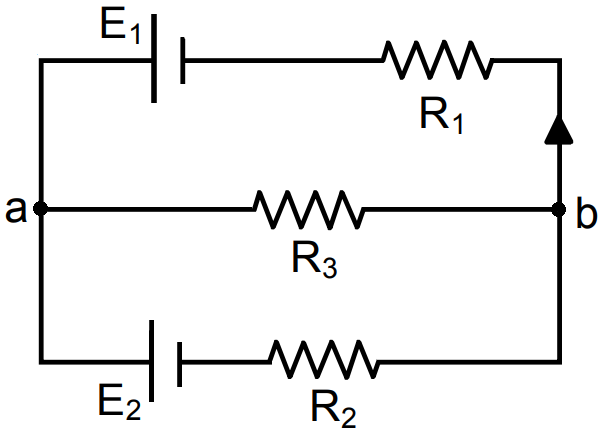
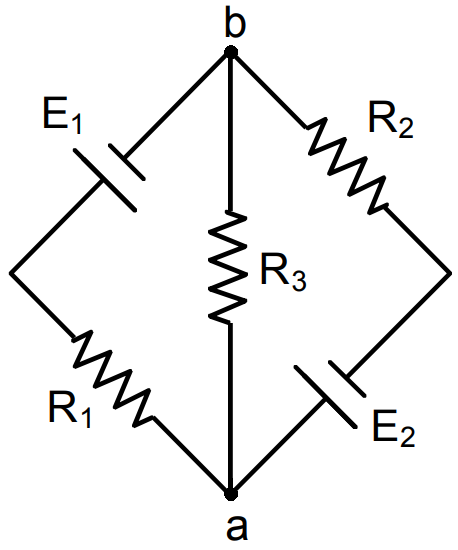
Find the potential difference Va - Vb in the circuits shown in figure.
Answer

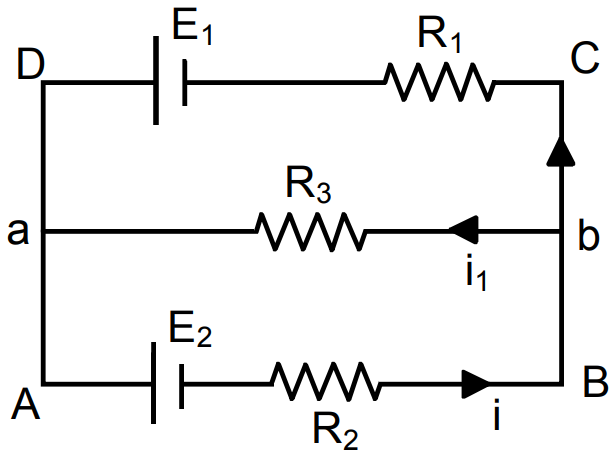
  1. In circuit, AB ba A

$\text{E}_2+\text{iR}_2+\text{i}_1\text{R}_3=0$

In circuit, $\text{i}_1\text{R}_3+\text{E}_1-(\text{i}-\text{i}_1)\text{R}_1=0$

$\Rightarrow\text{i}_1\text{R}_3+\text{E}_1-\text{iR}_1+\text{i}_1\text{R}_1=0$

$[\text{iR}_2+\text{i}_1\text{R}_3\ \ \ \ \ \ \ \ \ \ \ \ \ \ \ \ \ \ \ \ \ \ =-\text{E}_2]\text{R}_1\\ [\text{iR}_2-\text{i}_1(\text{R}_1+\text{R}_3)\ \ \ \ \ \ \ \ \ =\text{E}_1]\text{R}_2\\\underline{\ \ \ \ \ \ \ \ \ \ \ \ \ \ \ \ \ \ \ \ \ \ \ \ \ \ \ \ \ \ \ \ \ \ \ \ \ \ \ \ \ \ \ \ \ \ \ \ \ \ \ \ \ \ \ \ \ }\\\text{iR}_2\text{R}_1+\text{i}_1\text{R}_3\text{R}_1\ \ \ \ \ \ \ \ \ \ \ \ \ =-\text{E}_2\text{R}_1\\\text{iR}_2\text{R}_1-\text{i}_1\text{R}_2(\text{R}_1+\text{R}_3)=\ \ \ \text{E}_1\text{R}_2\\\underline{ \ \ \ \ \ \ \ \ \ \ \ \ \ \ \ \ \ \ \ \ \ \ \ \ \ \ \ \ \ \ \ \ \ \ \ \ \ \ \ \ \ \ \ \ \ \ \ \ \ \ \ \ \ \ \ \ \ }$

$\text{iR}_3\text{R}_1+\text{i}_1\text{R}_2\text{R}_1+\text{i}_1\text{R}_2\text{R}_3=\text{E}_1\text{R}_2-\text{E}_1\text{R}_1$

$\Rightarrow\text{i}_1(\text{R}_3\text{R}_1+\text{R}_2\text{R}_1+\text{R}_2\text{R}_3)=\text{E}_1\text{R}_2-\text{E}_2\text{R}_1$

$\Rightarrow\text{i}_1=\frac{\text{E}_1\text{R}_2-\text{E}_2\text{R}_1}{\text{R}_3\text{R}_1+\text{R}_2\text{R}_1+\text{R}_2\text{R}_3}$

$\Rightarrow\frac{\text{E}_1\text{R}_2\text{R}_3-\text{E}_2\text{R}_1\text{R}_3}{\text{R}_3\text{R}_1+\text{R}_2\text{R}_1+\text{R}_2\text{R}_3}=\Bigg(\frac{\frac{\text{E}_1}{\text{R}_1}-\frac{\text{E}_2}{\text{R}_2}}{\frac{1}{\text{R}_2}+\frac{1}{\text{R}_1}+\frac{1}{\text{R}_3}}\Bigg)$
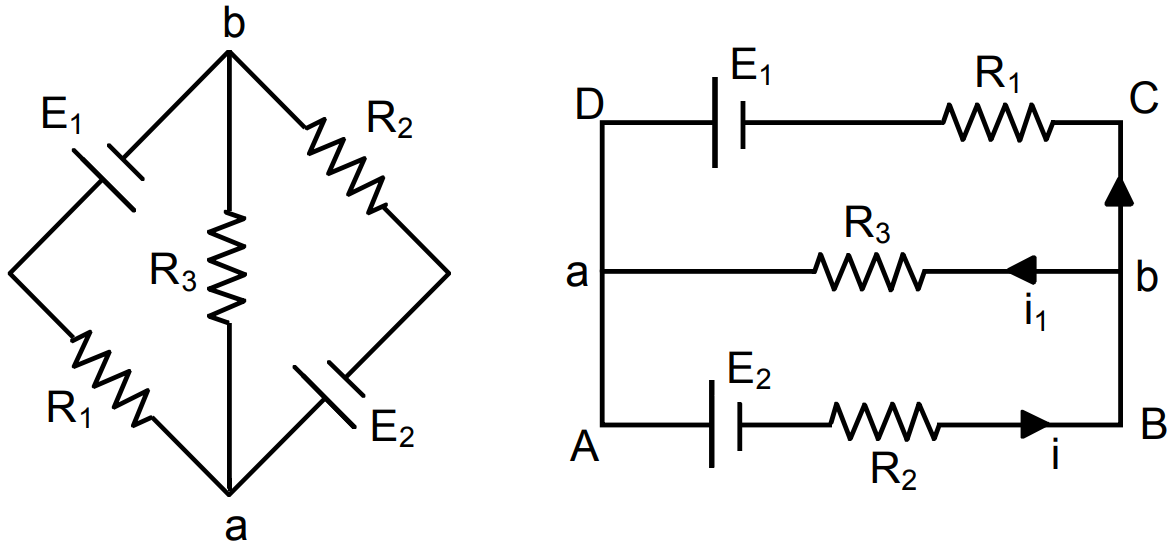
  1. $\therefore$ Same as a

Need a full question paper?

Generate a complete, print-ready paper with questions like this in minutes — across 16+ boards, with answer keys.
Start Generating Free

Similar questions

  1. Derive an expression for drift velocity of free electrons.
  2. How does drift velocity of electrons in a metallic conductor vary with increase in temperature? Explain.
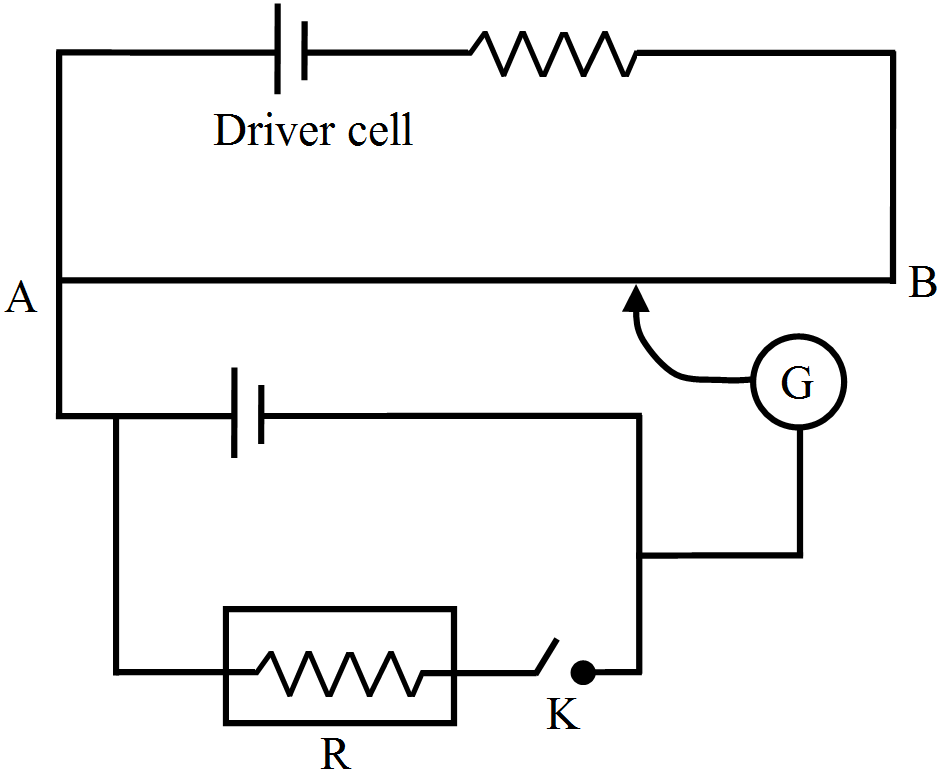
The following circuit shows the use of potentiometer to measure the internal resistance of a cell:

  1. When the key is open, how does the balance point change, if the current from the driver cell decreases?
  2. When the key K is closed, how does the balance point change if R is increased keeping current from the driver cell constant?
Explain use of juction diode as full wave rectifier.
The current through a wire depends on time as $\text{i}=\text{i}_0+\alpha\text{t},$
Where $\text{i}_0=10\text{A}$ and $\alpha=4\text{A/ s}.$ Find the charge that crosses through a section of the wire in 10 seconds.
Derive the expression for force per unit length between two long straight parallel current carrying conductors. Hence define one ampere.
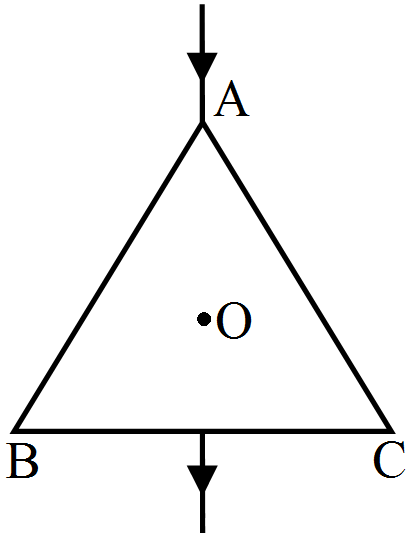
The. wire ABC shown in figure forms an equilateral triangle. Find the magnetic field B at the centre O of the triangle assuming the wire to be uniform.

In a periodic table the average atomic mass of magnesium is given as 24.312 u. The average value is based on their relative natural abundance on earth. The three isotopes and their masses are $^{24}_{12}\text{Mg }23.98504\text{u}),^{25}_{12}\text{Mg }(24.98584\text{u})\text{ and }^{26}_{12}\text{Mg }(25.98259\text{u}).$ The natural abundance of $^{24}_{12}\text{Mg}\text{ is }78.99\%$ by mass. Calculate the abundances of other two isotopes.
  1. Draw the energy level diagram showing the emission of b-particles followed by γ-rays by a $\text{ }^{60}_{27}\text{Co}$ nucleus.
  2. Plot of distribution of KE of b-particles is shown in fig. (b).


A p-n photodiode is fabricated from a semiconductor with band gap of 2.8 eV. Can it detect a wavelength of 6000 nm?
What is the de Broglie wavelength associated with (a) an electron moving with a speed of $5.4 \times 10^6 m / s$, and (b) a ball of mass $150 g$ travelling at $30.0 m / s$ ?