MCQ
Find the principal value of $\sec ^{-1}\left(\frac{2}{\sqrt{3}}\right)$
  • $\frac{\pi}{6}$
  • B
    $\frac{\pi}{3}$
  • C
    $\frac{\pi}{4}$
  • D
    $\frac{\pi}{2}$

Answer

Correct option: A.
$\frac{\pi}{6}$
a
Let $\sec ^{-1}\left(\frac{2}{\sqrt{3}}\right)=y \cdot$ Then, $\sec y=\frac{2}{\sqrt{3}}=\sec \left(\frac{\pi}{6}\right)$

We know that the range of the principal value branch of $\sec ^{-1}$ is $[0, \pi]-\left\{\frac{\pi}{2}\right\}$ and $\sec \left(\frac{\pi}{6}\right)=\frac{2}{\sqrt{3}}$

Therefore, the principal value of $\sec ^{-1}\left(\frac{2}{\sqrt{3}}\right)$ is $\frac{\pi}{6}$

Need a full question paper?

Generate a complete, print-ready paper with questions like this in minutes — across 16+ boards, with answer keys.
Start Generating Free

Similar questions

If a curve the $y = f(x)$  passes through point $(1, -1)$ and  satisfies the differential equation $y\left( {1 + xy} \right)dx = xdy$ then $f\left( { - \frac{1}{2}} \right) = $ . . . . . 
If $\text{A}=\begin{bmatrix}\alpha&\beta\\\gamma&-\alpha\end{bmatrix}$ is such that $A^2 = I,$ then:
Which of these is equal to $\int 2^{(x+3)} d x$, where $C$ is the constant of integration?
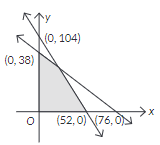
The feasible region of an LPP is given in the following figure
Image
Then, the constraints of the LPP are $x \geq 0, y \geq 0$ and
If $\left| {\,\begin{array}{*{20}{c}}{ - {a^2}}&{ab}&{ac}\\{ab}&{ - {b^2}}&{bc}\\{ac}&{bc}&{ - {c^2}}\end{array}\,} \right| = K{a^2}{b^2}{c^2},$ then $K = $
If $\theta$ is the angle between the vectors $2\hat{\text{i}}-2\hat{\text{j}}+4\hat{\text{k}}$ and $3\hat{\text{i}}+\hat{\text{j}}+2\hat{\text{k}},$ then $\sin\theta=$
The cofactor of the element $'4'$ in the determinant $\left| {\,\begin{array}{*{20}{c}}1&3&5&1\\2&3&4&2\\8&0&1&1\\0&2&1&1\end{array}\,} \right|$ is
Consider the function $f : R \rightarrow R$ defined by $f(x)=\left\{\begin{array}{cc}\left(2-\sin \left(\frac{1}{x}\right)\right)|x|, x \neq 0 \\ 0 & , x=0\end{array} .\right.$ Then $f$ is
Let $\vec{\text{a}}$ and $\vec{\text{b}}$ be two unit vectors and a be the angle between them. Then, $\vec{\text{a}}+\vec{\text{b}}$ is a unit vector if:
The degree of the differential equation $\big(\frac{\text{d}^{2}\text{y}}{\text{dx}^{2}}\big)^{3}+\big(\frac{\text{dy}}{\text{dx}}\big)^{2}+\sin\big(\frac{\text{dy}}{\text{dx}}\big)+1=0$ is: