MCQ 11 Mark
${\sin ^{ - 1}}\left[ {x\sqrt {1 - x} - \sqrt x \sqrt {1 - {x^2}} } \right] = $
- A
${\sin ^{ - 1}}x + {\sin ^{ - 1}}\sqrt x $
- ✓
${\sin ^{ - 1}}x - {\sin ^{ - 1}}\sqrt x $
- C
${\sin ^{ - 1}}\sqrt x - {\sin ^{ - 1}}x$
- D
AnswerCorrect option: B. ${\sin ^{ - 1}}x - {\sin ^{ - 1}}\sqrt x $
b
(b) Let $x = \sin \theta $ and $\sqrt x = \sin \phi $
Hence ${\sin ^{ - 1}}(x\sqrt {1 - x} - \sqrt x \,\sqrt {1 - {x^2}} )$
$ = {\sin ^{ - 1}}(\sin \theta \sqrt {1 - {{\sin }^2}\phi } - \sin \phi \sqrt {1 - {{\sin }^2}\theta } )$
$ = {\sin ^{ - 1}}(\sin \theta \cos \phi - \sin \phi \cos \theta ) = {\sin ^{ - 1}}\sin \,(\theta - \phi )$
$ = \theta - \phi = {\sin ^{ - 1}}(x) - {\sin ^{ - 1}}(\sqrt x )$.
View full question & answer→MCQ 21 Mark
If ${\tan ^{ - 1}}\frac{{1 - x}}{{1 + x}} = \frac{1}{2}{\tan ^{ - 1}}x$, then $ x =$
- A
$1$
- B
$\sqrt 3 $
- ✓
$\frac{1}{{\sqrt 3 }}$
- D
AnswerCorrect option: C. $\frac{1}{{\sqrt 3 }}$
c
(c) We have ${\tan ^{ - 1}}\,\frac{{1 - x}}{{1 + x}} = \frac{1}{2}{\tan ^{ - 1}}x$
$ \Rightarrow \,\,{\tan ^{ - 1}}\,\left[ {\frac{{1 - \tan \theta }}{{1 + \tan \theta }}} \right] = \frac{1}{2}\theta $ (Putting $x = \tan \theta )$
$ \Rightarrow \,\,{\tan ^{ - 1}}\,\left[ {\frac{{\tan \frac{\pi }{4} - \tan \theta }}{{1 + \tan \frac{\pi }{4}\tan \theta }}} \right] = \frac{\theta }{2}$
$ \Rightarrow \,\,{\tan ^{ - 1}}\tan \,\left( {\frac{\pi }{4} - \theta } \right) = \frac{\theta }{2}\,\, \Rightarrow \,\,\frac{\pi }{4} - \theta = \frac{\theta }{2}$
$ \Rightarrow \,\,\theta = \frac{\pi }{6} = {\tan ^{ - 1}}x\,\, $
$\Rightarrow \,\,x = \tan \frac{\pi }{6} = \frac{1}{{\sqrt 3 }}$.
View full question & answer→MCQ 31 Mark
If $\frac{\pi }{2} \le x \le \frac{{3\pi }}{2},$ then ${\sin ^{ - 1}}(\sin x)$ is equal to
- A
$x$
- B
$ - x$
- C
$\pi + x$
- ✓
$\pi - x$
AnswerCorrect option: D. $\pi - x$
d
(d) We have $\frac{\pi }{2} \le x \le \frac{{3\pi }}{2}$
$ \Rightarrow \,\,\frac{{ - \pi }}{2} \le x - \pi \le \frac{\pi }{2}\,\, \Rightarrow \,\,\frac{{ - \pi }}{2} \le \pi - x \le \frac{\pi }{2}$
$ \Rightarrow \,\,{\sin ^{ - 1}}\{ \sin \,(\pi - x)\} = \pi - x$.
View full question & answer→MCQ 41 Mark
If $\pi \le x \le 2\pi $, then ${\cos ^{ - 1}}(\cos x)$ is equal to
- A
$x$
- B
$ - x$
- C
$2\pi + x$
- ✓
$2\pi - x$
AnswerCorrect option: D. $2\pi - x$
d
(d) It is given that $\pi \le x \le 2\pi $
$ \Rightarrow \,\, - \pi \ge - x \ge - 2\pi \,\,\, \Rightarrow \,\,\pi \ge 2\pi - x \ge 0$
$ \Rightarrow \,\,{\cos ^{ - 1}}\,\left\{ {\cos \,(2\pi - x)} \right\} = 2\pi - x$.
View full question & answer→MCQ 51 Mark
The value of ${\sin ^{ - 1}}(\sin 10)$ is
- A
$10$
- B
$10 - 3\pi $
- ✓
$3\pi - 10$
- D
AnswerCorrect option: C. $3\pi - 10$
c
(c) Since $3\pi < 10 < 3\pi + \frac{\pi }{2}\,\, $
$\Rightarrow \,0 < 10 - 3\pi < \frac{\pi }{2}$
$ \Rightarrow \,\,\frac{{ - \pi }}{2} < 3\pi - 10 < 0$
$ \Rightarrow \,\,{\sin ^{ - 1}}\left\{ {\sin \,(3\pi - 10)} \right\} = 3\pi - 10$.
View full question & answer→MCQ 61 Mark
If $x$ takes non-positive permissible value, then ${\sin ^{ - 1}}x =$
- A
${\cos ^{ - 1}}\sqrt {1 - {x^2}} $
- ✓
$ - {\cos ^{ - 1}}\sqrt {1 - {x^2}} $
- C
${\cos ^{ - 1}}\sqrt {{x^2} - 1} $
- D
$\pi - {\cos ^{ - 1}}\sqrt {1 - {x^2}} $
AnswerCorrect option: B. $ - {\cos ^{ - 1}}\sqrt {1 - {x^2}} $
b
(b) Let ${\sin ^{ - 1}}x = y.$ Then $x = \sin y$
Since $ - 1 \le x \le 0,$ therefore $\frac{{ - \pi }}{2} \le {\sin ^{ - 1}}x \le 0$
and so $\frac{{ - \pi }}{2} \le y \le 0$
We have $\cos y = \sqrt {1 - {{\sin }^2}y} $
$ \Rightarrow \,\,\cos y = \sqrt {1 - {x^2}} $, for $0 \le y \le \pi $ …..$(i)$
Now $ - \frac{\pi }{2} \le y \le 0\,\, \Rightarrow \,\,\frac{\pi }{2} \ge - y \ge 0$
$ \Rightarrow \,\,\cos \,\left( { - y} \right) = \sqrt {1 - {x^2}} $ {from $(i)$}
$ \Rightarrow \,\, - y = {\cos ^{ - 1}}\sqrt {1 - {x^2}} \,\, $
$\Rightarrow \,\,y = - {\cos ^{ - 1}}\sqrt {1 - {x^2}} $.
View full question & answer→MCQ 71 Mark
If $\tan ^{ - 1}x + \tan ^{ - 1}y + \tan ^{ - 1}z = \frac{\pi }{2},$ then
- A
$x + y + z - xyz = 0$
- B
$x + y + z + xyz = 0$
- C
$xy + yz + zx + 1 = 0$
- ✓
$xy + yz + zx - 1 = 0$
AnswerCorrect option: D. $xy + yz + zx - 1 = 0$
d
(d) Given that $\tan ^{ - 1}x + \tan ^{ - 1}y + \tan ^{ - 1}z = \frac{\pi }{2},$
$ \Rightarrow \,\,{\tan ^{ - 1}}\,\left[ {\frac{{x + y + z - xyz}}{{1 - xy - yz - xz}}} \right] = \frac{\pi }{2}$
$ \Rightarrow \,\,\left[ {\frac{{x + y + z - xyz}}{{1 - xy - yz - zx}}} \right] = \tan \frac{\pi }{2} = \frac{1}{0}$
Hence $xy + yz + zx - 1 = 0$.
Trick : $x = y = z = \frac{1}{{\sqrt 3 }},$ so that
${\tan ^{ - 1}}\frac{1}{{\sqrt 3 }} + {\tan ^{ - 1}}\frac{1}{{\sqrt 3 }} + {\tan ^{ - 1}}\frac{1}{{\sqrt 3 }} = \frac{\pi }{2}$
Obviously $ (d)$ holds for these values of $x, y, z.$
View full question & answer→MCQ 81 Mark
If ${\tan ^{ - 1}}\frac{{x - 1}}{{x + 2}} + {\tan ^{ - 1}}\frac{{x + 1}}{{x + 2}} = \frac{\pi }{4}$, then $x =$
AnswerCorrect option: C. $ \pm \sqrt {\frac{5}{2}} $
c
(c) We have ${\tan ^{ - 1}}\,\frac{{x - 1}}{{x + 2}} + {\tan ^{ - 1}}\frac{{x + 1}}{{x + 2}} = \frac{\pi }{4}$
$ \Rightarrow \,\,{\tan ^{ - 1}}\,\left[ {\frac{{\frac{{x - 1}}{{x + 2}} + \frac{{x + 1}}{{x + 2}}}}{{1 - \left( {\frac{{x - 1}}{{x + 2}}} \right)\,\left( {\frac{{x + 1}}{{x + 2}}} \right)}}} \right] = \frac{\pi }{4}$
$ \Rightarrow \,\,\left[ {\frac{{2x\,(x + 2)}}{{{x^2} + 4 + 4x - {x^2} + 1}}} \right] = \tan \frac{\pi }{4}$
==> $\,\,\frac{{2x\,(x + 2)}}{{4x + 5}} = \tan \frac{\pi }{4} = 1$
$ \Rightarrow \,\,2{x^2} + 4x = 4x + 5$
$ \Rightarrow \,\,x = \pm \sqrt {\frac{5}{2}} $.
View full question & answer→MCQ 91 Mark
If ${\tan ^{ - 1}}\frac{{a + x}}{a} + {\tan ^{ - 1}}\frac{{a - x}}{a} = \frac{\pi }{6}$,then ${x^2} =$
- A
$2\sqrt 3 a$
- B
$\sqrt 3 a$
- ✓
$2\sqrt 3 {a^2}$
- D
AnswerCorrect option: C. $2\sqrt 3 {a^2}$
c
(c) Given equation is ${\tan ^{ - 1}}\frac{{a + x}}{a} + {\tan ^{ - 1}}\frac{{a - x}}{a} = \frac{\pi }{6}$
$ \Rightarrow \,{\tan ^{ - 1\,}}\left( {\frac{{\frac{{a + x}}{a} + \frac{{a - x}}{a}}}{{1 - \frac{{a + x}}{a}.\,\frac{{a - x}}{a}}}} \right) = \frac{\pi }{6}$
$ \Rightarrow \,\,\frac{{2{a^2}}}{{{x^2}}} = \tan \frac{\pi }{6} = \frac{1}{{\sqrt 3 }}\,\, $
$\Rightarrow \,\,{x^2} = 2\sqrt 3 {a^2}$.
View full question & answer→MCQ 101 Mark
If ${\tan ^{ - 1}}(x - 1) + {\tan ^{ - 1}}x + {\tan ^{ - 1}}(x + 1) = {\tan ^{ - 1}}3x$, then $ x =$
- A
$ \pm \frac{1}{2}$
- B
$0,\,\frac{1}{2}$
- C
$0,\, - \frac{1}{2}$
- ✓
$0,\, \pm \frac{1}{2}$
AnswerCorrect option: D. $0,\, \pm \frac{1}{2}$
d
(d) ${\tan ^{ - 1}}(x - 1) + {\tan ^{ - 1}}(x) + {\tan ^{ - 1}}(x + 1) = {\tan ^{ - 1}}3x$
$ \Rightarrow {\tan ^{ - 1}}(x - 1) + {\tan ^{ - 1}}(x) = {\tan ^{ - 1}}3x - {\tan ^{ - 1}}(x + 1)$
$ \Rightarrow {\tan ^{ - 1}}\left[ {\frac{{(x - 1) + x}}{{1 - (x - 1)(x)}}} \right] = {\tan ^{ - 1}}\left[ {\frac{{3x - (x + 1)}}{{1 + 3x(x + 1)}}} \right]$
$ \Rightarrow \frac{{2x - 1}}{{1 - {x^2} + x}} = \frac{{2x - 1}}{{1 + 3{x^2} + 3x}}$
$ \Rightarrow (1 - {x^2} + x)(2x - 1) = (1 + 3{x^2} + 3x)(2x - 1)$
On simplification $x = 0,\, \pm \frac{1}{2}.$
View full question & answer→MCQ 111 Mark
$4\, {\tan ^{ - 1}}\frac{1}{5} - {\tan ^{ - 1}}\frac{1}{{70}} + {\tan ^{ - 1}}\frac{1}{{99}} = $
- A
$\frac{\pi }{2}$
- B
$\frac{\pi }{3}$
- ✓
$\frac{\pi }{4}$
- D
AnswerCorrect option: C. $\frac{\pi }{4}$
c
(c) $4 \, {\tan ^{ - 1}}\frac{1}{5} - {\tan ^{ - 1}}\frac{1}{{70}} + {\tan ^{ - 1}}\frac{1}{{99}}$
$ = 2\, {\tan ^{ - 1}}\left[ {\frac{{\frac{2}{5}}}{{1 - \frac{1}{{25}}}}} \right] - {\tan ^{ - 1}}\frac{1}{{70}} + {\tan ^{ - 1}}\frac{1}{{99}}$
$ = 2\, {\tan ^{ - 1}}\left( {\frac{5}{{12}}} \right) - {\tan ^{ - 1}}\frac{1}{{70}} + {\tan ^{ - 1}}\frac{1}{{99}}$
$ = {\tan ^{ - 1}}\left[ {\frac{{\frac{5}{6}}}{{1 - \frac{{25}}{{144}}}}} \right] - {\tan ^{ - 1}}\frac{1}{{70}} + {\tan ^{ - 1}}\frac{1}{{99}}$
$ = {\tan ^{ - 1}}\left( {\frac{{120}}{{119}}} \right) - {\tan ^{ - 1}}\frac{1}{{70}} + {\tan ^{ - 1}}\frac{1}{{99}}$
$ = {\tan ^{ - 1}}\left( {\frac{{120}}{{119}}} \right) + {\tan ^{ - 1}}\left[ {\frac{{\frac{1}{{99}} - \frac{1}{{70}}}}{{1 + \frac{1}{{99}}.\frac{1}{{70}}}}} \right]$
$ = {\tan ^{ - 1}}\left( {\frac{{120}}{{119}}} \right) + {\tan ^{ - 1}}\left( {\frac{{ - 29}}{{6931}}} \right)$
$ = {\tan ^{ - 1}}\frac{{120}}{{119}} - {\tan ^{ - 1}}\frac{{29}}{{6931}} = {\tan ^{ - 1}}\frac{{120}}{{119}} - {\tan ^{ - 1}}\frac{1}{{239}}$
$ = {\tan ^{ - 1}}\left[ {\frac{{\frac{{120}}{{119}} - \frac{1}{{239}}}}{{1 + \frac{{120}}{{119}} \times \frac{1}{{239}}}}} \right] $
$= {\tan ^{ - 1}}(1) = \frac{\pi }{4}$.
View full question & answer→MCQ 121 Mark
If ${x^2} + {y^2} + {z^2} = {r^2}$, then ${\tan ^{ - 1}}\left( {\frac{{xy}}{{zr}}} \right) + $ ${\tan ^{ - 1}}\left( {\frac{{yz}}{{xr}}} \right) + {\tan ^{ - 1}} \left( {\frac{{zx}}{{yr}}} \right) = $
- A
$\pi $
- ✓
$\frac{\pi }{2}$
- C
$0$
- D
AnswerCorrect option: B. $\frac{\pi }{2}$
b
(b) ${\tan ^{ - 1}}\left( {\frac{{xy}}{{zr}}} \right) + {\tan ^{ - 1}}\left( {\frac{{yz}}{{xr}}} \right) + {\tan ^{ - 1}}\left( {\frac{{xz}}{{yr}}} \right)$
$ = {\tan ^{ - 1}}\left[ {\frac{{\frac{{xy}}{{zr}} + \frac{{yz}}{{xr}} + \frac{{xz}}{{yr}} - \frac{{xyz}}{{{r^3}}}}}{{1 - \left( {\frac{{{x^2} + {y^2} + {z^2}}}{{{r^2}}}} \right)}}} \right] = {\tan ^{ - 1}}\infty = \frac{\pi }{2}$.
View full question & answer→MCQ 131 Mark
If $\tan (x + y) = 33$ and $x = {\tan ^{ - 1}}3,$ then $y $ will be
AnswerCorrect option: C. ${\tan ^{ - 1}}(0.3)$
c
(c) $x + y = {\tan ^{ - 1}}33\,\,\, $
$\Rightarrow y = {\tan ^{ - 1}}33 - {\tan ^{ - 1}}3$
$ = {\tan ^{ - 1}}\frac{{33 - 3}}{{1 + 99}} = {\tan ^{ - 1}}\frac{{30}}{{100}}$
==> $y = {\tan ^{ - 1}}(0.3)$.
View full question & answer→MCQ 141 Mark
If ${\tan ^{ - 1}}x + {\tan ^{ - 1}}y + {\tan ^{ - 1}}z = \pi ,$ then $\frac{1}{{xy}} + \frac{1}{{yz}} + \frac{1}{{zx}} = $
- A
$0$
- ✓
$1$
- C
$\frac{1}{{xyz}}$
- D
$xyz$
Answerb
(b) ${\tan ^{ - 1}}(x) + {\tan ^{ - 1}}(y) + {\tan ^{ - 1}}(z) = \pi $
==> ${\tan ^{ - 1}}x + {\tan ^{ - 1}}y = \pi - {\tan ^{ - 1}}z$
==> $\frac{{x + y}}{{1 - xy}} = - z \Rightarrow x + y = - z + xyz$
==> $x + y + z = xyz$
(b) ${\tan ^{ - 1}}(x) + {\tan ^{ - 1}}(y) + {\tan ^{ - 1}}(z) = \pi $
==> ${\tan ^{ - 1}}x + {\tan ^{ - 1}}y = \pi - {\tan ^{ - 1}}z$
==> $\frac{{x + y}}{{1 - xy}} = - z \Rightarrow x + y = - z + xyz$
==> $x + y + z = xyz$
Dividing by $ xyz,$ we get
$\frac{1}{{yz}} + \frac{1}{{xz}} + \frac{1}{{xy}} = 1$.
Note: Students should remember this question as a formula.
Dividing by $xyz$, we get
$\frac{1}{{yz}} + \frac{1}{{xz}} + \frac{1}{{xy}} = 1$.
Note: Students should remember this question as a formula.
View full question & answer→MCQ 151 Mark
If $2{\tan ^{ - 1}}(\cos x) = {\tan ^{ - 1}}(2{\rm{cosec }}x),$ then $x =$
- A
$\frac{{3\pi }}{4}$
- ✓
$\frac{\pi }{4}$
- C
$\frac{\pi }{3}$
- D
AnswerCorrect option: B. $\frac{\pi }{4}$
b
(b) We have $2$ ${\tan ^{ - 1}}(\cos x) = {\tan ^{ - 1}}(2\cos {\rm{ec}}x)$
==> ${\tan ^{ - 1}}\left( {\frac{{2\cos x}}{{1 - {{\cos }^2}x}}} \right)$$= {\tan ^{ - 1}}(2\,{\rm{cosec }}x)$
$\frac{{2\cos x}}{{{{\sin }^2}x}} = 2{\rm{cosec}}\,x \Rightarrow 2\cos x = 2\sin x$
or $\sin x = \cos x$
$ \Rightarrow x = \frac{\pi }{4}$.
View full question & answer→MCQ 161 Mark
$\tan \left( {2{{\cos }^{ - 1}}\frac{3}{5}} \right) = $
- A
$\frac{7}{{25}}$
- B
$\frac{{24}}{{25}}$
- ✓
$ - \frac{{24}}{7}$
- D
$\frac{8}{3}$
AnswerCorrect option: C. $ - \frac{{24}}{7}$
c
(c) $\tan \left( {2{{\cos }^{ - 1}}\frac{3}{5}} \right) = \tan \left[ {{{\cos }^{ - 1}}\left( {2.\frac{9}{{25}} - 1} \right)} \right]$
{Since $2{\cos ^{ - 1}}x = {\cos ^{ - 1}}(2{x^2} - 1)$}
$ = \tan {\cos ^{ - 1}}\left( { - \frac{7}{{25}}} \right) = \tan {\tan ^{ - 1}}\left[ {\sqrt {\frac{{1 - \frac{{49}}{{625}}}}{{ - \frac{7}{{25}}}}} } \right] = - \frac{{24}}{7}$
Therefore $\tan \left( {2{{\cos }^{ - 1}}\frac{3}{5}} \right) = - \frac{{24}}{7}$.
View full question & answer→MCQ 171 Mark
$\frac{1}{2}{\cos ^{ - 1}}\left( {\frac{{1 - x}}{{1 + x}}} \right) = $
- A
${\cot ^{ - 1}}\sqrt x $
- ✓
${\tan ^{ - 1}}\sqrt x $
- C
${\tan ^{ - 1}}x$
- D
${\cot ^{ - 1}}x$
AnswerCorrect option: B. ${\tan ^{ - 1}}\sqrt x $
b
(b) Let $x = {\tan ^2}\theta \Rightarrow \theta = {\tan ^{ - 1}}\sqrt x $
Now, $\frac{1}{2}{\cos ^{ - 1}}\left( {\frac{{1 - x}}{{1 + x}}} \right)$
$ = \frac{1}{2}{\cos ^{ - 1}}\left( {\frac{{1 - {{\tan }^2}\theta }}{{1 + {{\tan }^2}\theta }}} \right)$
$ = \frac{1}{2}{\cos ^{ - 1}}\cos 2\theta = \frac{{2\theta }}{2} = \theta = {\tan ^{ - 1}}\sqrt x $.
View full question & answer→MCQ 181 Mark
$4{\tan ^{ - 1}}\frac{1}{5} - {\tan ^{ - 1}}\frac{1}{{239}}$ is equal to
- A
$\pi $
- B
$\frac{\pi }{2}$
- C
$\frac{\pi }{3}$
- ✓
$\frac{\pi }{4}$
AnswerCorrect option: D. $\frac{\pi }{4}$
d
(d) Since $2{\tan ^{ - 1}}x = {\tan ^{ - 1}}\frac{{2x}}{{1 - {x^2}}}$
$\therefore$ $4{\tan ^{ - 1}}\frac{1}{5} = 2\,\left[ {2{{\tan }^{ - 1}}\frac{1}{5}} \right] = 2{\tan ^{ - 1}}\frac{{\frac{2}{5}}}{{1 - \frac{1}{{25}}}}$
$ = 2{\tan ^{ - 1}}\frac{{10}}{{24}} = {\tan ^{ - 1}}\frac{{\frac{{20}}{{24}}}}{{1 - \frac{{100}}{{576}}}} = {\tan ^{ - 1}}\frac{{120}}{{119}}$
So, $4{\tan ^{ - 1}}\frac{1}{5} - {\tan ^{ - 1}}\frac{1}{{239}} = {\tan ^{ - 1}}\frac{{120}}{{119}} - {\tan ^{ - 1}}\frac{1}{{239}}$
$ = {\tan ^{ - 1}}\frac{{\frac{{120}}{{119}} - \frac{1}{{239}}}}{{1 + \frac{{120}}{{119}}.\frac{1}{{239}}}} = {\tan ^{ - 1}}\frac{{(120 \times 239) - 119}}{{(119 \times 239) + 120}}$
==> ${\tan ^{ - 1}}1 = \frac{\pi }{4}$.
View full question & answer→MCQ 191 Mark
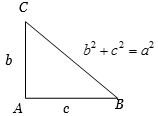
If $\angle A = {90^o}$ in the triangle ABC, then ${\tan ^{ - 1}}\left( {\frac{c}{{a + b}}} \right) + {\tan ^{ - 1}}\left( {\frac{b}{{a + c}}} \right) = $
- A
$0$
- B
$1$
- ✓
$\pi /4$
- D
$\pi /6$
AnswerCorrect option: C. $\pi /4$
c
(c) $\angle A = {90^o}$
${\tan ^{ - 1}}\left( {\frac{c}{{a + b}}} \right) + {\tan ^{ - 1}}\left( {\frac{b}{{a + c}}} \right)$
$ = {\tan ^{ - 1}}\left[ {\frac{{\frac{c}{{a + b}} + \frac{b}{{a + c}}}}{{1 - \left( {\frac{c}{{a + b}}} \right)\left( {\frac{b}{{a + c}}} \right)}}} \right]$
$ = {\tan ^{ - 1}}\left[ {\frac{{ca + {c^2} + ab + {b^2}}}{{{a^2} + ab + ca + bc - bc}}} \right]$
$ = {\tan ^{ - 1}}\left[ {\frac{{{a^2} + ab + ca}}{{{a^2} + ab + ca}}} \right]$
$ = {\tan ^{ - 1}}(1) = \frac{\pi }{4}$.
View full question & answer→MCQ 201 Mark
The solution of ${\sin ^{ - 1}}x - {\sin ^{ - 1}}2x = \pm \frac{\pi }{3}$ is
AnswerCorrect option: D. $ \pm \frac{1}{2}$
d
(d) ${\sin ^{ - 1}}2x = {\sin ^{ - 1}}x - {\sin ^{ - 1}}\frac{{\sqrt 3 }}{2}$
${\sin ^{ - 1}}2x = {\sin ^{ - 1}}\left( {x\sqrt {\left( {1 - \frac{3}{4}} \right)} - \frac{{\sqrt 3 }}{2}\sqrt {1 - {x^2}} } \right)$
$2x = \left( {\frac{x}{2} - \frac{{\sqrt 3 }}{2}\sqrt {1 - {x^2}} } \right)$
$\frac{{\sqrt 3 }}{2}\sqrt {1 - {x^2}} = \frac{x}{2} - 2x = \frac{{ - 3x}}{2}$
$\frac{{3(1 - {x^2})}}{4} = \frac{{9{x^2}}}{4}$
$ \Rightarrow 3 - 3{x^2} = 9{x^2}$
==> ${x^2} = \frac{1}{4} \Rightarrow x = \pm \frac{1}{2}$.
View full question & answer→MCQ 211 Mark
If $\tan ({\cos ^{ - 1}}x) = \sin \left( {{{\cot }^{ - 1}}\frac{1}{2}} \right)$, then $x =$
AnswerCorrect option: B. $ \pm \frac{{\sqrt 5 }}{3}$
b
(b) Given that $\tan \{ {\cos ^{ - 1}}(x)\} = \sin \left( {{{\cot }^{ - 1}}\frac{1}{2}} \right)$
Let ${\cot ^{ - 1}}\frac{1}{2} = \phi \Rightarrow \frac{1}{2} = \cot \phi $
$ \Rightarrow \sin \phi = \frac{1}{{\sqrt {1 + {{\cot }^2}\phi } }} = \frac{2}{{\sqrt 5 }}$
Let ${\cos ^{ - 1}}x = \theta \Rightarrow \sec \theta = \frac{1}{x} $
$\Rightarrow \tan \theta = \sqrt {{{\sec }^2}\theta - 1} $
$ \Rightarrow \tan \theta = \sqrt {\frac{1}{{{x^2}}} - 1} $
$\Rightarrow \tan \theta = \frac{{\sqrt {1 - {x^2}} }}{x}$
So, $\tan \{ {\cos ^{ - 1}}(x)\} = \sin \left( {{{\cot }^{ - 1}}\frac{1}{2}} \right)$
$ \Rightarrow \tan \left( {{{\tan }^{ - 1}}\frac{{\sqrt {1 - {x^2}} }}{x}} \right) = \sin \left( {{{\sin }^{ - 1}}\frac{2}{{\sqrt 5 }}} \right)$
$ \Rightarrow \frac{{\sqrt {1 - {x^2}} }}{x} = \frac{2}{{\sqrt 5 }} \Rightarrow \sqrt {(1 - {x^2})5} = 2x$
Squaring both sides, we get $x = \pm \frac{{\sqrt 5 }}{3}$.
View full question & answer→MCQ 221 Mark
${\tan ^{ - 1}}\,\left[ {\frac{{\sqrt {1 + {x^2}} + \sqrt {1 - {x^2}} }}{{\sqrt {1 + {x^2}} - \sqrt {1 - {x^2}} }}} \right] = $
- ✓
$\frac{\pi }{4} + \frac{1}{2}{\cos ^{ - 1}}{x^2}$
- B
$\frac{\pi }{4} + {\cos ^{ - 1}}{x^2}$
- C
$\frac{\pi }{4} + \frac{1}{2}{\cos ^{ - 1}}x$
- D
$\frac{\pi }{4} - \frac{1}{2}{\cos ^{ - 1}}{x^2}$
AnswerCorrect option: A. $\frac{\pi }{4} + \frac{1}{2}{\cos ^{ - 1}}{x^2}$
a
(a) ${\tan ^{ - 1}}\left[ {\frac{{\sqrt {1 + {x^2}} + \sqrt {1 - {x^2}} }}{{\sqrt {1 + {x^2}} - \sqrt {1 - {x^2}} }}} \right]$
$ = {\tan ^{ - 1}}\left[ {\frac{{\sqrt {1 + \cos 2\theta } + \sqrt {1 - \cos 2\theta } }}{{\sqrt {1 + \cos 2\theta } - \sqrt {1 - \cos 2\theta } }}} \right]$
(Putting ${x^2} = \cos 2\theta \Rightarrow \theta = \frac{1}{2}{\cos ^{ - 1}}{x^2})$
$= {\tan ^{ - 1}}\left[ {\frac{{\sqrt 2 \cos \theta + \sqrt 2 \sin \theta }}{{\sqrt 2 \cos \theta - \sqrt 2 \sin \theta }}} \right]$
$ = {\tan ^{ - 1}}\left[ {\frac{{1 + \tan \theta }}{{1 - \tan \theta }}} \right] = {\tan ^{ - 1}}\left[ {\frac{{\tan \frac{\pi }{4} + \tan \theta }}{{1 - \tan \frac{\pi }{4}\tan \theta }}} \right]$
$ = {\tan ^{ - 1}}\tan \left( {\frac{\pi }{4} + \theta } \right) = \frac{\pi }{4} + \theta = \frac{\pi }{4} + \frac{1}{2}{\cos ^{ - 1}}{x^2}$.
View full question & answer→MCQ 231 Mark
The equation $2{\cos ^{ - 1}}x + {\sin ^{ - 1}}x = \frac{{11\pi }}{6}$ has
Answera
(a) Given equation is $2{\cos ^{ - 1}}x + {\sin ^{ - 1}}x = \frac{{11\pi }}{6}$
==> ${\cos ^{ - 1}}x + ({\cos ^{ - 1}}x + {\sin ^{ - 1}}x) = \frac{{11\pi }}{6}$
==> ${\cos ^{ - 1}}x + \frac{\pi }{2} = \frac{{11\pi }}{6}$
$ \Rightarrow {\cos ^{ - 1}}x = 4\pi /3$
which is not possible as ${\cos ^{ - 1}}x \in [0,\,\pi ]$.
View full question & answer→MCQ 241 Mark
If ${\tan ^{ - 1}}x + {\tan ^{ - 1}}y + {\tan ^{ - 1}}z = \pi $, then $x + y + z$ is equal to
Answera
(a) ${\tan ^{ - 1}}x + {\tan ^{ - 1}}y + {\tan ^{ - 1}}z = \pi $
==> ${\tan ^{ - 1}}\left[ {\frac{{x + y + z - xyz}}{{1 - xy - yz - zx}}} \right] = \pi $
==> $x + y + z - xyz = 0$
==> $x + y + z\,\, = xyz$.
View full question & answer→MCQ 251 Mark
Write the function in the simplest form: $\tan ^{-1}(\sqrt{\frac{1-\cos x}{1+\cos x}}), x<\pi$
- A
$2x$
- ✓
$\frac{x}{2}$
- C
$\frac{\pi}{2}$
- D
$\pi$
AnswerCorrect option: B. $\frac{x}{2}$
b
$\tan ^{-1}(\sqrt{\frac{1-\cos x}{1+\cos x}}), x<\pi$
$\tan ^{-1}(\sqrt{\frac{1-\cos x}{1+\cos x}})$
$=\tan ^{-1}(\sqrt{\frac{2 \sin ^{2} \frac{x}{2}}{2 \cos ^{2} \frac{x}{2}}})$
$=\tan ^{-1}\left(\frac{\sin \frac{x}{2}}{\cos \frac{x}{2}}\right)$
$=\tan ^{-1}\left(\tan \frac{x}{2}\right)$
$=\frac{x}{2}$
View full question & answer→MCQ 261 Mark
Write the function in the simplest form: $\tan ^{-1}\left(\frac{\cos x-\sin x}{\cos x+\sin x}\right)$
- A
$-\frac{\pi}{4}+x$
- B
$-\frac{\pi}{4}-x$
- ✓
$\frac{\pi}{4}-x$
- D
$\frac{\pi}{4}+x$
AnswerCorrect option: C. $\frac{\pi}{4}-x$
c
$\tan ^{-1}\left(\frac{\cos x-\sin x}{\cos x+\sin x}\right)$
$=\tan ^{-1}\left(\frac{1-\left(\frac{\sin x}{\cos x}\right)}{1+\left(\frac{\sin x}{\cos x}\right)}\right)$
$=\tan ^{-1}\left(\frac{1-\tan x}{1+\tan x}\right)$
$=\tan ^{-1}(1)-\tan ^{-1}(\tan x)$ $\left[\because \frac{-y}{x y}=\tan ^{-1} x-\tan ^{-1} y\right]$
$=\frac{\pi}{4}-x$
View full question & answer→MCQ 271 Mark
Write the function in the simplest form: $\tan ^{-1} \frac{x}{\sqrt{a^{2}-x^{2}}},|x| < a$
- A
$\tan ^{-1} \frac{a}{x}$
- B
$\tan ^{-1} \frac{x}{a}$
- C
$\sin ^{-1} \frac{a}{x}$
- ✓
$\sin ^{-1} \frac{x}{a}$
AnswerCorrect option: D. $\sin ^{-1} \frac{x}{a}$
d
$\tan ^{-1} \frac{x}{\sqrt{a^{2}-x^{2}}}$
Let, $x=a \sin \theta \Rightarrow \frac{x}{a}=\sin \theta \Rightarrow \sin ^{-1}\left(\frac{x}{a}\right)$
$\therefore \tan ^{-1} \frac{x}{\sqrt{a^{2}-x^{2}}}$
$=\tan ^{-1}\left(\frac{a \sin \theta}{\sqrt{a^{2}-a^{2} \sin ^{2} \theta}}\right)$
$=\tan ^{-1}\left(\frac{a \sin \theta}{a \sqrt{1-\sin ^{2} \theta}}\right)$
$=\tan ^{-1}\left(\frac{a \sin \theta}{a \cos \theta}\right)$
$=\tan ^{-1}(\tan \theta)=\theta=\sin ^{-1} \frac{x}{a}$
View full question & answer→MCQ 281 Mark
Write the function in the simplest form: $\tan ^{-1}\left(\frac{3 a^{2} x-x^{3}}{a^{3}-3 a x^{2}}\right), a>0 ; \frac{-a}{\sqrt{3}} \leq x \leq \frac{a}{\sqrt{3}}$
- ✓
$3 \tan ^{-1} \frac{x}{a}$
- B
$3 \tan ^{-1} \frac{a}{x}$
- C
$ \tan ^{-1} \frac{x}{a}$
- D
$3 \cot ^{-1} \frac{x}{a}$
AnswerCorrect option: A. $3 \tan ^{-1} \frac{x}{a}$
a
Consider, $\tan ^{-1}\left(\frac{3 a^{2} x-x^{3}}{a^{3}-3 a x^{2}}\right)$
Let $x=a \tan \theta \Rightarrow \frac{x}{a}=\tan \theta$ $\Rightarrow \theta=\tan ^{-1}\left(\frac{x}{a}\right)$
$\tan ^{-1}\left(\frac{3 a^{2} x-x^{3}}{a^{3}-3 a x^{2}}\right)$
$=\tan ^{-1}\left(\frac{3 a^{2} \cdot a \tan \theta-a^{3} \tan ^{3} \theta}{a^{3}-3 a \cdot a^{2} \tan ^{2} \theta}\right)$
$=\tan ^{-1}\left(\frac{3 a^{3} \tan \theta-a^{3} \tan ^{3} \theta}{a^{3}-3 a^{3} \tan ^{2} \theta}\right)$
$=\tan ^{-1}(\tan 3 \theta)$
$=3 \theta$
$=3 \tan ^{-1} \frac{x}{a}$
View full question & answer→MCQ 291 Mark
Find the value of $\tan ^{-1}\left[2 \cos \left(2 \sin ^{-1} \frac{1}{2}\right)\right]$
- A
$\frac{\pi}{2}$
- ✓
$\frac{\pi}{4}$
- C
$\frac{\pi}{6}$
- D
$\frac{\pi}{3}$
AnswerCorrect option: B. $\frac{\pi}{4}$
b
Let $\sin ^{-1} \frac{1}{2}=x$
Then, $\sin x=\frac{1}{2}=\sin \left(\frac{\pi}{6}\right)$
$\therefore \sin ^{-1} \frac{1}{2}=\frac{\pi}{6}$
$\therefore \tan ^{-1}\left[2 \cos \left(2 \sin ^{-1} \frac{1}{2}\right)\right]$
$=\tan ^{-1}\left[2 \cos \left(2 \times \frac{\pi}{6}\right)\right]$
$=\tan ^{-1}\left[2 \cos \frac{\pi}{3}\right]$
$=\tan ^{-1}\left[2 \times \frac{1}{2}\right]$
$=\tan ^{-1} 1=\frac{\pi}{4}$
View full question & answer→MCQ 301 Mark
Find the value of $\tan \frac{1}{2}\left[\sin ^{-1} \frac{2 x}{1+x^{2}}+\cos ^{-1} \frac{1-y^{2}}{1+y^{2}}\right]$, $|x|<1, y>0$ and $xy<1$
- A
$\frac{x+y}{1+x y}$
- B
$\frac{x-y}{1+x y}$
- C
$\frac{x-y}{1-x y}$
- ✓
$\frac{x+y}{1-x y}$
AnswerCorrect option: D. $\frac{x+y}{1-x y}$
d
Let $x=\tan \theta$
Then, $\theta=\tan ^{-1} x$
$\therefore \sin ^{-1} \frac{2 x}{1+x^{2}}=\sin ^{-1}\left(\frac{2 \tan \theta}{1+\tan ^{2} \theta}\right)$
$=\sin ^{-1}(\sin 2 \theta)$
$=2 \theta$
$=2 \tan ^{-1} x$
Let $y=\tan \theta .$ Then, $\theta=\tan ^{-1} y$
$\therefore \cos ^{-1}\left(\frac{1-y^{2}}{1+y^{2}}\right)$
$=\cos ^{-1}\left(\frac{1-\tan ^{2} \theta}{1+\tan ^{2} \theta}\right)$
$=\cos ^{-1}(\cos 2 \theta)$
$=2 \theta=2 \tan ^{-1} y$
$\therefore \tan \frac{1}{2}\left[\sin ^{-1}\left(\frac{2 x}{1+x^{2}}\right)+\cos ^{-1}\left(\frac{1-y^{2}}{1+y^{2}}\right)\right]$
$=\tan \frac{1}{2}\left[2 \tan ^{-1} x+2 \tan ^{-1} y\right]$
$=\tan \left[\tan ^{-1}\left(\frac{x+y}{1-x y}\right)\right]$
$=\frac{x+y}{1-x y}$
View full question & answer→MCQ 311 Mark
Simplify $\tan ^{-1}\left[\frac{a \cos x-b \sin x}{b \cos x+a \sin x}\right],$ if $\frac{a}{b} \tan x>-1$
- A
$\tan ^{-1} \frac{b}{a}+x$
- B
$\tan ^{-1} \frac{b}{a}-x$
- ✓
$\tan ^{-1} \frac{a}{b}-x$
- D
$\tan ^{-1} \frac{a}{b}+x$
AnswerCorrect option: C. $\tan ^{-1} \frac{a}{b}-x$
c
$\tan ^{-1}\left[\frac{a \cos x-b \sin x}{b \cos x+a \sin x}\right]$ $=\tan ^{-1}\left[\frac{\frac{a \cos x-b \sin x}{b \cos x}}{b \cos x+a \sin x}\right]=\tan ^{-1}\left[\frac{\frac{a}{b}-\tan x}{1+\frac{a}{b} \tan x}\right]$
$=\tan ^{-1} \frac{a}{b}-\tan ^{-1}(\tan x)=\tan ^{-1} \frac{a}{b}-x$
View full question & answer→MCQ 321 Mark
Solve $\tan ^{-1}\left(\frac{x}{y}\right)-\tan ^{-1} \frac{x-y}{x+y}$ is equal to
- ✓
$\frac{\pi}{4}$
- B
$\frac{-3 \pi}{4}$
- C
$\frac{\pi}{2}$
- D
$\frac{\pi}{3}$
AnswerCorrect option: A. $\frac{\pi}{4}$
a
$\tan ^{-1}\left(\frac{x}{y}\right)-\tan ^{-1}\left(\frac{x-y}{x+y}\right)$
$=\tan ^{-1}\left[\frac{\frac{x}{y}-\frac{x-y}{x+y}}{1+\left(\frac{x}{y}\right)\left(\frac{x-y}{x+y}\right)}\right]$
$=\tan ^{-1}\left[\frac{\frac{x(x+y)-y(x-y)}{y(x+y)}}{\frac{y(x+y)+x(x-y)}{y(x+y)}}\right]$
$=\tan ^{-1}\left(\frac{x^{2}+x y-x y+y^{2}}{x y+y^{2}+x^{2}-x y}\right)$
$=\tan ^{-1}\left(\frac{x^{2}+y^{2}}{x^{2}+y^{2}}\right)=\tan ^{-1} 1=\frac{\pi}{4}$
View full question & answer→MCQ 331 Mark
The value of $\sin {\cot ^{ - 1}}\tan {\cos ^{ - 1}}x$ is equal to
- ✓
$x$
- B
$\frac{x }{2}$
- C
$2x$
- D
Answera
(a) Let ${\cos ^{ - 1}}x = \theta \,\,\, \Rightarrow \,\,x = \cos \theta \,\, \Rightarrow \,\,\sec \theta = \frac{1}{x}$
$ \Rightarrow \,\,\tan \theta = \sqrt {{{\sec }^2}\theta - 1} = \sqrt {\frac{1}{{{x^2}}} - 1} = \frac{1}{x}\sqrt {1 - {x^2}} $
Now $\sin \,\,{\cot ^{ - 1}}\tan \theta = \sin \,\,{\cot ^{ - 1}}\,\left( {\frac{1}{x}\sqrt {1 - {x^2}} } \right)$
Again, putting $x = \sin \theta $
$\sin \,\,{\cot ^{ - 1}}\left( {\frac{1}{x}\sqrt {1 - {x^2}} } \right) = \sin \,\,{\cot ^{ - 1}}\left( {\frac{{\sqrt {1 - {{\sin }^2}\theta } }}{{\sin \theta }}} \right)$
$ = \sin \,\,{\cot ^{ - 1}}\,(\cot \theta ) = \sin \theta = x$.
View full question & answer→MCQ 341 Mark
The smallest and the largest values of ${\tan ^{ - 1}}\left( {\frac{{1 - x}}{{1 + x}}} \right){\rm{ }},\,\,0 \le x \le 1$ are
- A
$0,\,\,\pi $
- ✓
$0,\,\frac{\pi }{4}$
- C
$ - \frac{\pi }{4},\frac{\pi }{4}$
- D
$\frac{\pi }{4},\,\frac{\pi }{2}$
AnswerCorrect option: B. $0,\,\frac{\pi }{4}$
b
(b) We have,
${\tan ^{ - 1}}\,\left( {\frac{{1 - x}}{{1 + x}}} \right) = {\tan ^{ - 1}}1 - {\tan ^{ - 1}}x = \frac{\pi }{4} - {\tan ^{ - 1}}x$
Since $0 \le x \le 1\,\, \Rightarrow \,\,0 \le {\tan ^{ - 1}}x \le \frac{\pi }{4}$
$ \Rightarrow \,\,0 \ge - {\tan ^{ - 1}}x \ge \frac{{ - \pi }}{4} $
$\Rightarrow \,\,\frac{\pi }{4} \ge \frac{\pi }{4} - {\tan ^{ - 1}}x \ge 0$
$ \Rightarrow \,\,\frac{\pi }{4} \ge {\tan ^{ - 1}}\left( {\frac{{1 - x}}{{1 + x}}} \right) \ge 0$.
View full question & answer→MCQ 351 Mark
The solution set of the equation ${\sin ^{ - 1}}x = 2{\tan ^{ - 1}}x$ is
- A
$\{1, 2\}$
- B
$\{-1, 2\}$
- ✓
$\{-1,1, 0\}$
- D
$\{1, \frac{1}{2} , 0\}$
AnswerCorrect option: C. $\{-1,1, 0\}$
c
(c) ${\sin ^{ - 1}}x = 2{\tan ^{ - 1}}x$
==> ${\sin ^{ - 1}}x = {\sin ^{ - 1}}\frac{{2x}}{{1 + {x^2}}}$
$ \Rightarrow \frac{{2x}}{{1 + {x^2}}} = x$ ==> ${x^3} - x = 0$
==> $x(x + 1)(x - 1) = 0$ ==> $x = \left\{ { - 1,\,\,1,\,\,0} \right\}$.
View full question & answer→MCQ 361 Mark
If ${\sin ^{ - 1}}x + {\sin ^{ - 1}}y + {\sin ^{ - 1}}z = \frac{\pi }{2}$, then the value of ${x^2} + {y^2} + {z^2} + 2xyz$ is equal to
Answerb
(b) ${\sin ^{ - 1}}x + {\sin ^{ - 1}}y + {\sin ^{ - 1}}z = \frac{\pi }{2}$
Put ${\sin ^{ - 1}}x = \alpha $, ${\sin ^{ - 1}}y = \beta ,$ ${\sin ^{ - 1}}z = \gamma $
$\therefore $ $\alpha + \beta + \gamma = \frac{\pi }{2}$, (Given)
or $\alpha + \beta = \frac{\pi }{2} - \gamma $ or $\cos (\alpha + \beta ) = \cos \left( {\frac{\pi }{2} - \gamma } \right)$
$\cos \alpha \cos \beta - \sin \alpha \sin \beta = \sin \gamma $ …..$(i)$
and, we have $\sin \alpha = x$ ==> $\cos \alpha = \sqrt {1 - {x^2}} $
Similarly, $\cos \beta = \sqrt {1 - {y^2}} $
$\therefore $ From equation $(i),$ we get $\sqrt {1 - {x^2}} .\sqrt {1 - {y^2}} = xy + z$
Squaring both sides, we have ${x^2} + {y^2} + {z^2} + 2xyz = 1$.
View full question & answer→MCQ 371 Mark
$\sin [{\cot ^{ - 1}}(\cos {\tan ^{ - 1}}x)] =$
- A
$\frac{x}{{\sqrt {{x^2} + 2} }}$
- B
$\frac{x}{{\sqrt {{x^2} + 1} }}$
- C
$\frac{1}{{\sqrt {{x^2} + 2} }}$
- ✓
$\sqrt {\frac{{{x^2} + 1}}{{{x^2} + 2}}} $
AnswerCorrect option: D. $\sqrt {\frac{{{x^2} + 1}}{{{x^2} + 2}}} $
d
(d) $\sin \,[{\cot ^{ - 1}}\,(\cos \,\,{\tan ^{ - 1}}x)]$
$ = \sin \,\left[ {{{\cot }^{ - 1}}\,\left( {\cos \,\,{{\cos }^{ - 1}}\frac{1}{{\sqrt {1 + {x^2}} }}} \right)} \right]$
$ = \sin \,\left[ {{{\cot }^{ - 1}}\frac{1}{{\sqrt {1 + {x^2}} }}} \right] = \sin \,\left[ {{{\sin }^{ - 1}}\sqrt {\frac{{1 + {x^2}}}{{2 + {x^2}}}} } \right]$
$ = \sqrt {\frac{{1 + {x^2}}}{{2 + {x^2}}}} $.
View full question & answer→MCQ 381 Mark
If $k \le {\sin ^{ - 1}}x + {\cos ^{ - 1}}x + {\tan ^{ - 1}}x \le K,$ then
- ✓
$k = 0,\,K = \pi $
- B
$k = 0,K = \frac{\pi }{2}$
- C
$k = \frac{\pi }{2},K = \pi $
- D
AnswerCorrect option: A. $k = 0,\,K = \pi $
a
(a) We have ${\sin ^{ - 1}}x + {\cos ^{ - 1}}x + {\tan ^{ - 1}}x = \frac{\pi }{2} + {\tan ^{ - 1}}x$
Since $\frac{{ - \pi }}{2} \le {\tan ^{ - 1}}x \le \frac{\pi }{2} $
$\Rightarrow 0 \le \frac{\pi }{2} + {\tan ^{ - 1}}x \le \pi $
$\therefore$ $K = \pi ,k = 0$.
View full question & answer→MCQ 391 Mark
If ${\cos ^{ - 1}}x + {\cos ^{ - 1}}y + {\cos ^{ - 1}}z = 3\pi ,$ then $xy + yz + zx = $
Answerc
(c) Given ${\cos ^{ - 1}}x + {\cos ^{ - 1}}y + {\cos ^{ - 1}}z = 3\pi $
$\because 0 \le {\cos ^{ - 1}}x \le \pi $
$\therefore 0 \le {\cos ^{ - 1}}y \le \pi $ and $0 \le {\cos ^{ - 1}}z \le \pi $
Here ${\cos ^{ - 1}}x = {\cos ^{ - 1}}y = {\cos ^{ - 1}}z = \pi $
$ \Rightarrow x = y = z = \cos \pi = - 1$
$\therefore$ $xy + yz + zx$$ = ( - 1)( - 1) + ( - 1)( - 1) + ( - 1)( - 1)$
$ = 1 + 1 + 1 = 3$.
View full question & answer→MCQ 401 Mark
$\sin \left( {4{{\tan }^{ - 1}}\frac{1}{3}} \right) = $
- A
$\frac{{12}}{{25}}$
- ✓
$\frac{{24}}{{25}}$
- C
$\frac{1}{5}$
- D
AnswerCorrect option: B. $\frac{{24}}{{25}}$
b
(b) $\sin \left( {4{{\tan }^{ - 1}}\frac{1}{3}} \right) = \sin \left[ {2{{\tan }^{ - 1}}\left( {\frac{{2/3}}{{1 - (1/9)}}} \right)} \right]$
$ = \sin \left[ {2{{\tan }^{ - 1}}\frac{3}{4}} \right] = \sin {\sin ^{ - 1}}\left( {\frac{{2 \times (3/4)}}{{1 + (9/16)}}} \right)$
$ = \frac{3}{2} \times \frac{{16}}{{25}} = \frac{{24}}{{25}}$
$\left( {\because 2{{\tan }^{ - 1}}x = {{\sin }^{ - 1}}\frac{{2x}}{{1 + {x^2}}}} \right)$
View full question & answer→MCQ 411 Mark
If $3{\sin ^{ - 1}}\frac{{2x}}{{1 - {x^2}}} - 4{\cos ^{ - 1}}\frac{{1 - {x^2}}}{{1 + {x^2}}} + 2{\tan ^{ - 1}}\frac{{2x}}{{1 - {x^2}}} = \frac{\pi }{3}$ then $x$ =
- A
$\sqrt 3 $
- ✓
$\frac{1}{{\sqrt 3 }}$
- C
$1$
- D
AnswerCorrect option: B. $\frac{1}{{\sqrt 3 }}$
b
(b) $3{\sin ^{ - 1}}\frac{{2x}}{{1 + {x^2}}} - 4{\cos ^{ - 1}}\frac{{1 - {x^2}}}{{1 + {x^2}}} + 2{\tan ^{ - 1}}\frac{{2x}}{{1 - {x^2}}} = \frac{\pi }{3}$
Putting $x = \tan \theta $
$3{\sin ^{ - 1}}\left( {\frac{{2\tan \theta }}{{1 + {{\tan }^2}\theta }}} \right) - 4{\cos ^{ - 1}}\left( {\frac{{1 - {{\tan }^2}\theta }}{{1 + {{\tan }^2}\theta }}} \right)$
$ + 2{\tan ^{ - 1}}\left( {\frac{{2\tan \theta }}{{1 - {{\tan }^2}\theta }}} \right) = \frac{\pi }{3}$
==> $3{\sin ^{ - 1}}(\sin 2\theta ) - 4{\cos ^{ - 1}}(\cos 2\theta )$
$ + 2{\tan ^{ - 1}}(\tan 2\theta ) = \frac{\pi }{3}$
==> $3(2\theta ) - 4(2\theta ) + 2(2\theta ) = \frac{\pi }{3} \Rightarrow 6\theta - 8\theta + 4\theta = \frac{\pi }{3}$
==> $\theta = \frac{\pi }{6} \Rightarrow {\tan ^{ - 1}}x = \frac{\pi }{6} \Rightarrow x = \tan \frac{\pi }{6} = \frac{1}{{\sqrt 3 }}$
View full question & answer→MCQ 421 Mark
The value of $\sin \left( {2{{\tan }^{ - 1}}\left( {\frac{1}{3}} \right)} \right) + \cos ({\tan ^{ - 1}}2\sqrt 2 ) = $
- A
$\frac{{16}}{{15}}$
- ✓
$\frac{{14}}{{15}}$
- C
$\frac{{12}}{{15}}$
- D
$\frac{{11}}{{15}}$
AnswerCorrect option: B. $\frac{{14}}{{15}}$
b
(b) $\sin \left[ {2{{\tan }^{ - 1}}\left( {\frac{1}{3}} \right)} \right] + \cos \,[{\tan ^{ - 1}}(2\sqrt 2 )]$
$= \sin \left[ {{{\tan }^{ - 1}}\frac{{2/3}}{{1 - 1/9}}} \right] + \cos \,[{\tan ^{ - 1}}(2\sqrt 2 )]$
$ = \sin [{\tan ^{ - 1}}3/4] + \cos \,[{\tan ^{ - 1}}2\sqrt 2 ]$
$ = \frac{3}{5} + \frac{1}{3} = \frac{{14}}{{15}}$.
View full question & answer→MCQ 431 Mark
For the equation ${\cos ^{ - 1}}x + {\cos ^{ - 1}}2x + \pi = 0$, the number of real solution is
Answerc
(c) ${\cos ^{ - 1}}x + {\cos ^{ - 1}}(2x) = - \pi $
==> ${\cos ^{ - 1}}2x = - \pi - {\cos ^{ - 1}}x$
$ \Rightarrow 2x = \cos (\pi + {\cos ^{ - 1}}x)$
==> $2x = \cos \pi (\cos {\cos ^{ - 1}}x) - \sin \pi \sin ({\cos ^{ - 1}}x)$
$2x = - x \Rightarrow x = 0$
But $x = 0$ does not satisfy the given equation.
No solution will exist.
View full question & answer→MCQ 441 Mark
The equation ${\sin ^{ - 1}}x - {\cos ^{ - 1}}x = {\cos ^{ - 1}}\left( {\frac{{\sqrt 3 }}{2}} \right)$ has
- A
- ✓
- C
Infinite number of solutions
- D
Answerb
(b) We have ${\sin ^{ - 1}}x - {\cos ^{ - 1}}x = {\cos ^{ - 1}}\frac{{\sqrt 3 }}{2} = \frac{\pi }{6}$
But ${\sin ^{ - 1}}x + {\cos ^{ - 1}}x = \frac{\pi }{2}$
$\therefore$ ${\sin ^{ - 1}}x = \frac{\pi }{3}$ and ${\cos ^{ - 1}}x = \frac{\pi }{6}$
==> $x = \frac{{\sqrt 3 }}{2}$ is the unique solution.
View full question & answer→MCQ 451 Mark
$2{\tan ^{ - 1}}(\cos x) = {\tan ^{ - 1}}({\rm{cose}}{{\rm{c}}^2}x),$ then $ x =$
- A
$\frac{\pi }{2}$
- B
$\pi $
- C
$\frac{\pi }{6}$
- ✓
$\frac{\pi }{3}$
AnswerCorrect option: D. $\frac{\pi }{3}$
d
(d) $2{\tan ^{ - 1}}(\cos x)$$ = {\tan ^{ - 1}}(\cos {\rm{e}}{{\rm{c}}^2}x)$
==> ${\tan ^{ - 1}}\left( {\frac{{2\cos x}}{{1 - {{\cos }^2}x}}} \right) = {\tan ^{ - 1}}\left( {\frac{1}{{{{\sin }^2}x}}} \right)$
$ \Rightarrow \frac{{2\cos x}}{{{{\sin }^2}x}} = \frac{1}{{{{\sin }^2}x}}$
==> $2\cos x = 1$
$ \Rightarrow x = \frac{\pi }{3}$.
View full question & answer→MCQ 461 Mark
If $\theta = {\sin ^{ - 1}}x + {\cos ^{ - 1}}x - {\tan ^{ - 1}}x,x \ge 0$, then the smallest interval in which $\theta $ lies is given by
- A
$\frac{\pi }{2} \le \theta \le \frac{{3\pi }}{4}$
- ✓
$0 < \theta < \pi $
- C
$ - \frac{\pi }{4} \le \theta \le 0$
- D
$\frac{\pi }{4} \le \theta \le \frac{\pi }{2}$
AnswerCorrect option: B. $0 < \theta < \pi $
b
(b) $\theta = {\sin ^{ - 1}}x + {\cos ^{ - 1}}x - {\tan ^{ - 1}}x$ = $\frac{\pi }{2} - {\tan ^{ - 1}}x$
we know $ - \frac{\pi }{2} < {\tan ^{ - 1}}x < \frac{\pi }{2}$ $ \Rightarrow $ $\frac{\pi }{2} > - {\tan ^{ - 1}}x > - \frac{\pi }{2}$
$\therefore $ $0 < \frac{\pi }{2} - {\tan ^{ - 1}}x < \pi $.
View full question & answer→MCQ 471 Mark
If in a triangle $ABC$, $A = {\tan ^{ - 1}}2$ and $B = {\tan ^{ - 1}}3,$ then angle $C$ is equal to
- A
$\pi /2$
- B
$\pi /3$
- ✓
$\pi /4$
- D
AnswerCorrect option: C. $\pi /4$
c
(c) Given that $\angle A = {\tan ^{ - 1}}2,\;\angle B = {\tan ^{ - 1}}3$
We know that $\angle A + \angle B + \angle C = \pi $
$ \Rightarrow {\tan ^{ - 1}}2 + {\tan ^{ - 1}}3 + \angle C = \pi $
$ \Rightarrow {\tan ^{ - 1}}\left( {\frac{{2 + 3}}{{1 - 2 \times 3}}} \right) + \angle C = \pi $$ \Rightarrow {\tan ^{ - 1}}( - 1) + \angle C = \pi $
$ \Rightarrow \frac{{3\pi }}{4} + \angle C = \pi \Rightarrow \angle C = \frac{\pi }{4}$.
View full question & answer→MCQ 481 Mark
If ${\sec ^{ - 1}}x = {\rm{cose}}{{\rm{c}}^{ - 1}}y,$ then ${\cos ^{ - 1}}\frac{1}{x} + {\cos ^{ - 1}}\frac{1}{y} = $
- A
$\pi $
- B
$\frac{\pi }{4}$
- C
$\frac{{ - \pi }}{2}$
- ✓
$\frac{\pi }{2}$
AnswerCorrect option: D. $\frac{\pi }{2}$
d
(d) Given, ${\sec ^{ - 1}}x = {\rm{cose}}{{\rm{c}}^{ - 1}}y$
${\cos ^{ - 1}}\left( {\frac{1}{x}} \right) = {\sin ^{ - 1}}\left( {\frac{1}{y}} \right)$ $ \Rightarrow {\cos ^{ - 1}}\left( {\frac{1}{x}} \right) = \frac{\pi }{2} - {\cos ^{ - 1}}\left( {\frac{1}{y}} \right)$
$ \Rightarrow {\cos ^{ - 1}}\left( {\frac{1}{x}} \right) + {\cos ^{ - 1}}\left( {\frac{1}{y}} \right) = \frac{\pi }{2}$.
View full question & answer→MCQ 491 Mark
$\sin \,\left[ {{{\cos }^{ - 1}}\left( {\frac{3}{5}} \right) + {{\tan }^{ - 1}}2} \right]$ =
- ✓
$\frac{2}{{\sqrt 5 }}$
- B
$\frac{-2}{{\sqrt 5 }}$
- C
$\frac{3}{{\sqrt 5 }}$
- D
$\frac{-3}{{\sqrt 5 }}$
AnswerCorrect option: A. $\frac{2}{{\sqrt 5 }}$
a
$\sin \left[\sin ^{-1}\left(\frac{4}{5}\right)+\sin ^{-1}\left(\frac{2}{\sqrt{5}}\right)\right]$
$=\sin \left[\sin ^{-1}\left(\frac{4}{5} \sqrt{1-\frac{4}{5}}+\frac{2}{\sqrt{5}}\right)\right]$
$=\sin \left[\sin ^{-1}\left(\frac{10}{5 \sqrt{5}}\right)\right]$
$=\frac{2}{\sqrt{5}}$
View full question & answer→MCQ 501 Mark
$\cot^{-1}(1) + \cot^{-1} (\frac{1}{2}) + \cot^{-1}(\frac{1}{3}) =$
- A
$0$
- B
$\frac{3 \pi}{4}$
- C
$\frac{2 \pi}{3}$
- ✓
$\pi$
Answerd
$\cot^{-1}(1) + \cot^{-1} (\frac{1}{2}) + \cot^{-1}(\frac{1}{3})$
$=\tan ^{-1}(1)+\tan ^{-1}(2)+\tan ^{-1}(3)$
$=\frac{\pi}{4}+\left[\frac{\pi}{2}-\cot ^{-1} 2\right]+\frac{\pi}{2}-\cot ^{-1} 3$
$=\frac{\pi}{4}+\frac{\pi}{2}+\frac{\pi}{2}-\left[\cot ^{-1}(2)+\cot ^{-1}(3)\right]$
$=\frac{5 \pi}{4}-\left[\tan ^{-1}\left(\frac{1}{2}\right)+\tan ^{-1}\left(\frac{1}{3}\right)\right]$
$=\frac{5 \pi}{4}-\left[\tan ^{-1}\left(\frac{\frac{1}{2}+\frac{1}{3}}{1-\frac{1}{2} \times \frac{1}{3}}\right)\right]$
$=\frac{5 \pi}{4}-\tan ^{-1}\left(\frac{\frac{5}{6}}{\frac{5}{6}}\right)$
$=\frac{5 \pi}{4}-\tan ^{-1}(1)$
$=\frac{5 \pi}{4}-\frac{\pi}{4}$
$=\pi$
View full question & answer→