Question
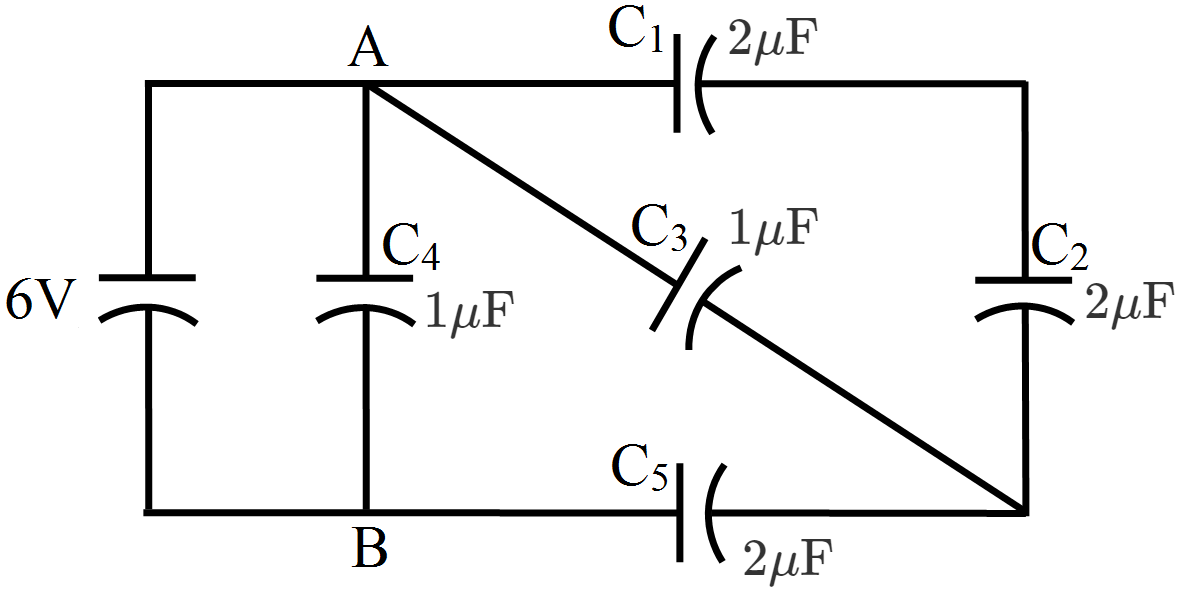
Find the total energy stored in the capacitors in the given network.
Answer

The equivalent capacitance of C1 and C2 in series,

$\text{C}'=\frac{\text{C}_1\text{C}_2}{\text{C}_2+\text{C}_2}=\frac{2\times2}{2+2}=1\mu\text{F}$

C′ is in parallel with C3, so equivalent capacitance of C1, C2 and C3 is:

$\text{C}''=1+1=2\mu\text{F}$

C′′ is in series with C4; their equivalent capacitance,

$\text{C}'''=\frac{\text{C}_4\text{C}}{\text{C}_4+\text{C}''}=\frac{2\times2}{2+2}=1\mu\text{F}$

This is in parallel with C5; So equivalent capacitance across AB is $\text{C}_{\text{AB}}=1+1=2\mu\text{F},$

Energy stored $\text{V}'=\frac{1}{2}\text{C}_{\text{AB}}\text{V}^2=\frac{1}{2}\times2\times10^{-6}\times(6)^2=36\times10^{-6}\text{J}$

Need a full question paper?

Generate a complete, print-ready paper with questions like this in minutes — across 16+ boards, with answer keys.
Start Generating Free

Similar questions

A hot gas emits radiation of wavelengths 46.0nm, 82.8nm and 103.5nm only. Assume that the atoms have only two excited states and the difference between consecutive energy levels decreases as energy is increased. Taking the energy of the highest energy state to be zero, find the energies of the ground state and the first excited state.
The intensity of sound from a point source is 1.0 × 10-6W/m2 at a distance of 5.0m from the source. What will be the intensity at a distance of 25m from the source?
A long charged cylinder of linear charge density $+\lambda_1$ is surrounded by a hollow coaxial conducting cylinder of linear charge density $-\lambda_2$. Use Gauss’s law to obtain expressions for the electric field at a point (i) in the space between the cylinders, and (ii) outside the larger cylinder.
Obtain the equation of equivalent power for combination of thin lenses placed in contact.
Is there any meaning of "Weight of the earth"?
What is the de Broglie wavelength of:
  1. A bullet of mass 0.040 kg travelling at the speed of 1.0 km/s,
  2. A ball of mass 0.060 kg moving at a speed of 1.0 m/s, and
  3. A dust particle of mass 1.0 × 10–9 kg drifting with a speed of 2.2 m/s?
Consider the situation of the previous problem. A particle having charge q and mass m is projected from the point Q in a direction going into the plane of the diagram. It is found to describe a circle of radius r between the two plates. Find the speed of the charged particle.
Two concentric circular coils X and Y of radii 16 cm and 10 cm, respectively, lie in the same vertical plane containing the north to south direction. Coil X has 20 turns and carries a current of 16 A; coil Y has 25 turns and carries a current of 18 A. The sense of the current in X is anticlockwise, and clockwise in Y, for an observer looking at the coils facing west. Give the magnitude and direction of the net magnetic field due to the coils at their centre.
How does the resolving power of a compound microscope get affected on:
  1. Decreasing the diameter of its objective?
  2. Increasing the focal length of its objective?
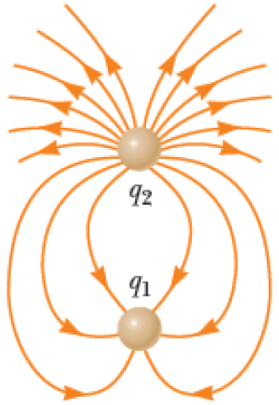
Consider the situation shown in figure. What are the signs of q1 and q2? If the lines are drawn in proportion to the charge, what is the ratio $\frac{\text{q}_1}{\text{q}_2}?$