MCQ
Find the true statement.
  • A
    Most of the substances show ferromagnetism.
  • B
    The magnetic susceptibility of diamagnetic substances are temperature independent.
  • C
    Water is paramagnetic in nature.
  • D
    Typical domain size of a ferromagnetic material is 1nm.
Answer

  1. The magnetic susceptibility of diamagnetic substances are temperature independent.

Explanation:

The magnetic susceptibility of diamagnetic materials doesn’t depend upon temperature. This is often because there’s an outsized barrier between the bottom state and therefore the excited states of diamagnetic substances. Hence, it remains constant during the change of temperature. All the other statements are false.

Need a full question paper?

Generate a complete, print-ready paper with questions like this in minutes — across 16+ boards, with answer keys.

Start Generating Free

Similar questions

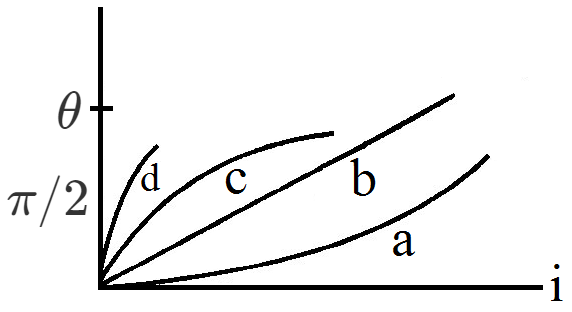
Which of the following four graphs may best represent the current-deflection relation in a tangent galvanometer?

Radioactivity was discovered by

(a) Becquerel

(b) Pierre Curie

(c) Roentgen

(d) Rutherford

In a lossless transformer an alternating current of  2 amp is flowing in the primary coil. The number of turns in the primary and secondary coils are 100 and 20 respectively. The value of the current in the secondary coil is

(a) 0.08 A

(b) 0.4 A

(c) 5 A

(d) 10 A

The brightness of a bulb will be reduced, if a resistance is connected in

(a) Series with it

(b) Parallel with it

(c) Series or parallel with it

(d) Brightness of the bulb cannot be reduced

If the ionisation potential of helium atom is 24.6 volt, the energy required to ionise it will be

(a) 24.6 eV

(b) 24.6 V

(c) 13.6 V                                           

(d) 13.6 eV

When a light wave goes from air into water,  the quality that remains unchanged is its

(a) Speed                                          

(b) Amplitude

(c) Frequency

(d) Wavelength

An electron moving towards the east enters a magnetic field directed towards the north. The force on the electron will be directed

(a) Vertically upward

(b) Vertically downward

(c) Towards the west

(d) Towards the south

Ultraviolet radiations of 6.2eV  falls on an aluminium surface (work function 4.2 eV). The kinetic energy in joules of the fastest electron emitted is approximately

(a) 3.2  

(b) 3.2  

(c) 3.2  

(d) 3.2  

When a photon stimulates the emission of another photon, the two photons have:
Similarities of Biot–Savart’s law and Coulomb’s law for the electrostatics are:
  1. Both are long range and inversely proportional to the square of distance from the source to the point of interest.
  2. Both are linear in source.
  3. Both are produced by scalar sources.
  4. Both follow principle of superposition.