Five identical cells each of internal resistance $1\, \Omega$ and $emf \;5\, {V}$ are connected in series and in parallel with an external resistance $'R'.$ For what value of $'R',$ current in series and parallel combination will remain the same ? (in $\Omega$)
JEE MAIN 2021, Diffcult


Download our appand get started for free
Experience the future of education. Simply download our apps or reach out to us for more information. Let's shape the future of learning together!No signup needed.*
Similar Questions
- 1If the resistance of a conductor is $5\,\Omega\,\,$ at $\,50\,^oC$ and $7\, \Omega\,$ at $\,100\,^oC$ then the mean temperature coefficient of resistance of the material is ............... $^oC$View Solution
- 2In a building there are $15$ bulbs of $45\; \mathrm{W}, 15$ bulbs of $100\; \mathrm{W}, 15$ small fans of $10 \;\mathrm{W}$ and $2$ heaters of $1 \;\mathrm{kW}$. The voltage of electric main is $220\; \mathrm{V}$. The minimum fuse capacity (rated value) of the building will be: .......... $A$View Solution
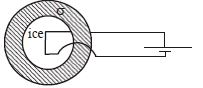
- 3Figure shows a thick shell made of electrical conductivity $\sigma$ and has inner & outer radii of $10\ cm$ & $20\ cm$ respectively and is filled with ice inside it. Its inside and outside surface are kept at different potentials by a battery of internal resistance $\frac{2}{\pi} \Omega \ \&\ \in = 5V$. Find value of $\sigma$ for which ice melts at maximum possible rate if $25\%$ of heat generated by shell due to joule heating is used to melt ice.View Solution
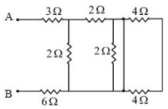
- 4In the given circuit, the equivalent resistance between the terminal $A$ and $B$ is $........\Omega$.View Solution
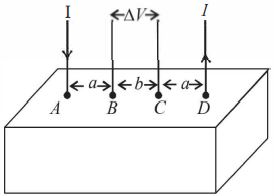
- 5Consider a block of conducting material ofresistivity '$\rho$' shown in the figure. Current '$I$' enters at '$A$' and leaves from '$D$'. We apply superp osition principle to find voltage '$\Delta V$ ' developed between '$B$' and '$C$'. The calculation is done in the following steps:View Solution
$(i)$ Take current '$I$' entering from '$A$' and assume it to spread over a hemispherical surface in the block.
$(ii)$ Calculatefield $E(r)$ at distance '$r$' from $A$ by using Ohm's law $E = \rho j$, where j is the current per unit area at '$r$'.
(iii) From the '$r$' dependence of $E(r)$, obtain the potential $V(r)$ at $r$.
(iv) Repeat $(i), (ii)$ and $(iii)$ for current '$I$' leaving '$D$' and superpose results for '$A$' and '$D$'.$\Delta V$ measured between $B$ and $C$ is
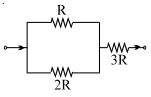
- 6The ratio of powers dissipatted respectively in $R$ and $3R$, as shown is:View Solution
- 7Find out equivalent resistance between $A$ and $B$View Solution
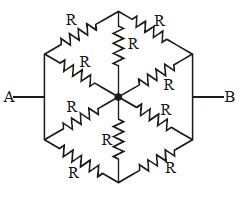
- 8Two electric bulbs whose resistances are in the ratio of $1 : 2$ are connected in series. The powers dissipated in them have the ratioView Solution
- 9$A$ wire of cross-section area $A$, length $L_1$, resistivity $\rho_1$ and temperature coefficient of resistivity $\alpha_1$ is connected to a second wire of length $L_2$, resistivity $\rho_2$ , temperature coefficient of resistivity $\alpha_1$ and the same area $A$, so that wire carries same current. Total resistance $R$ is independent of temperature for small temperature change if (Thermal expansion effect is negligible)View Solution
- 10A uniform metallic wire has a resistance of $18\,\Omega $ and is bent into an equilateral triangle. Then, the resistance between any two vertices of the triangle is .................. $\Omega$View Solution