Question
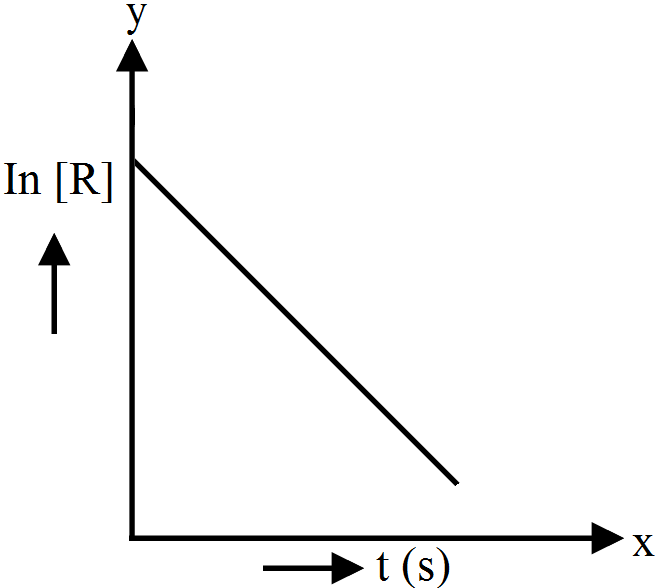
For a certain chemical reaction variation in the concentration ln [R] vs. time plot is given alongside.

For this reaction:

  1. What is the order of the reaction?
  2. What are the units of rate constant k?
  3. Give the relationship between k and t1/2 (half-life period).
  4. What is the slope of the curve?
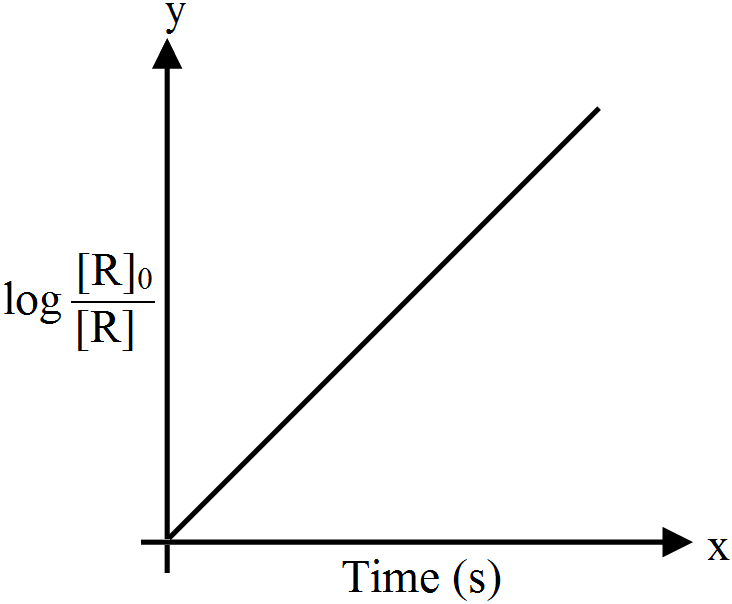
  5. Draw the plot log [R]0 /[R] vs time t(s).
Answer

  1. First order.
  2. Time-1 (s-1)
  3. $\text{k}=\frac{0.693}{\text{t}_{1/2}}$
  4. Slope = - k (rate constant).
  5.  

Need a full question paper?

Generate a complete, print-ready paper with questions like this in minutes — across 16+ boards, with answer keys.

Start Generating Free

Similar questions

Match the terms given in Column I with the units given in Column II.

 
Column I


Column II

i.

$\wedge_{\text{m}}$

a.

Intensive property.

ii.

$\text{E}^{\ominus}_{\text{Cell}}$

b.

Depends on number of ions/volume.

iii.

$\text{K}$

c.

Extensive property.

iv.

$\Delta_{\text{r}}\text{G}_{\text{Cell}}$

d.

Increases with dilution.

The rate constant for the decomposition of N2O5 at various temperatures is given below:
T/°C 0 20 40 60 80
105 × k/s-1 0.0787 1.70 25.7 178 2140
Draw a graph between ln k and 1/T and calculate the values of A and Ea. Predict the rate constant at 30° and 50°C.
  1. What type of deviation is shown by a mixture of ethanol and acetone? Give reason.
  2. A solution of glucose (molar mass = 180 g mol–1) in water is labelled as 10% (by mass). What would be the molality and molarity of the solution?

(Density of solution = 1.2 g mL–1).

Give reasons for the following:
On electrolysis in acidic solution amino acids migrate towards cathode, while in alkaline solution these migrate towards anode.
How are different aromatic compounds synthesized by benzene diazonium chloride? Explain with examples.
Describe the methods of studying various first order reactions with examples.
Discus in detail the following $C - H$ bond cleavage reactions of ether :
(i) Peroxide formation
(ii) Halogenation
All energetically effective collisions do not result in a chemical change. Explain with the help of an example.
Explain the structure of fructose.
Explain the oxidation of primary, secondary and tertiary alcohols.