Question
For a photosensitive surface, threshold wavelength is $\lambda_0.$ Does photoemission occur if the wavelength of radiation is (i) more than $\lambda_0$ and (ii) less than $\lambda_0?$ Justify your answer.

Answer

Energy of a photon $\text{E}=\frac{\text{hc}}{\lambda}$ For emission of photoelectrons energy of a photon $\geq$ work function or wavelength of incident photon $\lambda$ should be less than threshold wavelength $\lambda_0(\text{i.e., }\lambda<\lambda_0).$

Need a full question paper?

Generate a complete, print-ready paper with questions like this in minutes — across 16+ boards, with answer keys.

Start Generating Free

Similar questions

Which currents are produced when an external electric field is applied on a semi-conductor?
Using Bohr’s atomic model, derive the expression for the radius of $n^{th}$ orbit of the revolving electron in a hydrogen atom.
Why is exposure to X-rays injurious to health but not exposure to visible light, when both are electromagnetic waves?
Explain the difference between behaviour of a conductor and a dielectric inside external electric field.
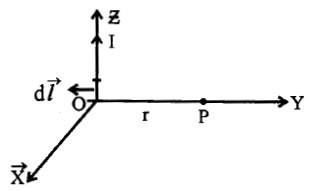
State Biot-Savart law.A current I flows in a conductor placed perpendicular to the plane of the paper.Indicate the direction of the magnetic field due to a small element d $\overrightarrow{l}$at point P situated at a  distance $ \overrightarrow{r}$ from the element as shown in the figure.
Find the dimensions of:
  1. Angular speed $\omega.$
  2. Angular acceleration $\alpha.$
  3. Torque $\tau$ and
  4. Moment of interia I.
Some of the equations involving these quantities are$\omega=\frac{\theta_2-\theta_1}{\text{t}_2-\text{t}_1},\alpha=\frac{\omega_2-\omega_1}{\text{t}_2-\text{t}_1},\tau=\text{F.r}$ and $\text{I = mr}^2.$
The symbols have standard meanings.
A neutron having kinetic energy 12.5eV collides with a hydrogen atom at rest. Nelgect the difference in mass between the neutron and the hydrogen atom and assume that the neutron does not leave its line of motion. Find the possible kinetic energies of the neutron after the event.
A glass contains some water at room temperature 20°C. Refrigerated water is added to it slowly. When the temperature of the glass reaches 10°C, small droplets condense on the outer surface. Calculate the relative humidity in the room. The boiling point of water at a pressure of 17.5mm of mercury is 20°C and at 8.9mm of mercury it is 10°c.
If $\overrightarrow{\text{A}}\times\overrightarrow{\text{B}}=0,$ can you say that:
  1. $\overrightarrow{\text{A}}=\overrightarrow{\text{B}}$
  2. $\overrightarrow{\text{A}}\neq\overrightarrow{\text{B}}$
A potential difference $V$ is applied across the ends of a conductor of length $L$ and diameter $D$. What will be the effect on drift velocity of charge carriers in the conductor when (i) V is made half (ii) L is doubled and (iii) D is made half?