Question
Explain the difference between behaviour of a conductor and a dielectric inside external electric field.

Answer

Image

Image
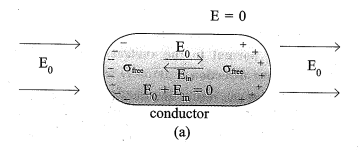
Conductor in external electric field :
As shown in figure (a) when a conductor is placed in external electric field, static electric charge is induced on its surface. Electric field is created inside the conductor due to this electric charge.
The electric field generated due to induced charges, opposes the external electric field in the region inside the conductor.
In stable situation, both these electric fields cancel out their mutual effect. When both these electric fields are of equal magnitude the net electric field inside conductor vanishes to zero.
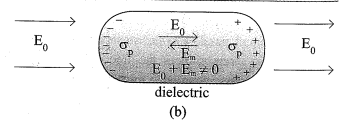
Dielectric in the external electric field :
Non-conducting material is called dielectric. Free motion of electric charges is not possible in dielectric.
The external electric field induces dipole moment either by pulling the molecules of dielectric or by their re-arrangement. Due to which some net charge is induced on the surface of the dielectric.
The electric field produced by this electric charge opposes the external electric field.
Due to which electric field inside the dielectric decreases.
In non-conducting materials, magnitudes of both these electric fields cannot be equal and hence net electric field inside die-electric is not zero.
Need a full question paper?

Generate a complete, print-ready paper with questions like this in minutes — across 16+ boards, with answer keys.

Start Generating Free

Similar questions

Write Snell's law and derive its general equation.
A long narrow horizontal slit is placed $1\ mm$ above a horizontal plane mirror. The interference between the light coming directly from the slit and that after reflection is seen on a screen $1.0m$ away from the slit. Find the fringe$-$width if the light used has a wavelength of $700\ nm$.
Can a gravitational field be added vectorially to an electric field to get a total field?
A cylindrical capacitor is constructed using two coaxial cylinders of the same length 10cm and of radii 2mm and 4mm:
  1. Calculate the capacitance.
  2. Another capacitor of the same length is constructed with cylinders of radii 4mm and 8mm. Calculate the capacitance.
A photographic film is coated with a silver bromide layer. When light fells on this film, silver bromide molecules dissociate end the film records the light there. A minimum of $0.6\ eV$ is needed to dissociate a silver bromide molecule. Find the maximum wavelength of light that can be recorded by the film.
Two metallic wires A and B made from same substance have equal lengths and their cross-sections are in the ratio $1: 2$. They are joined in (i) series (ii) parallel. In both the above combinations, compare the drift velocities of electrons in the two wires.
A metal piece of mass $160g$ lies in equilibrium inside a glass of water The piece touches the bottom of the glass at a small number of points. If the density of the metal is $8000\ kg/m^3,$ find the normal force exerted by the bottom of the glass on the metal piece.
What is meant by radioactive equilibrium?
  1. Find the first excitation potential of $He^+ \text{ion}.$
  2. Find the ionization potential of $Li^{++ } \text{ion}.$
Two identical metal spheres of exactly equal mass have been taken. One is charged with negative charge say q and the other with the same amount of positive charge. Will there be any difference in the mass of the two spheres? If yes then why?