MCQ
For a transistor, in a common emitter arrangement, the alternating current gain $b$ is given by
  • $\beta=\left(\frac{\Delta \mathrm{I}_{\mathrm{C}}}{\Delta \mathrm{I}_{\mathrm{B}}}\right)_{\mathrm{VC}}$
  • B
    $\beta=\left(\frac{\Delta \mathrm{I}_{\mathrm{B}}}{\Delta \mathrm{I}_{\mathrm{C}}}\right)_{\mathrm{VC}}$
  • C
    $\beta=\left(\frac{\Delta \mathrm{I}_{\mathrm{C}}}{\Delta \mathrm{I}_{\mathrm{E}}}\right)_{\mathrm{VC}}$
  • D
    $\beta=\left(\frac{\Delta \mathrm{I}_{\mathrm{E}}}{\Delta \mathrm{I}_{\mathrm{C}}}\right)_{\mathrm{VC}}$
Answer

Correct option: A.
$\beta=\left(\frac{\Delta \mathrm{I}_{\mathrm{C}}}{\Delta \mathrm{I}_{\mathrm{B}}}\right)_{\mathrm{VC}}$

Need a full question paper?

Generate a complete, print-ready paper with questions like this in minutes — across 16+ boards, with answer keys.

Start Generating Free

Similar questions

Three point charges are placed at the corners of an equilateral triangle. Assuming only electrostatic forces are acting(a) The system can never be in equilibrium(b) The system will be in equilibrium if the charges rotate about the centre of the triangle(c) The system will be in equilibrium if the charges have different magnitudes and different signs(d) The system will be in equilibrium if the charges have the same magnitudes but different signs


Two positive charges of 20 coulomb  and Q coulomb are situated at a distance of 60 cm. The neutral point between them is at a distance of 20 cm from the 20 coulomb charge. Charge Q is(a) 30 C (b) 40 C (c) 60 C   (d) 80 C
       
 A man is looking at a small object placed at his near point. Without altering the position of his eye or the object, he puts a simple microscope of magnifying power 5X before his eyes. The angular magnification achieved is:
100 mA current gives a full scale deflection in a galvanometer of 2Ω  resistance. The resistance connected with the galvanometer to convert it into a voltmeter to measure 5V is(a) 98 Ω  (b) 52 Ω(c) 50 Ω   (d) 48 Ω
       
When a wire of uniform cross$-$section a, length $I$ and resistance $R$ is bent into a complete circle, resistance between any two of diametrically opposite points will be
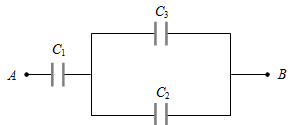
The combination of capacitors with $C_1=3 \mu F, C_2=4 \mu F$ and $C_3=2 \mu F$ is charged by connecting $AB$ to a battery. Consider the following statements
$I.$ Energy stored in $C_1$ = Energy stored in $C_2\ +$ Energy stored in $C_3$
$II.$ Charge on $C_1 =$ Charge on $C_2\ +$ Charge on $C_3$
$III.$ Potential drop across $C_1 =$ Potential drop across $C_2 =$ Potential drop across $C_3$
Which of these is/are correct
If ${ }_f R_p=7 \mathrm{~K} \Omega, g m=2.5$ millimho, then on increasing plate voltage by  $50 V,$ how much the grid voltage is changed so that plate current remains the same
The primary winding of a transformer has 100 turns and its secondary winding has 200 turns. The primary is connected to an ac supply of 120 V and the current flowing in it is 10 A. The voltage and the current in the secondary are(a) 240 V, 5 A(b) 240 V, 10 A(c) 60 V, 20 A(d) 120 V, 20 A
       
Which of the following formula is correct for a spherical lens?
If the field lines in a magnetic field are parallel and equidistant, the magnetic field is __________ .