MCQ
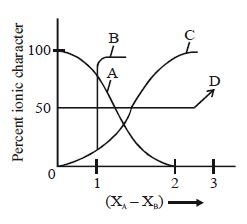
For $AB$ bond if percent ionic character is plotted against electronegativity difference $(X_A -X_B),$ the shape of the curve would look like The correct curve is 
  • A
    $(A)$
  • B
    $(B)$
  • $(C)$
  • D
    $(D)$

Answer

Correct option: C.
$(C)$
c
$50 \,\%$ ionic character occurs when the electronegativity difference between the atoms is equal to $1.7$. This is evident from curve $C$ and hence is the most appropriate.

$\Delta E . N .=1.7 \Rightarrow 50\,\%$ ionic and $50 \,\%$ covalent

$\Delta E . N .\,>\,1.7 \Rightarrow$ more than $50\, \%$ ionic and less than $50 \,\%$ covalent

$\Delta E . N .\,<\,1.7 \Rightarrow$ less than $50\, \%$ ionic and more than $50\, \%$ covalent

Need a full question paper?

Generate a complete, print-ready paper with questions like this in minutes — across 16+ boards, with answer keys.

Start Generating Free

Similar questions

Which of the following relation is correct with respect to first $(I)$ and second $(II)$ ionization potentials of sodium and magnesium
Cortisone is a molecular substance containing 21 atoms of carbon per molecule. The mass percentage of carbon in cortisone is 69.98%. It's molar mass is:
The absorption of hydrogen by platinum is known as:
Which one of the following informations can be obtained on the basis of Le-Chatelier principle?
Product $(A)$ is
The maximum number of electrons that can have principal quantum number, $n=3$, and spin quantum number, $m_{ s }=-1 / 2$, is
Give the number of electrons in the species, $O _2$ and $O _2{ }^{+}$.
On addition of an inert gas at constant volume to the reaction ${N_2} + 3{H_2}$ $\rightleftharpoons$ $2N{H_3}$ at equilibrium
The hydrogen-like species $\mathrm{Li}^{2+}$ is in a spherically symmetric state $\mathrm{S}_1$ with one radial node. Upon absorbing light the ion undergoes transition to a state $\mathrm{S}_2$. The state $\mathrm{S}_2$ has one radial node and its energy is equal to the ground state energy of the hydrogen atom.

$1.$ The state $S_1$ is

$(A)$ $1 \mathrm{~s}$ $(B)$ $2 \mathrm{~s}$ $(C)$ $2 \mathrm{p}$ $(D)$ $3 \mathrm{~s}$

$2.$ Energy of the state $S_1$ in units of the hydrogen atom ground state energy is

$(A)$ $0.75$ $(B)$ $1.50$ $(C)$ $2.25$ $(D)$ $4.50$

$3.$ The orbital angular momentum quantum number of the state $S_2$ is

$(A)$ $0$ $(B)$ $1$ $(C)$ $2$ $(D)$ $3$

Give the answer question $1,2$ and $3.$

Given, $pH$ of a solution $A$ is $3$ and it is mixed with another solution $B$ having $pH\,2$. If both are mixed in equal volume, then the resultant $pH$ of the solution will be