MCQ
For an ideal liquid
  • A
    The bulk modulus is infinite.
  • B
    The bulk modulus is zero.
  • C
    The shear modulus is infinite.
  • D
    The shear modulus is zero.

Answer

  1. The bulk modulus is infinite.
  1. The shear modulus is zero.

Explanation:

An ideal liquid is not compressible.

Bulk modulus $(\text{K})=\frac{-\text{p(V)}}{\Delta\text{V}} (\because\Delta\text{V=0})$

$\because\Delta\text{V=0}$ for ideal liquid.

$\therefore\text{K=}\infty$ for ideal liquid.

As there is no net tangential force on liquid (S.T. is all around on a particle) so shearing strain $\Delta\theta=0\text{ and F=0.}$

$\eta=\frac{\text{F/A}}{\Delta\theta}=\frac{0}{0}$ indeterminant value.

Hence, verifies option (a) and (d) and rejects option (b, c).

Need a full question paper?

Generate a complete, print-ready paper with questions like this in minutes — across 16+ boards, with answer keys.

Start Generating Free

Similar questions

Pressure applied to an enclosed fluid is transmitted undiminished to every portion of the fluid and the walls of the containing vessel. This law was first formulated by
An object is moving through the liquid. The viscous damping force acting on it is proportional to the velocity. Then dimension of constant of proportionality is
If T is the total time of flight, $h$ is the maximum height $ \& R$ is the range for horizontal motion, the $x$ and $y$ co-ordinates of projectile motion and time $t$ are related as
A sound source is moving towards a stationary observer with $(1/10)$ of the speed of sound. The ratio of apparent to real frequency is .........
A particle is tied to $20\, cm$ long string. It performs circular motion in vertical plane. What is the angular velocity of string when the tension in the string at the top is zero  ........ $rad/sec$
A body of mass $M$ at rest explodes into three pieces, in the ratio of masses $1: 1: 2$. Two smaller pieces fly off perpendicular to each other with velocities of $30 \,ms ^{-1}$ and $40 \,ms ^{-1}$ respectively. The velocity of the third piece will be ............... $\,ms ^{-1}$
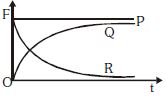
A heavy spherical ball is dropped near surface in a long column of viscous liquid. Which of the following graphs represent the variation of

$(i)$ Gravitational force with time

$(ii)$ Viscous force with time

$(iii)$ Net force acting on the ball with time
The radii of two planets $A$ and $B$ are $R$ and $4 R$ and their densities are $\rho$ and $\rho / 3$ respectively. The ratio of acceleration due to gravity at their surfaces $\left(g_A: g_B\right)$ will be
In Guericke's experiment to show the effect of atmospheric pressure, two copper hemispheres were tightly fitted to each other to form a hollow sphere and the air from the sphere was pumped out to create vacuum inside. If the radius of each hemisphere is $R$ and the atmospheric pressure is $p$, then the minimum force required (when the two hemispheres are pulled apart by the same force) to separate the hemispheres is
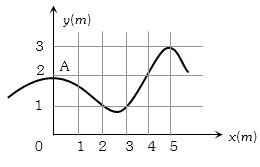
The trajectory of a particle moving in vast maidan is as shown in the figure. The coordinates of a position A are $(0,2)$. The coordinates of another point at which the instantaneous velocity is same as the average velocity between the points are