MCQ
For Carnot engine, which process should be chosen to take the working substance from T1 to T2 or vice-versa?
  • A
    Isochoric.
  • B
    Isothermal.
  • C
    Adiabatic.
  • D
    Isobaric.

Answer

  1. Adiabatic.

Need a full question paper?

Generate a complete, print-ready paper with questions like this in minutes — across 16+ boards, with answer keys.

Start Generating Free

Similar questions

The displacement of a damped harmonic oscillator is given by $x\left( t \right) = {e^{ - 0.1\,t}}\,\cos \left( {10\pi t + \varphi } \right)$  The time taken for its amplitude of vibration to drop to half of its initial value is close to .... $s$
A particle is dropped from rest and another particle is thrown downward simultaneously with initial speed $u$, then
A uniform metal rod is used as a bar pendulum. If the room temperature rises by $10°C$, and the coefficient of linear expansion of the metal of the rod is $2 \times 10^{-6}$ per $°C,$ the period of the pendulum will have percentage increase of
Which of the following doesn't represent rotatory motion?
In a head-on elastic collision of two bodies of equal masses:
  1. The velocities are interchanged.
  2. The speeds are interchanged.
  3. The momenta are interchanged.
  4. The faster body slows down and the slower body speeds up.
  5. All of the above.
A particle of mass $'{m}'$ is moving in time $'t'$ on a trajectory given by

$\overrightarrow{{r}}=10 \alpha {t}^{2}\, \hat{{i}}+5 \beta({t}-5)\, \hat{{j}}$

Where $\alpha$ and $\beta$ are dimensional constants. The angular momentum of the particle becomes the same as it was for ${t}=0$ at time ${t}=$ .....$seconds.$
A set of $n$  identical cubical blocks lies at rest parallel to each other along a line on a smooth horizontal surface. The separation between the near surfaces of any two adjacent blocks is $L$. The block at one end is given a speed $v$ towards the next one at time $t = 0$. All collisions are completely inelastic, then
Some liquid is filled in a cylindrical vessel of radius $R$. Let $ F_1 $ be the force applied by the liquid on the bottom of the cylinder. Now the same liquid is poured into a vessel of uniform square crss-section of side $R$. Let $F_2$ be the force applied by the liquid on the bottom of this new vessel. Then:
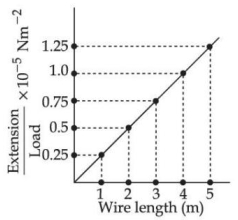
In an experiment to determine the Young's modulus, steel wires of five different lengths $(1,2,3,4$ and $5\,m )$ but of same cross section $\left(2\,mm ^{2}\right)$ were taken and curves between extension and load were obtained. The slope (extension/load) of the curves were plotted with the wire length and the following graph is obtained. If the Young's modulus of given steel wires is $x \times 10^{11}\,Nm ^{-2}$, then the value of $x$ is
A body is thrown vertically upwards. Which one of the following graphs correctly represent the velocity vs time?