MCQ
For light diverging from a point source:
- AThe wavefront is spherical.
- BThe intensity decreases in proportion to the distance squared.
- CThe wavefront is parabolic.
- DThe intensity at the wavefront does not depend on the distance.
Solution:
| Type of wavefront | Intensity | Amplitude |
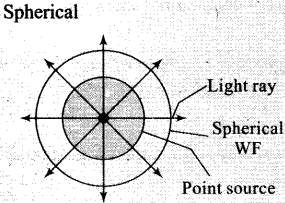 | $\text{I}\propto\frac{1}{\text{r}^2}$ | $\text{A}\propto\frac{1}{\text{r}}$ |
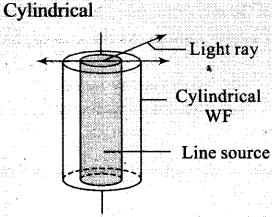 | $\text{I}\propto\frac{1}{\text{r}}$ | $\text{A}\propto\frac{1}{\sqrt{\text{r}}}$ |
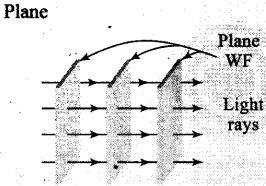 | $\text{I}\propto\text{r}^0$ | $\text{A}\propto\text{r}^0$ |
Due to the point source light propagates in all directions symmetrically and hence, wevefront will be spherical as shown in the diagram.
As intensity of the source will be,
$\text{I}\propto\frac{1}{\text{r}^2}$
where, r is radius of the wavefront at any time
Hence the intensity decreases in proportion to the distance squared.
Generate a complete, print-ready paper with questions like this in minutes — across 16+ boards, with answer keys.
A copper disc of radius 0.1 m is rotated about its centre with 10 revolutions per second in a uniform magnetic field of 0.1 Tesla with its plane perpendicular to the field. The e.m.f. induced across the radius of disc is
|
(a) |
(b) |
(c) π |
(d) 2π |
In an RC circuit while charging, the graph of in i versus time is as shown by the dotted line in the diagram figure, where i is the current. When the value of the resistance is doubled, which of the solid curve best represents the variation of in i versus time

|
(a) P |
(b) Q |
(c) R |
(d) S |
During a negative beta decay
|
(a) An atomic electron is ejected |
|
(b) An electron which is already present within the nucleus is ejected |
|
(c) A neutron in the nucleus decays emitting an electron |
|
(d) A part of the binding energy is converted into electron |
The resistance of a 5 cm long wire is 10 W. It is uniformly stretched so that its length becomes 20 cm. The resistance of the wire is
|
(a) 160 W |
(b) 80 W |
(c) 40 W |
(d) 20 W |
Two metal spheres of radii  and
and  are charged to the same potential. The ratio of charges on the spheres is
|
(a) |
(b) |
(c) |
(d) |
If a magnet is hanged with its magnetic axis then it stops in
|
(a) Magnetic meridian |
(b) Geometric meridian |
|
(c) Angle of dip |
(d) None of these |