MCQ
For question, two statements are given$-$one labelled Assertion and the other labelled Reason. Select the correct answer to these questions from the codes $(a), (b), (c)$ and $(d)$ as given below.
Assertion: Regulator and operator genes are not associated with constitutive genes
Reason: Constitutive genes need not be repressed.
  • Both assertion and reason are true, and reason is the correct explanation of assertion.
  • B
    Both assertion and reason are true, but reason is not the correct explanation of assertion.
  • C
    Assertion is true, but reason is false.
  • D
    Both assertion and reason are false

Answer

Correct option: A.
Both assertion and reason are true, and reason is the correct explanation of assertion.
Regulator gene controls the operator gene in cooperation with a chemical compound called inducer present in the cytoplasm. The regulation gene codes for and produce a protein substance called repressor. The repressor substance combines with the operator gene to repress its function. Therefore it is called regulator gene. The constitutive genes keep on functioning all the time. They need not be repressed. Therefore, the regulator and operator genes are not associated with them.

Need a full question paper?

Generate a complete, print-ready paper with questions like this in minutes — across 16+ boards, with answer keys.

Start Generating Free

Similar questions

GM crops help to reduce the _______ losses.
For two statements are given$-$one labelled Assertion and the other labelled Reason. Select the correct answer to these questions from the codes $(a), (b), (c)$ and $(d)$ as given below.
Assertion: Nucellus functions as a nutritive tissue.
Reason: Nucellus is always exhausted completely during development of embryo sac.
For question two statements are given $-$ one labelled Assertion and the other labelled Reason. Select the correct answer to these questions from the codes $(a), (b), (c)$ and $(d)$ as given below.
Assertion : Phytoplanktons grow in abundance in the profundal zone of lake.
Reason : Profundal zone is illuminated by light which supports growth of phytoplanktons.
The purpose of biopiracy is :
Two statements are given$-$one labelled Assertion and the other labelled Reason. Select the correct answer to these questions from the codes $(a), (b), (c)$ and $(d)$ as given below.
Assertion: Type  restriction endonucleases are not used in recombinant $\text{DNA}$ technology.
Reason: Type  restriction endonucleases recognise specific sites within the $\text{DNA}$ but do not cut these sites.
Two statements are given$-$one labelled Assertion and the other labelled Reason. Select the correct answer to these questions from the codes $(a), (b), (c)$ and $(d)$ as given below.
Assertion: Azolla is used as a biofertiliser in rice fields.
Reason: Azolla shows the presence of $N_2 -$ fixing bacteria in its leaf cavities.
For question two statements are given-one labelled Assertion and the other labelled Reason. Select the correct answer to these questions from the codes $(a), (b), (c)$ and $(d)$ as given below.
Assertion : Haplodiploidy occurs in some insects.
Reason: Male insects develop parthenogenetically, while females grow from fertilised eggs.
Read the following and answer any four questions from $(i)$ to $(v)$ given below:
A typical angiospermic ovule is a small structure attached to the placenta by means of a stalk called funicle. The body of the ovule fuses with funicle in the region called hilum. Each ovule has one or two protective envelopes called integuments. Integuments encircle the nucellus except at the tip where a small opening called the micropyle is formed. Mature ovules are classified on the basis of funiculus. It can be orthotropous, anadromous, hernitropous, campylotropous, etc.
  1. The body of the ovule consists of a mass of parenchymatous cells called:
  1. Integuments.
  2. Nucellus.
  3. Hilum.
  4. Funiculus.
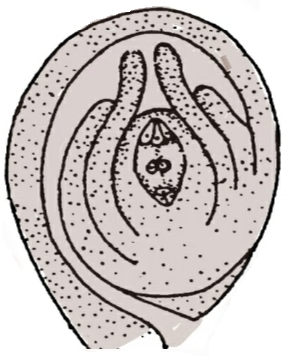
  1. Refer to the given figure and select the correct statement regarding it.
  1. This type of ovule is found in cactus.
  2. The micropyle comes to lie close to the funiculus due to unilateral growth of ovule.
  3. It is most common type of ovule found in the members of Chenopodiaceae.
  4. It is half inverted ovule.
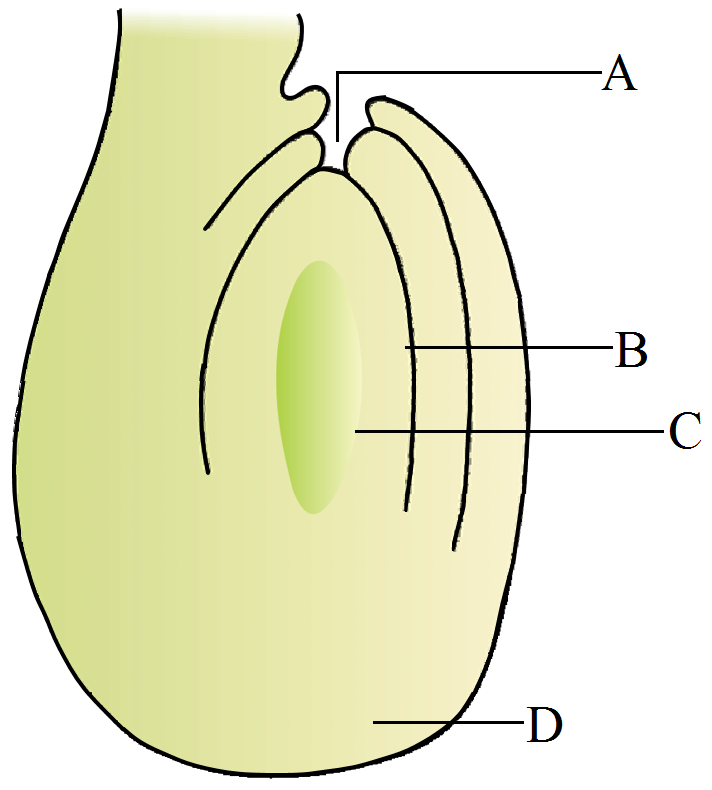
  1. Identify the parts labelled as $A, B, C$ and $D$ in the given figure and select the correct option.
S. No $A$ $B$ $C$ $D$
$(a)$ Chalaza Female gametophyte Embryo sac Micropyle
$(b)$ Chalaza NuceIIus Embryo sac Micropyle
$(c)$ Micropyle Egg Embryo sac Chalaza
$(d)$ Micropyle Nucellus Embryo sac Chalaza
  1. Mature ovules are classified on the basis of funiculus. If micropyle lie close to the funiculus, the ovule is termed as:
  1. Orthotropous.
  2. Anatropous.
  3. Hemitropous.
  4. Campylotropous.
  1. In Asphodel us, ovule is:
  1. Unitegmic.
  2. Tritegmic.
  3. Bitegmic.
  4. Ategmic.
For question two statements are given$-$one labelled Assertion and the other labelled Reason. Select the correct answer to these questions from the codes $(a), (b), (c)$ and $(d)$ as given below.
Assertion: Immunoglobutin functions as antibody.
Reason: Different inununoglobulins molecules have different antigen binding properties.
Two statements are given-one labelled Assertion and the other labelled Reason. Select the correct answer to these questions from the codes $(a), (b), (c)$ and $(d)$ as given below.
Assertion: $\text{YAC}$ vectors have been exploited extensively in the mapping of large genomes.
Reason: $\text{YAC}$ vectors have a composite structure made of bacteriophage and plasmid.