MCQ
For question, two statements are given$-$one labelled Assertion and the other labelled Reason. Select the correct answer to these questions from the codes $(a), (b), (c)$ and $(d)$ as given below.
Assertion : Allergy is an immunity disorder.
Reason: Allergy is confined to a person only.
  • A
    Both assertion and reason are true, and reason is the correct explanation of assertion.
  • Both assertion and reason are true, but reason is not the correct explanation of assertion.
  • C
    Assertion is true, but reason is false.
  • D
    Both assertion and reason are false.

Answer

Correct option: B.
Both assertion and reason are true, but reason is not the correct explanation of assertion.
Allergy is non$-$infectious unusual reaction or hypersensitivity of an individual to a foreign substance or agent that may be harmless to other individuals $($thus it is considered as immunity disorder$)$. It is non$-$communicable as it is confined to a person only and does not spread from one person to another. The foreign substance or allergen on first contact functions as mild antigen. It produces antibodies which remain attached with the mast cell. Lysis of mast$-$cells occur, which releases histamine as allergy mediator.

Need a full question paper?

Generate a complete, print-ready paper with questions like this in minutes — across 16+ boards, with answer keys.

Start Generating Free

Similar questions

Read the following and answer any four questions from $(i)$ to $(v)$ given below:
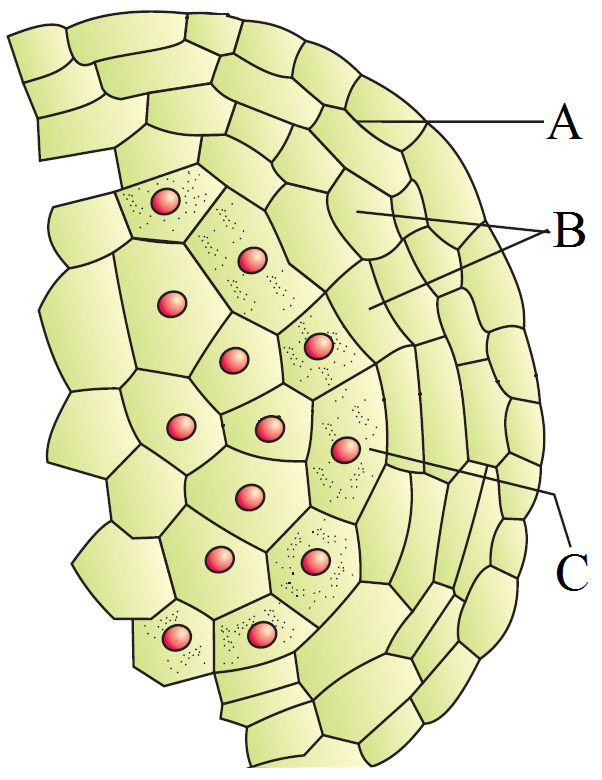
The anther is a four$-$sided structure consisting of four microsporangia located at the corners, two in each lobe. $TI1e$ microsporangia develop further and become pollen sacs. In a transverse section, a typical microsporangium appears near circular in outline. It is generally surrounded by four wall layers$-$the epidermis, endothecium, middle layers and the tapetum.
  1. A dithecous another consists of $(A)$ microsporangia, $(B)$ in each lobe.
Select the option that correctly fills the blanks.
S. No
$A$ $B$
$(a)$
Four
Two
$(b)$
Two
One
$(c)$
Two
Two
$(d)$
Four
One
  1. The given diagram shows microsporangium of a mature anther. Identify $A, B$ and $C.$
$(a)$
$A-$Middle layer
$B-$Endothecium
$C-$Tapetum
$(b)$
$A-$Endothecium
$B-$Tapetum
$C-$ Middle layer
$(c)$
$A-$Endothecium
$B-$Middle layer
$C-$Tapetum
$(d)$
$A-$Tapetum
$B-$Middle layer
$C-$Endothecium
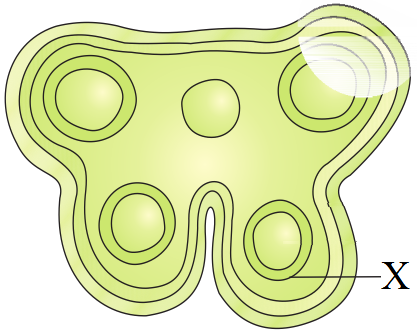
  1. The function of labelled part $X$ is:
  1. Dehiscence.
  2. Mechanical.
  3. Nutrition.
  4. Protection.
  1. Select the incorrect statement.
  1. Microsporangium is generally surrounded by four wall layers$-$epidermis, endothecium, middle layers and tapetum.
  2. Outer three layers perform functions of protection and dehiscence of anthers.
  3. Cells of tapetum possess dense cytoplasm and generally have more than one nucleus.
  4. Cells of tapetum undergo meiosis and produce microspore tetrads.
  1. Which function oftapetum is correct?
  1. Helps in pollen wall formation.
  2. Transportation of nutrients to inner side of another.
  3. Synthesis of callase enzyme for separation of microspore tetrads.
  4. All of these.
Two statements are given $-$ one labelled Assertion and the other labelled Reason. Select the correct answer to these questions from the codes $(a), (b), (c)$ and $(d)$ as given below.
Assertion: The insertion of $\text{DNA}$ fragment into $\text{PBR} \ 322$ plasmid using enzyme Past $I$ or Pvu $I$ make ampicillin resistant gene non functional.
Reason: Bacterial cells containing recombinant $\text{PBR}\ 322$ is unable to grow in the presence of ampicillin.
For two statements are given$-$one labelled Assertion and the other labelled Reason. Select the correct answer to these questions from the codes $(a), (b), (c)$ and $(d)$ as given below.
Assertion: A medical termination of pregnancy is legally allowed upto the $28^{th}$​​​​​​​ week of pregnancy.
Reason: $\text{MTP}$ is done if family physician or gynaecologist consider the need for abortion.
For question, two statements are given$-$one labelled Assertion and the other labelled Reason. Select the correct answer to these questions from the codes $(a), (b), (c)$ and $(d)$ as given below.
Assertion: $R-$type of Pneumococcus is non$-$virulent.
Reason: $R-$type of Pneumococcus can be virulent by having transformation with $S -$type of Pneumococcus.
For two statements are given$-$one labelled Assertion and the other labelled Reason. Select the correct answer to these questions from the codes $(a), (b), (c)$ and $(d)$ as given below.
Assertion: $\text{PCR, ELISA, DNA}$ hybridisation are confirmatory tests for sexually transmitted diseases.
Reason: Incidence of $\text{STDs}$ are very high in persons above the age of $30.$
For two statements are given$-$one labelled Assertion and the other labelled Reason. Select the correct answer to these questions from the codes $(a), (b), (c)$ and $(d)$ as given below.
Assertion: The egg apparatus, consists of two synergids and one egg cell.
Reason: Filiform apparatus play an important role in guiding the pollen tubes into the synergids.
For question, two statements are given$-$one labelled Assertion and the other labelled Reason. Select the correct answer to these questions from the codes $(a), (b), (c)$ and $(d)$ as given below. Assertion: Sequences of bases in one polynucleotide chain of $\text{DNA}$ can determine the sequence of bases in the other chain.
Reason: In a $\text{DNA}$, amount of adenine equals that of thymine and amount of guanine equals that of cytosine, i.e., $A = T$ and $C = G$.
$\text{DNA}$ or $\text{RNA}$ segment tagged with a radioactive molecule is called $...........$
For question, two statements are given$-$one labelled Assertion and the other labelled Reason. Select the correct answer to these questions from the codes $(a), (b), (c)$ and $(d)$ as given below.
Assertion: Regulator and operator genes are not associated with constitutive genes
Reason: Constitutive genes need not be repressed.
For question two statements are given $-$ one labelled Assertion and the other labelled Reason. Select the correct answer to these questions from the codes $(a), (b), (c)$ and $(d)$ as given below.
Assertion : Communities with more species tend to be more stable than those with less species.
Reason : Conununities with more species is not able to resist occasional disturbances.