MCQ
For question two statements are given $-$ one labelled Assertion and the other labelled Reason. Select the correct answer to these questions from the codes $(a), (b), (c)$ and $(d)$ as given below.
Assertion : Kangaroo rat can live without drinking water.
Reason : This is an adaptation to water scarcity in arid conditions.
  • Both assertion and reason are true and reason is the correct explanation of assertion.
  • B
    Both assertion and reason are true but reason is not the correct explanation of assertion.
  • C
    Assertion is true but reason is false.
  • D
    Both assertion and reason are false.

Answer

Correct option: A.
Both assertion and reason are true and reason is the correct explanation of assertion.
Two types of adaptations are prominent in animals living in arid regions,viz. loweringofwaterloss as much as possible and adapting to arid conditions. The kangaroo rat conserves water by excreting solid urine, and can live from birth to death without even drinking water.
The camels show unique adjustments to desert conditions, being very economical in water use, tolerant to wide fluctuations in body temperature and are able to maintain blood stream moisture even during extreme heat stress.

Need a full question paper?

Generate a complete, print-ready paper with questions like this in minutes — across 16+ boards, with answer keys.

Start Generating Free

Similar questions

Two statements are given-one labelled Assertion and the other labelled Reason. Select the correct answer to these questions from the codes $(a), (b), (c)$ and $(d)$ as given below.
Assertion: Azotobacter fixes nitrogen in symbiotic form.
Reason: Azotobacter form root nodules in the roots of leguminous plants.
Human insulin is being commercially produced from transgenic species of $...........$
Read the following and answer any four questions from $(i)$ to $(v)$ given below:
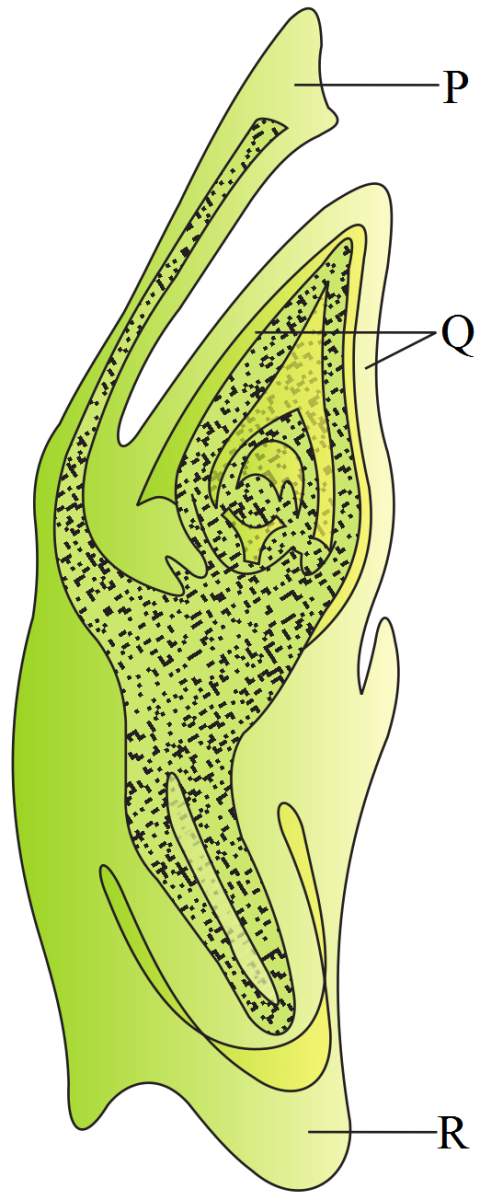
Embryo develops at the micropylar end of the embryo sac, where the zygote is situated. Most zygotes divided only after certain amount of endosperm is formed. The early stages of embryo development are similar in both monocotyledons and dicotyledons. The zygote gives rise to the proembryo and subsequently to the globular heart-shaped and mature embryo. A typical dicotyledonous embryo consists of an embryonal axis and two cotyledons. Embryo of monocotyledons possess only one cotyledon.
  1. True embryo develops as a result of fusion of:
  1. Two polar nuclei of embryo sac.
  2. An egg cell and a male gamete.
  3. Synergid and male gamete.
  4. A male gamete and antipodals.
  1. Refer to the given diagram of the embryo of an angiospermous plant with parts labelled $P, Q$ and $R$. Select the correct statement$(s)$ regarding this.
  1. Part $'P\ '$ supplies nutrition to the developing embryo.
  2. Part $'Q\ '$ is the protective sheath of radicle and root cap.
  3. Part $'R\ '$ is the protective sheath of shoot apex and leaf primordia.
  4. The embryo shown in the diagram is present in members of Family Poaceae.
  1. $(IV)$ only.
  2. $(II)$ and $(III)$ only.
  3. $(I)$ and $(IV)$ only.
  4. $(I), (II), (III)$ and $(IV).$
  1. Which of the given statements are true?
  1. During the development of a dicot embryo, heart$-$shaped embryo is followed by globular embryo.
  2. The part of embryonal axis above the level of cotyledons is epicotyl, while the part below the level of cotyledons is hypocotyl.
  3. Monocot seeds possess a single cotyledon, represented by scutellum.
  1. $(I)$ and $(II).$
  2. $(II)$ and $(III).$
  3. $(I)$ and $(III).$
  4. $(I), (II)$ and $(III).$
  1. Consider the following parts of an embryonal axis of a dicot seed.
  1. Hypocotyl.
  2. Epicotyl.
  3. Radicle.
  4. Plumule.
In which of the following the above parts are correctly arranged from top to base?
  1. $(III) \rightarrow (I) \rightarrow (II) \rightarrow (IV).$
  2. $(II) \rightarrow (I) \rightarrow (III) \rightarrow (IV).$
  3. $(IV) \rightarrow (II) \rightarrow (I) \rightarrow (III).$
  4. $(III) \rightarrow (IV) \rightarrow (II) \rightarrow (I).$
  1. In grass family, the cotyledon, is called:
  1. Epiblast.
  2. Plumule.
  3. Scutellum.
  4. Perisperm.
For two statements are given$-$one labelled Assertion and the other labelled Reason. Select the correct answer to these questions from the codes $(a), (b), (c)$ and $(d)$ as given below.
Assertion: $\text{PCR, ELISA, DNA}$ hybridisation are confirmatory tests for sexually transmitted diseases.
Reason: Incidence of $\text{STDs}$ are very high in persons above the age of $30.$
Directions : In the following questions, the Assertions $(A)$ and Reason $(s) \ (R)$ have been put forward. Read both the statements carefully and choose the correct alternative from the following:
Assertion : $\text{PCR}$ can detect very low amounts of $\text{DNA}$ and is now routinely used to defect $\text{HIV}$ in suspected $\text{AIDS}$ patient.
Reason : $\text{PCR}$ is a powerful technique to identify many other genetic disorders.
For question, two statements are given$-$one labelled Assertion and the other labelled Reason. Select the correct answer to these questions from the codes $(a), (b), (c)$ and $(d)$ as given below. Assertion : The uptake of $\text{DNA}$ during transformation is an active, energy requiring process.
Reason: Transformation occurs in only those bacteria, which possess the enzymatic machinery involved in the active uptake and recombination.
Two statements are given$-$one labelled Assertion and the other labelled Reason. Select the correct answer to these questions from the codes $(a), (b), (c)$ and $(d)$ as given below.
Assertion: The alcoholic content of fortified wines are high.
Reason: The fermentation is stopped before all the sugars are being converted.
Directions: In the following questions, the Assertions $(A)$ and Reason$(s) (R)$ have been put forward. Read both the statements carefully and choose the correct alternative from the following:
Assertion: Phenylketonuria is a recessive hereditary disease caused by body's failure to oxidise an amino acid phenylalanine to tryrosine, because of a defective enzyme.
Reason: It results the presence of phenylalanine acid in urine.
For question two statements are given $-$ one labelled Assertion and the other labelled Reason. Select the correct answer to these questions from the codes $(a), (b), (c)$ and $(d)$ as given below.
Assertion : There are $36$ biodiversity hotspots in the world.
Reason : High level of species richness is a criteria for selection of a biodiversity hotspot.
For question, two statements are given$-$one labelled Assertion and the other labelled Reason. Select the correct answer to these questions from the codes $(a), (b), (c)$ and $(d)$ as given below.
Assertion : It is considered advantageous to give the polio vaccine orally.
Reason: The oral polio vaccine prevents reinfection by causing intestinal immunity.