MCQ
For series $LCR$ circuit, wrong statement is
  • A
    Applied e.m.f. and potential difference across resistance are in same phase
  • B
    Applied $e.m.f$. and potential difference at inductor coil have phase difference of $\pi /2$
  • Potential difference at capacitor and inductor have phase difference of $\pi /2$
  • D
    Potential difference across resistance and capacitor have phase difference of $\pi /2$
Answer

Correct option: C.
Potential difference at capacitor and inductor have phase difference of $\pi /2$
c
For series $LCR$ circuit, potential difference at capacitor and inductor have phase difference of $\pi$.

Need a full question paper?

Generate a complete, print-ready paper with questions like this in minutes — across 16+ boards, with answer keys.

Start Generating Free

Similar questions

A solid reflects incident light and it’s electrical conductivity decreases with temperature. The binding in this solids
An electron and a proton are in a uniform electric field, the ratio of their accelerations will be
Half-life is measured by
According to Planck’s quantum theory any electromagnetic radiation is:
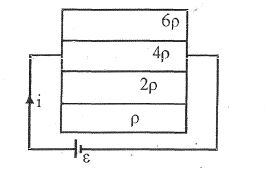
If resistivity of all four wire connected in parallel is different as given in figure and all other dimensions of wire are same then current $i$ is (resistance of wire having resistivity $\rho $ is $R_0$ )
The ratio of kinetic energy to total energy in Bohr's Model of $n$ quantum level of electron in hydrogen atom will be :
Originally the radioactive beta decay was thought as a decay of a nucleus with the emission of electrons only (Case $I$) . However, in addition to the electron, another (nearly) massless and electrically neutral particle is also emitted (Case $II$). Based on the figure below, which of the following is correct?
Two coherent monochromatic light beams of intensities $ I$ and $4I$ are superposed. The maximum and minimum possible intensities in the resulting beam are
A square object of area $100\,sq.\,cm$ is placed perpendicular to the principle axis of a concave mirror. If the lateral magnification of the mirror, for the above object position, is $0.4,$ then the area of the image will be......$\,sq.\,cm$
${ }_{92} U^{235}$ nucleus absorbs a neutron and disintegrates into ${ }_{54} X e^{139} ,{ }_{38} Sr ^{94}$ and $X$. What will be the product $X$ ?