MCQ
For simple harmonic motion of an object of mass $m,$
  • A
    $\text{F}=-\text{m}\omega^2\text{x}$
  • B
    $\text{F}=-\text{m}\omega\text{x}$
  • C
    Force always acts in the opposite direction of displacement
  • Both $(a)$ and $(c)$

Answer

Correct option: D.
Both $(a)$ and $(c)$

Need a full question paper?

Generate a complete, print-ready paper with questions like this in minutes — across 16+ boards, with answer keys.
Start Generating Free

Similar questions

A liquid film is formed in a loop of area $0.05$ $m^2$. Increase in its potential energy will be ($T = 0.2\, N/m$)
To a person, going eastward in a car with a velocity of $25\, km/hr$, a train appears to move towards north with a velocity of $25\sqrt 3 $ $km/hr$. The actual velocity of the train will be..........$km/hr$
An object is moving in a circle of radius $100 \,m$ with a constant speed of $31.4 \,m/s$. What is its average speed for one complete revolution ......... $m/s$
From the top of a tower of height $40\,m$, a ball is projected upwards with a speed of $20\,m / s$ at an angle of elevation of $30^{\circ}$. The ratio of the total time taken by the ball to hit the ground to its time of flight (time taken to come back to the same elevation) is (take $g=10\,m / s ^2$ )
A body of mass $2\,kg$ is initially at rest. It starts moving unidirectionally under the influence of a source of constant power P. Its displacement in $4\,s$ is $\frac{1}{3} \alpha^2 \sqrt{ P } m$. The value of $\alpha$ will be $.............$
A particle moves with constant speed $v$ along a regular hexagon $ABCDEF$ in the same order. Then the magnitude of the average velocity for its motion from $A$ to
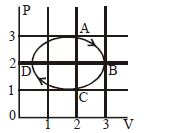
The figure shows the $P-V$ plot of an ideal gas taken through a cycle $ABCDA.$ The part $ABC$ is a semicircle and $CDA$ is half of an ellipse. Then,
A ball is projected horizontally with a speed $v$ from the top of inclined an plane which is  inclined at an angle $45^o$ with the horizontal. How far from the point of projection will  the ball strike the plane ?
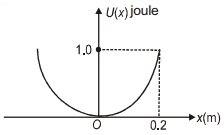
A particle of mass $4 \,kg$ moves simple harmonically such that its $P E(U)$ varies with position $x$, as shown. The period of oscillations is ............
Which of the following statement is true